2.1: Brave Dog Training with Anita Frank
What if, instead of seeing “bad” dogs, we see a plea for help?
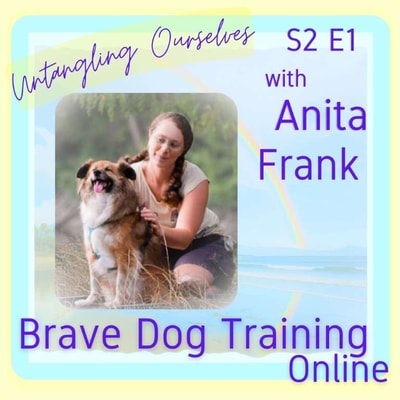
Transcript
This was really hard for me. But, yeah, he was the first person who got me into thinking about relationships from a new perspective. He showed me that relationships can be eye to eye. We can actually respect each other's boundaries. We can respect each other's. No.
KaitlinRight.
AnitaThat was something completely new.
KaitlinYeah.
AnitaBut, yeah, I mean, he was the first one who taught me that no means no, and that's okay.
KaitlinOn today's show, I'm speaking with Anita Frank of Brave Dog Training Online. Anita and I share the journey from childhood trauma to people pleasing to collaborative relationships. For her, Sammy the rescue dog forced her to reach out for help and learn that she had options and could build trust by respecting his no. For me, parenting taught me much of this, but my reactive rescue dog pushed me even further. This is a heartwarming episode about how even though we may all be traumatized, us humans as well as our dogs, recognizing trauma helps us take steps towards healing, trust and connection. Hi, welcome to Untangling Ourselves with Kaitlyn. I am here with Anita Frank. That's right. Right.
AnitaThat's the yes
KaitlinYeah. Okay. I'm here with Anita Frank. She is a certified dog trainer specializing in behavior in Austria. And I'm really excited to talk to you because you've made such a huge difference in my life. We have a rescue dog who is very funny. She's 45 pounds with six inch legs and lots of muscle. She's like eight different breeds. And we fell in love with her when we saw her because she was in the dog shelter and she was all curled up and quiet and I thought, oh, what a sweetheart. And we had to carry her out of the shelter because she was so scared of the other dogs. And I didn't really know enough about dogs to know that that was maybe an issue. But pretty soon after we got her, we realized that she was really reactive to other dogs. If there was a dog two or three, four blocks away, anywhere in sight, she'd lunge and growl and she'd act like she was picking a fight. And even though she's really short, she has a really deep bark, so people would get scared because she's obviously strong, even though she's not a big dog, but she has a big mouth and a big bark, people would get scared. So as I know, Anita shared on a lot of videos that can be a lot emotionally for the humans. So I started looking for help and I was looking at trainers in my area, but I really wanted to find a way to trust somebody. And I think a lot like when I had kids and one of them was diagnosed as autistic. I wanted. I. I knew there was something that I was looking for, which is that perspective from the person who's suffering and causing the, quote, unquote, behavior. And I was just going through YouTube and just people would recommend trainers, and I would look through videos, and then I found Brave Dog Training, which is Anita's channel. And it just resonated so much because from the start, you're talking about what the dog's perspective is on everything that's happening and how to work with that knowledge and understand them. So ever since I basically, I have an alert on your podcast, I jump on it as soon as I hear it. I've had moments with your podcast where I put something into practice, and it was like, game changer. Like, oh, this is what we need to do. So Toast has made a lot of progress. So we've made so much progress. We found friends for her. She's been able to play sometimes, and. Yeah. So I'm really excited to talk to you, Anita. Hi. I guess that was a long intro, but I get excited telling. Telling the story of my dog and our journey.
AnitaI love it. I'm goosebumping and tearing up, and I'm celebrating you so hard right now. So cute. Yeah, but it's. I mean, what you describe is something that happens so often, and it's so challenging for us humans, too, right? We get this adorable little fur baby, and we want to take care of them and love them, and everything's perfect. We just have a new addition to the family, and then we go outside for the first time, and boom, things go south badly. It's just horrible. This little fluffy, friendly, loving thing turns into this horrifying, berserk mode.
KaitlinAnd I never understood why people would have an aggressive dog and say, oh, they're friendly. Okay. I didn't get it until I had my dog and I realized, oh, she's terrifying people. Even though I feel totally safe with her.
AnitaYou know, I totally get it. I get it from the perspective of the mom. I've been the mom. The dog's perspective. I mean, that's pretty easy as an empath, but it's something we humans do, too, if we think about it. But also as innocent bystander. Unless if they have dogs or not. It just. Not everybody knows what it feels like. Right. It's just some people always had easy going. Yeah, happy go, lucky dogs. And they just don't know what a dog could look like who just feels uncomfortable or stressed or big emotions in Some kind of way. Right. So, yeah, this just might look scary.
KaitlinYeah, totally. Yeah. You know, I'm thinking about what we're describing, like these instances where the dog is reactive. And it, like everything in this whole process reminds me so much of my parenting journey. But there's so much pressure, I think, when you have a reactive dog to correct the behavior for the sake of other people. And that doesn't necessarily help the dog learn. I mean, you obviously want to keep other people safe and maybe make them comfortable if you can. But you talk so much about the difference between suppressing a behavior that might explode at you later and really helping the dog feel safe. So some of the principles that I get from learning about your training perspective are that remind me of parenting are all behavior is communication. That dogs are doing their best with what they know and the bodies and minds that they have. That connection is really important. And connection is the most powerful form of therapy. And I've had, you know, parenting coaches and people I work with say that exact same thing, that connection is the most powerful form of therapy. And to look for the stressors behind the behavior. So it's not really about the behavior, it's about what is causing it, where is the stressor. And I love how you talk about stressors a day ago or two days ago or that morning, not just in the street, when you're seeing a dog, and how that slowly leads to reactivity. So those are some of the core principles that I've heard you talk about. Is there anything you would add to that or anything you want to expand on with those?
AnitaYeah, I mean, so much of what we know about dog behavior originally comes from human psychology. Because let's be honest, before there are any dog psychology studies, which is trickier to do, usually there is large human studies, many participants, and then we dog people see something we find interesting, and then we see if we can apply that to dogs. And then there are studies. So this is like the other way around.
KaitlinSo it's kind of a trickle down from the human psychology.
AnitaOkay, totally.
KaitlinYeah.
AnitaAnd the brain kind of works the same in humans and in dogs. There are a little. There are little differences. Like the scent part of the brain is larger in dogs and stuff like that. But the neurophysiology, so neurons, nerves, the nervous system in general works the same way. So many things we do with humans can be applied to dogs. Not everything, but it's. Yeah, pretty much. I think I heard that on your podcast. We want our relationships to be neither invasive nor evasive.
KaitlinYeah, that Was such a beautiful statement. Yeah. That Lee made on the last episode. Yeah, yeah. It's.
AnitaIt's so genius. It's the same thing for our dogs if we stop taking everything personally. Right. So especially when it comes to very sensational TV shows and stuff. It's so very often told that, well, the dog does that to overpower you or to be the boss of you or to annoy you or to whatever.
KaitlinRight.
AnitaAnd that's where we're not the same. Dogs are not power hungry.
KaitlinWhat's the difference? It's their thing.
AnitaTotally.
KaitlinRight.
AnitaThat's not how dogs work. But behavior always has a reason. That's where we are very similar. And if we look at reactivity or fear, if a dog's afraid because there is a human coming and they have never been on leash before and they don't know what a human is or whatever, they don't know how to act, they will try to flee, they will try to hide, they will try all of their expressions. They have to tell the other one, hey, I'm friendly. I don't want any trouble. Please don't come closer. I don't feel safe. And if all of that is ignored, they will yell at that person to stay away, be it a human, a dog, a trash can, whatever. And that's the activity we see.
KaitlinYeah.
AnitaTrash cans are a thing. They are a thing.
KaitlinI know. It's just funny to yell at the trash can to go away. Yeah.
AnitaSometimes it works. Or at least in the dog's brain, because we pull them along. Right?
KaitlinRight.
AnitaWe tell them, come on, come on. Because it's embarrassing for us if the dog starts barking and things so they get further away. So the behavior worked.
KaitlinRight.
AnitaThey accomplished what they wanted. So they learn again.
KaitlinI should yell at the next trash can.
AnitaYeah, exactly. And it's the same thing if we want something easier. Right. If we want our dogs to sit down, put their butt on the floor. If we reward that, they will do it more often. If we punish them for not doing that, they will do it because they're scared. That's not only how dogs work, but how human brains work too. Right. So. Right. But that's what we have to keep in mind. It's not about us, it's about them. It's about feeling safe. It's about having advantages in their lives. And to be honest, our dogs usually don't choose who they live with. We choose that. So we decide, hey, dog, you are going to live with me if you want to or not. Bummer. You just have to. So it's our responsibility to make life livable for them. So they have to learn to cope with our lives. And that might not be normal for them or natural for them. Like, if we look at how natural dogs, wild dogs, live, that has nothing to do with what we are expecting them to do. Walking on a leash, nicely, staying out of fences, neighbors, backyards, whatever. Not barking at whatever. But barking has a function or they wouldn't do it. They are not supposed to growl. They're not supposed to dig, they're not supposed to roll around in dirt, they're not supposed to mate. They're not supposed to run up to other dogs they find interesting.
KaitlinYeah.
AnitaThey have zero freedom. Like, we decide when to eat, when to sleep, when to poop, where to poop.
KaitlinYeah.
AnitaAnd so on. So for them to learn what's allowed, what's not allowed, what we expect, is pretty tough.
KaitlinYeah. It's a huge. I think at some point, you said there's just so many boundaries and rules that they have to think about all the time. Yeah. And I think the thing that you add to this, because a lot of what you're talking about could also relate to, like, human psychology and behaviorism, but you also add this element of trauma, informed practice and thinking about trauma and the way the brain works. Do you want to talk about that a little bit? Because I find that so crucial in terms of shifting from just, oh, you could reward them or you could punish them, and this is how you're going to fix it, is just training and saying what's right and what's wrong and reinforcing the boundaries. But you also add this element of trauma and safety.
AnitaIt's just these last few years, we as humans have realized that a lot of us humans are actually traumatized. And so this is a relatively new field of research for the human world, even newer in the dog world. But it seems to be kind of similar. So if we think about what happens to the dogs in the first few weeks of their lives, it's not. Yeah. Hard to imagine that there is trauma there.
KaitlinI was thinking when you were talking, every dog has adoption trauma. And if you look at human psychology and adoption trauma, I mean, people talk in human psychology about adoption trauma. Even if everything's perfect, there's still going to be trauma in the child. And every single dog goes through that almost. Yeah.
AnitaBecause at first there is a litter. Right. There are a bunch of puppies and a mom. And even if it's a really, really awesome space, and the person who's taking Care of them is super, super awesome. Meeting all their needs and trying to build up their confidence and helping them get resilient, and everything's awesome. But there is one day where the puppy will get to leave or has to leave the mom and the siblings. So this is the first moment that could be traumatizing or. It's not the first moment, actually. There are a lot of earlier possibilities for trauma.
KaitlinRight.
AnitaEven epigenetics and so in the womb and early experiences and so on and so on. But this is something that very often happens, this very invasive cut. So one day you have your mom, your siblings, everything's fine, you're loved, you're taken care of, you're warm and fun, fuzzy and awesome. And then a stranger comes. Best case scenario, you have met that person before. Worst case scenario, that is a complete stranger takes you to a completely new place. You don't know anything there. Everything's new. The smells are new, the people are new. There are either no other dogs or unfamiliar other dogs. Maybe other animals you haven't seen before. Everybody has their own personality. So you have to deal with all that.
KaitlinYeah.
AnitaIf it's all positive and you have humans who are very caring and loving and all the things that might not be an issue. And also if that puppy has met humans before who were very caring and just social partners. But if anything goes wrong and so much can go wrong, there can be trauma because this can happen pretty quickly. Right. And we are not. We are not prone to just have perfect lives. Right. There can always be something. We can have our dogs be home alone and there is a thunderstorm, the dog panics, bam. Trauma or what we see very often here is that dogs get adopted from other countries.
KaitlinWell, and even here, I mean, most. We have so many in the US there's so many kill shelters. Right. And there's so many dogs that we'd have too many dogs here. And the shelters are really overcrowded all the time. I mean, we adopted on a free weekend because they had to get dogs out of the shelter. And. And I thought she was so sweet curled up, but she was actually really probably shut down in the shelter. You know, she probably completely just turned off because the other dogs were barking and she was just curled up sleeping, which is also, you know, more about that trauma, like understanding that the difference between shut down and being a calm dog. Yeah.
AnitaThat's where we are very similar again. So the responses, the nervous system responses are really, really similar in humans and in dogs. So the whole shutdown thing, it's pretty much the same. It also looks very similar if we look at. And that's also why the training methods are so important. And trauma sensitive training always includes force free. It has to be force free whenever we deal with fear or big emotions. Because when we put the nervous system into a position where it only has fight, flight, freeze, fiddle, so goof around or faint, we don't really have a learning opportunity anymore.
KaitlinRight.
AnitaAnd the worst thing we can see is the faint thing. That's also pretty new thing, but it's what we see in abusive relationships in humans. It's when a person tries to not act or behave at all because everything they do could lead to some kind of punishment, some kind of pain, some kind of scary whatever, and they try to not behave anymore. Yeah, that's the complete shutdown. That's learned helplessness. And that's also what happens to dogs, especially when training includes corrections or force.
KaitlinYeah. And then, I mean, you talk a lot about not the learning window and how fight, flight, freeze and faint are outside the learning window. You've missed the opportunity. You're not able to use the part of your brain to learn if you're already in these trauma responses. And that's just one of the core principles. So do you want to talk about how you got into this? Because I know it's a really special story of your dog that you rescued and the journey that you had to go on to get there. And I know you have a lot of videos about this too, but it's really, you know, you entered right into this, right into the trauma and the learning and the desperation and the reaction right away. Right.
AnitaYeah. I mean, I might cry on this because I always did when I talked about this, but he's gone since November and.
KaitlinOh, I'm sorry.
AnitaThis. Oh, thank you. It's. Yeah, I'm not over it. Oh, yeah, he is.
KaitlinBut how long did you have him?
AnitaIt would have been 10 years in January. Okay, Just missed the spot.
KaitlinYeah, it's.
AnitaHe taught me so much and if it weren't for him, I would be a completely different person. Really completely different. That's. It's just he taught me so much about myself because when I adopted him, I was like super motivated because I always wanted a dog. This was just something. Oh, boy, I got a dog. And he was so fluffy and cute and super adorable.
KaitlinAnd we'll put some pictures in the show notes because he is, you know, you just want to hug him, which was the problem, right?
AnitaOh, yeah. Everybody wanted to hug him. Everybody wanted to touch him and be nice to him. And that was just not his idea of dealing with the world. Is the rescue organization described him as a little bit shy. That was a little understatement. So he was terrified of kids. It was absolutely impossible to walk with him anywhere near kids. And we lived next to school. He was pretty scared of humans. And he learned very quickly that biting was the only option to keep humans away from himself. He was scared of dogs. That was something he learned within two weeks with us. Because people would just let their dogs run up to him and they always picked on him. Yeah, he was a typical victim. And even though he always tried to fiddle his way out of those situations, it was not possible. And he was really tough to handle at home. So his bite responses were not just towards strangers, it was toward us as well. So no brushing him. Even though he was a long haired
Kaitlindog
Anitafor six years I did not brush that dog. Six years. He. It did not mat. So there was no matting on him. He would just. He would not put on his harness because he didn't want to go outside. And he did not like anything on his body because he was hypersensitive. Later turned out he had a neurological problem. But yeah, that was just one of his issues. Yeah, he was very, very reactive. Within two weeks of living with us, that was something he developed very quickly. And I was from, oh, yeah, we can do that. I have experience with horses and this was always easy for me and I was very good at training and so I was really confident in I could do this. Also, I had watched a lot of tv so I thought, well, this can't be a problem. Right? Yeah. Within two weeks I was completely devastated and I got referred to my first trainer and she was so amazing. She showed me that we actually do not need force to deal with our dogs. A completely new concept for me. Because when I grew up, I was. This was just normal for me. Yeah, just. Well, you didn't want to do that. So you get forced to do that or you didn't want to put on, I don't know, pantyhoses. And you get forced into them, whether you like that or not, or you behaved wrong in some kind of way, then you get beaten. That's what you get. No matter if you understand it or not. Who cares? That's not how this game works.
KaitlinRight. It's not about even about the learning when it's that level of abuse and force. Yeah.
AnitaAnd that's what was done with the horses as well. So this is my Whole upbringing I learned that if somebody doesn't do what you want, you force them, you hit them, you scream at them, you use whatever tool inflicts enough pain so they just do what you want.
KaitlinYeah.
AnitaAnd this was something completely new because I always felt that that was not the way to go. That was just. It was wrong. Even though I had no idea about body language or seeing the signs in the horses faces or in the dog's faces. But I always felt like this is wrong. There's something fundamentally wrong with that approach. And he was, he was highly sensitive, just as I am, and he was so obviously not having any of it.
KaitlinDid you start in those first couple weeks trying to use force or did you just sort of helpless with him?
AnitaThe first couple weeks I tried using a little bit of force. Way less than I was taught to use originally, but some things like body blocking, leash corrections, things like that.
KaitlinYeah.
AnitaBut it was so obvious immediately that those were making him worse, the behavior worse, and it destroyed the relationship. The little bit of trust we had built in between got completely destroyed every single time. Even if it wasn't obvious force or obvious punishment. Little things like you don't want to go outside, but you have to because you have to pee right now. Those little things, those day to day routine things where we just took away his choice.
KaitlinRight.
AnitaThat destroyed the relationship so badly and it took years to recover it, but we did it.
KaitlinYeah.
AnitaThe last few years we did it. He was awesome. He was really awesome.
KaitlinI can hear you kind of choking.
AnitaYeah.
KaitlinSo you learned about this force free stuff and then you just worked for years to build trust and understand his safety and his sensitivity and. Yeah, yeah.
AnitaAnd he was a tough one because he was. He was usually pretty fine with his life, but there were moments when he would just, I don't know, fall into a pit or whatever it was. Later I learned that this was because of the neurological issue he had. But there were moments where he would just panic out of nowhere. There were no triggers we could see, so no reasons, nothing that scared him or anything. It was just from one second to another he would panic or he would shut down completely or things like that. He had days where he couldn't go outside just because the world was suddenly way too much for him. From one day to another without any obvious reason. No thunderclouds or anything on the horizon, no sounds that could scare him later. It was when we talked to our vets, it was more or less obvious that it was just the neurological things. Sometimes pain, stuff like that.
KaitlinYeah. He just needed extra comfort and retreating into the house.
AnitaYeah, totally.
KaitlinI mean, I can relate so much to kind of shattering this paradigm of force and control, you know, having the connection. I mean, for me, that was mostly parenting, but I feel like having my rescue dog was sort of the next level of breaking apart these things that I grew up with, of prioritizing behavior and pain. And, you know, we had dogs growing up, but it was. It was a similar thing. It was about force. We would. If they dug up the garden, they would get hit hours later when someone realized, which obviously nobody was learning from. You know, it was. What a ridiculous thing to do. It was only about anger and power and just terrible, you know, and parenting really shattered that paradigm for me and helped me prioritize connection and safety. But then with my dog, it was another level, because the dog. I think with parenting, I could say it's just a kid if they're having a meltdown or if we're not appearing the way we should. You know, I could. I learned to be strong through that. But with the dog, when it was, I'm in the street and I'm scaring somebody, you know, that was a new experience for me because I really didn't want to do that. I didn't want to make my neighbors all afraid of me, which. And that, you know, that prioritizing the connection. For me, you have to sort of set aside what other people think for a while and really focus on your connection with your dog and understanding them and what they need and how they learn and all these trauma responses, and then that kind of reverberates out into other things in life. It's a really powerful concept, I feel like, to focus on connection and safety. And it sounds like for you, Sami really changed who you are because of that.
AnitaAnd I totally get what you're saying about parenting, because a lot of my. A lot of my colleagues who have kids say the same thing. It's very, very similar. It's not the same, but it's very similar.
KaitlinYeah. Yeah. Well, it's just you. All of a sudden, you have to decide if you're going to prioritize your relationship with your kid or your relationship with your random neighbors or people you encounter in the lib who are glaring at you because your kid is being noisy. You know, and it took me a lot because I was. When I was a kid, I was definitely in more of that faint or fawning response. A lot of the time I wanted to. I would just shut down to make other people happy. So Switching from doing that as my automatic response to, you know, f off. I don't care about you. I'm going to prioritize my kid and their safety. That was huge for me. Yeah. It was a big deal to change, and it changed everything in my life because then I learned to set boundaries and, you know, protect my own safety, which was a whole new challenge. So having Sami, it sounds like, really changed you in that way. You were able to start advocating. I mean, your whole channel is about advocating for respect and understanding and safety.
AnitaI mean, I think that is something I still get to learn. He started the whole thing because. Yeah. I'm a little people pleaser, too, and.
KaitlinYeah.
AnitaYeah. How could you not be?
KaitlinI mean, you had to. To survive, right? That's.
AnitaYeah. Yeah, totally. So I think we get each other.
KaitlinYeah.
AnitaBut, yeah, I think whenever our dogs are acting out, social pressure is something that we have to somehow learn to deal with. And he was the first. The starter kind of who got me in that direction, because when I got him, I was. I didn't really want to go outside with him anymore because Mostly because I was so ashamed of him, and I was so terrified of what people might call me this time or do to me, because they were already kind of. One woman was even camping in front of my apartment building to yell at me because I was. She told me I was abusing my dog because he was not allowed to run up to her dog, who was flat on the ground. Yeah, she was. The dog was flat on the ground, ears pinned back, tail tucked. Totally afraid of my dog.
KaitlinYeah.
AnitaBecause she was in the leash, yelling and lunging and doing. Doing totally berserk. And I was like.
KaitlinAnd she wanted you to let go and let him run up to her dog?
AnitaI mean, he was friendly. He would. Whenever he ran up to a dog, he was totally friendly. So. Okay. But her dog was terrified of other
Kaitlindogs, and you could see that.
AnitaYeah, this was really hard for me. But, yeah, he was the first. The first person who got me into thinking about relationships from a new perspective. He showed me that relationships can be eye to eye. We can actually respect each other's boundaries. We can respect each other's. No.
KaitlinRight?
AnitaThat was something completely new.
KaitlinYeah. No pennyhose. No. Yeah.
AnitaNo pantyhose. But, yeah. I mean, we got told as kids that you are allowed to say no if a bad man wants to touch you, you're allowed. But that rule dropped the moment we entered the house. Right. Or at least for me, it was like that. I think for my Friends, it was different. But for me, it was like that. So he was the first one who taught me that no means no, and that's okay. And as soon as we accept that no, it can turn into a yes.
KaitlinYeah.
AnitaBecause we can change things. We can just change the whole scenario where we got the no into something that feels doable for whoever said no. Right. But yeah, he was the first one.
KaitlinYeah. I mean, that's such a huge thing I realized a few years ago. And I. It was such a life changing thing for me that I've been. I feel like I've been trying to talk about it and explain it ever since, that boundaries actually deepen the relationship, that having a no and listening to the no makes the relationship stronger, which is something I did not understand until about six, seven years ago. That, you know, you don't, you don't actually get safety by not having any boundaries. What you get is fawning or fainting, or you get these codependent relationships and human relationships. But that having the no and respecting the no, you're really seeing the other person. When you see their nose, you can understand them and you can build more safety and trust. Yeah. And then what you're saying with dogs is the same thing. Like if you can see his no to putting on a harness, that helps you see, oh, he has sensory sensitivities, or he was really afraid of going outside today, or it helps you just see him more fully. And if you're only focused on, you have to go outside, you have to put on the harness. I need to win this battle. I need to show you that I'm the boss. You're not seeing him, you're not learning about him, you're not deepening your relationship.
AnitaAnd we might lose the little trust we have. So they might not tell us no anymore, but they still feel crappy. So it might not be as dangerous for us if we talk about just fear of going outside, but if we talk about something more serious, like we have the reactivity that can turn into redirected aggression. So where the dog barks at the other dog, we try to do whatever, we do not listen. And the dog turns around and bites into the human because he can't reach the other dog. Or we have something like resource guarding or something like that, where I get the fear behind it that people say, well, I cannot let my dog growl at me because they have a bone or something. But if we suppress that, if we correct it, if we punish it, if we tell the dog, you don't get to growl at me because I'm the boss of. You're just a subordinate.
KaitlinWhatever.
AnitaThen yes, we take the growl away. But that does not build trust. It just makes the dog even more insecure of us because we are the ones who are doing something uncomfortable for them. So how would that build trust? It's the same thing as if I was walking on the street and somebody tries to take my purse away and I say, hey, piss off. Right. And that person would slap my face because I told him to piss off. I would not trust that person more because of it. I mean, duh. Right?
KaitlinYeah.
AnitaThen what happens in dogs is they just stay quiet as long as they can, but then they escalate and they escalate way worse than it was before. So even if we just see it completely unemotionally and just from a very, I don't know, cold perspective and. Yeah.
KaitlinJust 100% practical. You just want behavior.
AnitaYeah, exactly. And just want to be safe and. Right. We want our dogs to be nice members of the community and stuff like that. If they get to say no and they get to tell us what they are uncomfortable with, we can help them. And that's what makes them safe members of the community. Not if they are suppressed until they explode.
KaitlinYeah, yeah. And I was gonna ask you what's happening in a dog's mind when you use punitive methods of training. And I think you just explained it right there. They're just, they're suppressing. They're, you know, they don't know what to do. Basically, if their communication isn't working and they're trapped in your house, dependent on you, they just don't know what to do and they just suppress until they explode some other way. So maybe with the resource guarding that you were just talking about, do you want to give an example of what you would do? My dog doesn't. Resource guard, which I'm grateful for. But it's an interesting example because I do know a family with young kids who had to give up a dog recently because it was resource guarding so heavily. And obviously you can't stop a 3 year old from grabbing food.
AnitaI mean, with resource guarding it's kind of a special thing because we have to keep everybody safe in any kind of training scenario. But with resource guarding, it's happening so much in the household, so we have to install a lot of safety measures anyway, with kids it sometimes is the more safe solution to re home the dog. Yes. But if we're thinking about safety measures, that can be a muzzle. It can Be baby gates. It can be an open crate or a room where we feed the dog and then we switch rooms and stuff like that. So a lot of management with resource guarding in the beginning, that's not training. That's just to keep everybody safe. And with training, we usually start with something the dog doesn't guard and we teach the dog, hey, if I come closer to you and you have something positive things happen. Like I'm giving you a piece of food and I move away again. And giving them the piece of food doesn't even have to be out of my hand, so I could just throw it.
KaitlinIf something you've talked about recently is those positive feelings, they're not like a reward for the bad behavior. They are a different experience. And I just really loved how you explained this. I feel it's really important to understand. So in that scenario, even if the dog's starting to feel a little bit anxious or unsafe, and they're. Even if it's something they don't usually guard, but maybe they're slightly feeling protective, getting a little tense, you're not rewarding that feeling of tension or uncertainty. You're replacing it with a different experience, which is safety, positivity, connection.
AnitaThat's an awesome point you bring up. Because still, so many people are afraid of reinforcing fear or reinforcing bad emotions with something positive like food. But that's not possible. We cannot reinforce an emotion with a reinforcer like food or praise or whatever. But what happens is training always includes emotion. We cannot just turn it off. That would be awesome. But if the dog learns that approaching person brings me something good, and if we train really well, we do not get the tension, we do not get the growls. We do not get any of that. But it might happen. Of course, the positive emotions counteract that. So it's pretty much like if we're moving into a new house and we don't know the neighbors yet, right? But there is one neighbor who just walks into our backyard, which is weird, right? But when we go outside, we see that he just put a cake there and he's gone again. So he just came over to put the cake there, and then he left again, which is pretty nice, right? Then he does that every single day. And we realize, oh, every single day he brings us something awesome. That's cool. And then we start anticipating something good when he's coming over. So, oh, that guy again, great. I'm getting good stuff. And even if, I don't know, a week or two or a month later, he comes by takes our lawnmower and mows his lawn and brings it back afterward. We wouldn't be angry at him because he did so much good for us that it would be okay. But if he were just to come over, take some kind of power tool from us, and leave again, we would be pretty angry. Right. So we do research.
KaitlinSo what I'm hearing is the positivity registers in the body in a way, the emotions in the body. It's not just about. It's not just about a reward. Like, it's not about the cake. It's really about the way your body responds in the cake scenario, but the way the dog's body responds. Because when we see them being aggressive, that's their body, that's their emotions having a reaction. And so we're not necessarily trying to, one for one, do behavioral training. We're trying to build a level of safety and an emotional response to your presence in the room.
AnitaYeah, we're just. I mean, it also depends on how we see aggression, I guess, because we could see aggression as the dog's bed, and that would label them as dangerous, bad, I don't know. But we could also see aggression as just a tool to create distance for whatever reason, and that's completely unemotional. So we are seeing the dogs differently. Might not change the outcome, but it changes how we see the dogs. And yes, we are, with our training, changing how dogs see us too. Because if we're doing good things and we are reliable and predictable, why should they guard stuff from us?
KaitlinRight.
AnitaI mean, yes, they could have learned it from previous experiences, whatever, but it's not like we're expecting them to be fine with everybody taking their stuff. We want them to be fine to trust us with their stuff, and that's what we want to accomplish with training.
KaitlinYeah. So you would start with just dropping the treat when they have something they're not guarding, and then, I'm assuming, move up into. Gradually into something that they would guard more.
AnitaYeah, yeah. I would include every possible angle, every possible person. So if the grandma lives in the house, grandma trains with the dog. If grandma cannot do that, we need to find other solutions for the grandma or kids, whatever. But we include as much as we can and every possible scenario we can think of before we move to the next difficult thing. So that could be. If it's about food, it could be some really boring chew.
KaitlinYeah.
AnitaAnd give the dog that next. But what we are adding is way more valuable. So if we say it's some kind of piece of wood, to chew on. And we are adding steak. Something like that.
KaitlinYeah. Okay.
AnitaWay more high value.
KaitlinYeah.
AnitaAnd we only get closer if the dog tells us that's okay. So we address them. We do not sneak up to them. We address them. We tell them, hey, I'm coming closer. Head goes up, Eyes are open and friendly, Mouth is open and relaxed, body is relaxed, tail might be wagging or not. It's definitely relaxed. Then we can approach to a certain boundary, toss the treat, and leave again. And that boundary gets closer and closer and closer to the dog.
KaitlinAnd the boundary is really set by the dog by watching the dog's behavior.
AnitaYeah. If it's something really bad, so the dog guarding something really badly, we might move the thing the dog's guarding away from the dog. So create distance between the thing and the dog. That makes it easier as well. And then approach from a different angle. So we are not approaching the thing, we're approaching the dog. It kind of depends. It always depends. But that's overall what I would do. Yeah.
KaitlinYeah. And another key part of that, that I know, and you go over this, you have several videos and podcasts that we can link. But a really key part of that is knowing your dog's signals. Watching your dogs, you would describe the happy. The ears, the eyes open, the tail wagging. And you've talked a lot in your videos. And I feel like it's a. Maybe the first step in understanding what to do next. Learning your dog's stressor signs and what they are. Yeah.
AnitaAnd it, again, it depends. That's always the answer nobody wants to hear.
KaitlinBut, yeah, it's true.
AnitaBut there are a few things we can watch out in every dog. Whenever we see a lot of white in the eyes, whenever we see pupils dilated, which is very hard to see in dogs. Right. We see it in video. So always film your dogs. That's really, really valuable. But things like folds, if the dogs get wrinkles in the face, if the mouth suddenly closes so they were panting and suddenly the mouth closes. Or if it seems like they're clenching their teeth, really biting down, if the ears go back, if the hackles get up, if the body lowers, if the body straightens a little bit so the legs straighten, if the center of gravity gets back or forward, if the tail goes up or down. So basically, if anything changes. Yeah, I mean, the stress signals are good to know. But what we often notice easier is changes. So we look at the dog, the dog looks fine, and suddenly something changes. And sometimes for very empathetic people, it's just a gut feeling. And if your gut's telling you something's off, trust your gut.
KaitlinYeah.
AnitaEven if you don't know what it is, if you can't pinpoint it, it doesn't matter. Your gut's right.
KaitlinYeah. And so when your gut's right. So I'm thinking of how I've put this into practice, which is we have a whole protocol now with seeing other dogs after years of working on this. What ended up working, If I catch her right at the beginning of that stare and say, come here and have her sit and get a treat, she'll just be like, oh, great, I'm getting treats from mom now. It's okay. We've gotten to the point where we can use that activity of sitting and getting treats to kind of ride out the dog passing by, as long as they're not too close and as long as she doesn't get too activated. And so when you say trust your gut feeling, I think the next step, then when someone has that gut feeling is some of the ideas you've given before of get some distance from the trigger or give them something else to do. Right.
AnitaYeah. I mean, again, it depends. I always feel guilty.
KaitlinIt's good to have nuance, right? There's a lot to learn. It's not just a few things.
AnitaYeah, totally. But as basic rules, we can sum it up as, yeah, if you have a gut feeling about something's about to happen, help your dog. So that can look totally different for every dog, but it often looks something like, we need more distance, we need a visual barrier, we need to do something. Or we just need to tell our dogs that is still what we want. So we use a market signal that's just announcing a treat or a click or whatever, and then throw a treat. Or we play a game as something to do. Whatever game works for the dog or whatever we have previously trained. So Toast obviously knows a sit pretty well. So this works for another dog that might be sniffing, or it. It might be going behind the human, or it might be hiding behind a car, or it might be running together, playing together. Walking in a curve can be so many things, but pretty much we need to help them now.
KaitlinYeah, and you're helping them, and you're also getting to know them like what you described. I mean, it's getting to know their signals of tension, but also getting to know what makes them happy and what they like to do and what is actually, oh, I'm doing this now, and this is really good. I think it took us two years to get to that point. Really? Even just what I described, like just sitting and throwing treats and letting a dog walk by, took a couple years.
AnitaThat's not too bad. I mean, you're doing on your own, so that's not too bad.
KaitlinWhen we started, we would go. When we were first starting to learn, when I learned about the distance, which you talk about a lot as being so important, and we could only walk at 11pm or 6am or something when there was no dogs around for a while at the beginning. And then what we would do is we would go to a dog park that has a really big grassy area and we would sit 500ft. I measured it on a map 500ft away from the dog park. And that was the point where she started to get a little activated, you know, like that was her boundary. And we would go and we would do a treat game, and I would be like, look, there's the dogs. And she would stare at them a little bit. And we would do a treat game and then we'd go home. And we did that for months. And we did 500ft, and we did 400ft, and we did 350ft, and we just. We did that for a long time. It was one of the biggest things we did to help her because learning that it was important for her to actually have that safety zone, but also see the other dogs a bit, especially because she does want to play. Yeah, yeah, I guess there's a lot of nuance. And you have so many videos and podcasts explaining everything, so of course we'll link to those. But if you had just a few quick tips, what would you want to share with people?
AnitaI would say don't take behavior personally. That's a huge one. And it's a tough one sometimes, especially in teenage dogs. But yeah, it's. Yeah, it's a game changer. Don't listen to TV dog trainers and.
KaitlinExcept for you on YouTube.
AnitaYeah, I mean, I'm very careful about YouTube as well, because everybody can call themselves dog trainer in many countries. Mine as well as yours, I think. So this is something. It's not regulated in many countries. And if somebody has no credentials, so no education, no. At least seminars or something, they might still do a good job. But if you don't have credentials to check, you really need to know what to look for in the training process, because they can tell you everything, Anything. And some things might sound good and they're not for the dog. Right. So this is something I learned the hard way. And something else I learned the hard way is there is no perfectionism and if we're too ambitious, dogs might just shut down. So we need to learn to accept that mistakes happen and next time we can do a better job so we can learn from them. Always use video because in the moment things happen way too fast. At least for me, things happen way too fast. And on video we can just go back, watch it again, see what really happened and also take the emotion out of it because every time mistakes happen, if it's something bigger than asset or whatever, we get emotional too. Right. It's embarrassing, it's frustrating, it's whatever. If we take the emotion out of it, way easier to assess. So this is something I love to do now and I wish I had known earlier. Yeah, those are the big ones. I guess.
KaitlinSo in a way, your whole paradigm about training is about emotions and trauma. But then when we're thinking about how we interact with our dog, we want to separate from those emotions because they can cloud what we're seeing. I know. Yeah. I feel horrible when we make a big mistake or when she scares somebody at a park or if a dog sneaks up on us. Not sneaks, but if a dog comes up on us and I didn't notice because my back was turned and she's suddenly lunging at them. Yeah, I feel horrible. Yeah. But that's not really helping her if I'm getting down on myself.
AnitaAnd you need to, because mistakes happen. And even if we feel horrible and we beat ourselves up, we won't get better because of it. So we can learn from it. It's okay to make mistakes and not the whole training process is screwed up because one mistake.
KaitlinYeah, that gives us people something to take away. But is there any other quote or guiding principle that you want to share that is something that you've learned from this whole process or that helps you, you know, like we've talked about the whole time, there's so much pressure around dog training. There's so much fear and judgment. And is there something that helps you stay centered when you are working with a dog that might be highly reactive?
AnitaI think one of the huge ones, when pressure becomes a little bit much and we're leaning towards is it really okay to just use force free methods when is the time to use something else? Maybe I always go for, would you want somebody to do this to you if you're stressed and acting out because of it, or if you just don't know what to do with the situation and you're just doing whatever you can to get back to feeling safe. Would you want somebody to do that to you? And if the answer is no, I will not use it. And there are a few other things I. I like to lean on. One is small steps may work slowly, but large steps don't work at all.
KaitlinThat.
AnitaYeah, that's a good reminder that a really awesome colleague of mine once said. Because when we work with fearful dogs, small steps sometimes feel ridiculous. And process can really feel very frustrating if we just. If we go crazy about one step being turned into 10 because it's still too large. But that principle always works. And if we try to rush it, it's way harder than if we do just the small steps. Way quicker and easier and motivating. And then I had my first trainer teach me something I used to this day that is before everything unwanted, there is something you can at least tolerate. So let's say we have a dog who barks at the doorbell. Typical thing, before they bark, they will lift their head or they will open their eyes. And if we can catch that and reward that, they will not start barking. So if we're quick enough, we can get at least something tolerable before they escalate. I think that's a huge one.
KaitlinYeah. Because it gives you the opportunity to connect and give them something positive that they can do.
AnitaYeah, yeah. And I think I have one last one, and that is something that I actually adopted from bodybuilding, and that's trust the process. And for dogs, if we trust the process and the fact that dogs want to cooperate, we don't need force, because force will always lead to counterforce. So whenever we take the choice away, the dogs will never choose to cooperate. And if we let them, they will. We have so many years of evolution on our side. Dogs want to be with us. They have proven that time and time again. So we can just trust that. Yeah, yeah. And if they can't say, yes, we need to change something. It's just information. There is nothing bad going on. It's just information.
KaitlinYes, absolutely. And problem solving. I mean, when you were talking earlier about the resource guarding and keeping people safe to start with. If all you're thinking is, my dog's terrible, this is horrible. My dog's so bad, I'm a failure. It's really hard to problem solve. How to keep everybody safe. Like, it's hard to use your logical, practical side of your brain and think, okay, how can I feed them in a safe room? What will work? What can I use in my house to make everybody safe? You're not thinking that. If you're thinking, my dog's so bad and all these things.
AnitaAlthough we cannot underestimate how scary these things can get. So I want people to know that it's okay to feel afraid or frustrated or devastated. Sometimes it's totally okay to feel scared, and that's the moment. Or sometimes we need somebody from the outside to come in to help us, to guide us, and to just be by our side. That's such a huge difference. Sometimes struggling with all of that alone is so much harder.
KaitlinYeah, absolutely. I mean, the trust that they want to connect with you, they want to be with us is also. Dogs and humans are social animals. Right. We all. We need that connection to build safety. Again, you can't just be perfect with your dog by yourself. Yeah, yeah, yeah, absolutely.
AnitaWe're practically all traumatized. Nobody knows about it now. We have to deal with it in our 30s and 40s and 50s. Yeah. Oh, God.
KaitlinWell, and it's. It is so important. And everybody's traumatized. And also, I think it doesn't mean. Oh, no, everybody's doomed to depression and sadness. You know, like everything you're talking about is not doom and gloom that every dog might be traumatized, but just changing the way you relate and connect and thinking about safety. It's not necessarily a sad story, even though it is sad, but it's not necessarily, oh, everyone's traumatized. So everyone's just going to be depressed and disconnected and reactive and angry, and there's nothing we can do about it because everyone's traumatized. Just means approach everyone with that listening and compassion and connection. And there might be a reason behind everybody's behavior, as bad as it is. Yeah.
AnitaAnd we can do so much about trauma. Not every potentially traumatic situation is traumatic. Right. I mean, there are people who have experienced horrendous things, and they're not traumatized because they had somebody who caught them and who helped them and who supported them. And that's the huge difference. Right. If you have somebody who's there for you and you have tools and capabilities that keep you sane, then you're probably not traumatized. But if you're just on your own, very young, having no tools and no support, then you're doomed.
KaitlinYeah. And no safety and no processing. I mean, one of the things you've talked about with the dogs is, like, they go through something traumatic or something triggering, and they need all this time for the cortisol to work a way out, and they need. They need to do the sniffing on the ground like Just the treat. Scatter. You know, just letting that brain. Every time, you know, they do the back wiggles, the dogs, they get on their back and they wiggle around, you know, like. I don't know what you call it there. I don't know what the name is it, but
Anitait depends if it's Germany or Austria. And Austria we call it. It's just rolling around.
KaitlinOkay, well, we. Because Toast has those short little legs and she's so muscly, she kind of looks like a pig when she's doing it. So we call it piggies that she's. When she's rolling around on her back, we call it piggies because. And she kind of. She sort of pretends to bite things in the air so she looks like she's snorting like a pig. So she. So every time she does it, we call it. We call it piggies, but she does that. You know, we go on a walk and maybe we saw a squirrel or we saw a cat or we saw another dog, and all these things happen. And then we get home and she bursts through the door, runs around a couple times, and then gets on the couch and does. Does the piggies. And you can just see her brain processing everything. Now I'm home and I'm safe, and I'm gonna imagine getting that cat and I'm gonna imagine this. And you can just see the. Like. It's so clear to me what she's doing, that she's just. Just going through everything in her mind and in a safe space, figuring it
Anitaout, you know, and that sounds very close to somebody experiencing. Right?
KaitlinRight.
AnitaYeah. And there is. I mean, there's so much going on in the dog world. They are experimenting with somatic experiencing and EMDR and things like that, which is so cool. Oh, cool.
KaitlinThat's wild.
AnitaOh, I gotta look that up.
KaitlinThat's.
AnitaThat's really neat. It's. It's called something else in the doggy world, but it's. I. I think if we were just to Google EMDR for dogs, it would come up. There's very, very little studies on it, but they're testing it and. That is so awesome.
KaitlinThat is awesome. That's amazing. I forgot to ask you at the beginning. What is your favorite thing about dogs?
AnitaOh, my God.
KaitlinWell,
Anitathey just are. There is no social norms for them. No obsessing about what everybody else thinks of them. No scheming. And they do what benefits them. And they are the best at building relationships with different species. Nobody else does that as well as dogs do, which Is awesome, right? I mean, and they live in the moment. They, yes, trauma can affect them. They can be more pessimistic or more optimistic about life in general and they can strategize, like, how can I get my human to give me that treat in that treat pouch. That is something they can do. Right. Or how do they get out of a bad situation? But other than that, they live life from smell to smell instead of worrying about old age and stuff.
KaitlinYeah, yeah, they're wonderful. I mean, I am so grateful to my dog for helping me overcome some more people pleasing hurdles and getting me outside. And just the love and connection is really powerful. Well, before we go, I want to give you a chance to mention anything you specifically you want to. I know I've mentioned your YouTube frequently. You have a podcast, do you want to mention where people can get in touch with you? And I can put it in the show notes also awesome.
AnitaI mean, my largest channel is definitely YouTube. Everything else is not worth mentioning.
KaitlinYeah.
AnitaEvery podcast also gets put onto YouTube. So for everybody who wants to have a visual to the voice, YouTube is the place to be. For everybody who likes podcasts, if there is not too much training in it, I do put it into a podcast too. If it's just training, I put it on YouTube only. Other than that, I do have weekly secrets of dog training and behavior. If anybody wants to get that, it's free. I do have a lot of free guides on brave dog training online for just relaxed walks and leisure activity beginner guides. So this is something. If you have a reactive dog, you could just start with that. It's really simple. Not easy, but simple. And I think I have tried to put everything I learned in the beginning with Sammy into that. So it's kind of a shortcut or I tried to make a shortcut for you.
KaitlinSo when people are desperate, they can jump in and practice those, those simple but not easy steps.
AnitaYeah, I try to give out as much as I can for free.
KaitlinYeah.
AnitaBecause I think sometimes it's just what somebody can get.
KaitlinAnd you, you have courses too that are paid and you work one on one. Do you do a lot of your work remotely across the world? Because if people want to, they can work with you as a dog trainer remotely, with video.
AnitaIt's both. Yeah. Lately I've done mostly remote work because I've. I've had a lot of really fearful dogs and even if I were close to them, they would probably not have been fine with me coming over.
KaitlinOh. So even if they live in the same Town. You're not gonna come over because they need distance.
AnitaIt depends on the dog. But if the dog is really not comfortable with any human interaction or completely panicked when guests come over, it would be no use of me coming into the household because I wouldn't see normal behavior anyway. The humans would be completely occupied by the dog, and we couldn't talk anyway, so we couldn't train anything. Yeah. Then we do it remotely, and it really depends, but remotely works just as fine as one on one in person.
KaitlinYeah. Yeah. Well, let me. Do you want to meet Toast? I think I can. I have to, like, unplug several things. Let me see. Give me a second. And I can carry my computer in and we can. We can say hi. Let's see.
AnitaAwesome.
KaitlinHey, Toast, do you want to say hi? Thank you. You want to. Oh, she's doing paw. Because I held my hand up. There you go. Good girl. You did it.
AnitaShe's so clever.
KaitlinWell, thank you to you and thank you to Sammy for everything he gave you. And s. And Toast gets his gift of learning this way. It had an impact around the world. Right?
AnitaThank you so much.
KaitlinYeah. Take care. I hope you have a beautiful day.
AnitaYou too.
KaitlinThank you for listening to Untangling Ourselves. This is the first episode of season two, and I'm excited to broaden our discussion of non coercive relationships and change into many different topics, starting with dog training. Don't forget to check the show notes because it has links to Anita's many free resources, including her leash reactivity course, which made a big difference in my relationship with my dog. Subscribing, rating and reviewing the podcast helps me keep making more episodes like this one, so thank you. I also have a Patreon now if you'd like to see the chaos and cuteness of Anita meeting Toast over Zoom. It's just $3 a month, which gets you access to that bonus video, as well as a space to comment and discuss each episode of this podcast. See you there.
With safety at stake, dogs pose a challenge to principles of connection and non-coercion. Dogs can be scary! So what happens when, instead of seeing “bad” behavior, we see anxiety and plea for help? Anita from Brave Dog Training Online shares her journey toward trusting relationships and trauma-informed dog training.
Time Stamps
6:24 Psychology of trauma-informed human and dog relationships
21:21 Anita's story of adopting Sammy, her rescue dog
25:47 From coercion and abuse in childhood to collaborative dog training
42:51 Training examples
58:27 Quick tips
1:05:33 Trust, trauma, and healing
Show notes
Brave Dog Training Online on youtube, including Anita's Deep dive on reactivity
Anita's website and podcast: “A Dog’s Soul: An Empath’s Guide to Your Dog’s Feelings”
Free leash reactivity course, as well as marker signals and muzzles.
Free Bonus content: Dog pictures! and a tribute to Sammy
Paid Patreon bonus: video of Anita meeting Toast, plus Kaitlin and Anita talking parenting, love, and grief.
Relationships that are neither invasive nor evasive is from Parker J Palmer’s book, A Hidden Wholeness, referenced by Lee in Season 1 Episode 8.
“Rilke’s image of love offers us a third possibility. Instead of fixing up, or letting down, people who have a problem, we stand with simple attentiveness at the borders of their solitude—trusting that they have within themselves whatever resources they need and that our attentiveness can help bring those resources into play.
A circle of trust consists of relationships that are neither invasive nor evasive. In this space, we neither invade the mystery of another’s true self nor evade another’s struggles. We stay present to each other without wavering, while stifling any impulse to fix each other up.” (64)
Support Untangling Ourselves by contributing to their tip jar: https://tips.pinecast.com/jar/untangling-ourselves
Find out more at https://untanglingourselves.com
This podcast is powered by Pinecast. Try Pinecast for free, forever, no credit card required. If you decide to upgrade, use coupon code r-c49ec3 for 40% off for 4 months, and support Untangling Ourselves.