1.8: What Can’t Be Taken: Voice & Community with Lee Hoffman
CW: Mentions of CSA, genocide, feminicide, anti-LGBTQ hate crimes
Transcript
Yeah. And I have been exposed directly to what happens when music is introduced in a situation of injustice. And so I know that in my bones. So I knew that that's what we needed, something to happen that way. And you know, as you can see now, everybody in the whole world knows that it's not at all. It's not my idea at freak at all. It's been something that people have known for probably forever in some way. And it speaks to what we know. Like in that knowing place, deep, deep, knowing place, that music being creative in any way, whether it's dance or whatever it is, I love to see more and more creative arts being placed in the context of this fight for justice.
KaitlinHi, it's Kaitlin and I'm back with the Untangling Ourselves podcast. Today's conversation is with vocal teacher Lee Hoffman. Lee offers heartfelt reflections about Voice, about being safe in our bodies and about finding our power individually and collectively. Voice is such an emotional, physical and political topic. And this episode is for anybody who sings, especially if you only sing when no one can hear you. You can check out more episodes by subscribing in your favorite podcast app or on our website, Untangling ourselves dot com.
Hi, welcome to Untangling Ourselves. I'm here today with Lee Hoffman. Lee Hoffman is a choral conductor, voice teacher. She's taught college. She's led church and community choirs. Most recently, she's worked on the All Voices Choral Project in Sacramento, California and founded the Peace and Justice Choir, which is an ongoing activist choir in Sacramento. Her work is following in the tradition of civil rights and feminist community choirs. And I have her here today to talk about this moment and why Voice is a way to meet this moment. Because this moment is so challenging. We're facing so much well funded violence and hate and bigotry and shooting. She's brought into being these choirs that give people voice and courage, community and respect. And I want to know more about how she does that, so. Hi, Leigh.
Hi. Good to Kaitlin, Good to see you too. And thank you very much for asking me to do this. It's a wonderful set of questions. You're so perceptive and insightful. So. Yeah. And it's clear that, you know, we, we share a lot. Actually was interesting to read a little bit more about you. Yeah, there's a lot that we have in common. I found out. So.
KaitlinYeah. Really? Well, I can't wait to dig into that. That's part of the reason I do the podcast is because, you know, when I meet people who I respect, and admire. And I feel like they're leading according to their values. I want to know how they got there, because I feel like there's always a story. And unless you got really lucky, most people have a story of how they got to the point where they can do that kind of leadership and just commitment to their own principles and work in the world.
LeeYeah.
KaitlinWhen I sent you the questions, I wrote that when I met you. We were just talking about when I met you. It was right before the Peace and Justice choir had been around for a couple months. And I was so excited to join this choir. And I walked into this room getting ready for this concert, and there's Lee directing. And I could just feel immediately that, number one, you had courage. You were just ready to drop a new song in the week before the concert, and you had faith and respect in people, and you had a sense of purpose because you were. You were putting something in there. That's this poem about Gaza, and that takes courage at this moment, and then to present it to your community and say, I want to do this, and I know you can do it. It was just a really beautiful moment, actually. And I also could immediately feel that you had respect for every single person in that room and that when you're up there leading and directing, I'm sure sometimes you get frustrated, but you never seem to denigrate the people in front of you, that you always were honored to be with the people in your choir. And I think that's such a beautiful thing.
LeeIt's incredibly important. It's crucial, so crucial to. I have known that it's incredibly important to hold myself accountable for the impact that I have, regardless of my intentions and how people can be shut down and harmed unintentionally by things I say or don't say or do or don't do. And I can't control all of that. And whenever it does happen, either that I'm tired and I go outside of what I intend, I do everything I can to take care of it and address it and. And really care for the relationships I've seen too many times and also directly experienced too many times where a. No matter what it is, whether it's a choir or an interpersonal relationship or, you know, within a family or in a classroom, when that is not cared for, when the person in authority isn't monitoring themselves with that accountability in mind, Holy crap. It ain't good. And so I really want to do my best. It is attached to everything. It's a through line, along with why voice is so important to me. Why collaboration is so important to me. All that. It's all kind of woven together.
KaitlinYeah. Yeah. Because I've experienced an approach, inquires where there's an expectation and maybe a respect, but if the expectation isn't met, people can start putting each other down, you know, and it's so interesting because we're all there to use our voices, and then as soon as you start putting each other down, for me, at least in my personal experience, my voice just literally will start shutting down. You know, like just literal lockup. No more singing. It's not really funny, but.
LeeYeah. Well, no, I mean, what are you gonna do? Cry or laugh?
KaitlinYeah, exactly. Yeah.
LeeLet's take a moment and cry. Ready? Go.
KaitlinYeah.
LeeReally sad, but it's true.
KaitlinYeah. So to be in a space where the people are gonna. Like you were talking about, impact, the impact and the relationships that care for the relationships is gonna come before the expectation. That created an incredibly safe space for me. And honestly, I started this podcast a few months after joining the choir, and I don't think I would have done it without it.
LeeThat means a lot.
KaitlinYeah, I don't think I would have. I think there's kind of a daily practice to singing that kind of opens you up, opens up your access to your voice, and the choir's just enabled that in a way that also enables me to be here and do things like this. So thank you.
LeeThank you. Yeah.
KaitlinYeah. So do you want to talk a little bit about how you got here? Like, what your story is and how you decided, you know, how you came to the point where you could really center these values of collaboration and impact and care on relationships.
LeeSure thing. So something that's on my mind, kind of off of what we were just talking about before I go directly respond to that, is, you know, when. When people feel shut down or feel like they have to protect themselves, even if they're not shutting down, they have to protect themselves. It results in a certain sound.
KaitlinYes.
LeeIt is a different sound when people are. When they're unconscious, especially of the effect of how they're protecting themselves. How that ends up changing the quality of the sound. Yeah. From themselves. And then as it ripples out in a choir, of course it ripples out and affects the whole group. And, you know, somebody can have in mind a certain ideal, something that meets a standard or exceeds a standard of tone, you know, because it's serving, let's say, the Western European standard of beautiful tone. And that is the objective at all costs. And they might Be able to get the sound that makes people go, ooh, ah. When they hear it. And perhaps it's even got something about it, has the ability to cause catharsis. It's not that it's completely not worthwhile, but there is an edge attention to that. And it doesn't have that sense of, we're all together, we're all equal, we're safe.
KaitlinYeah.
LeeThat when you have a group of people singing together and people are not focused on protecting themselves, perhaps they're still protecting themselves because that's where they are in life. But there's nothing in the environment. Environment that's causing them to feel like they have to protect themselves. So they can kind of let go a little bit more. And the sound is impossible to produce any other way. It's a very special choral sound. And also solo. Solo sound. I know this from teaching voice. When an individual or when a group is free, they produce a sound that you cannot produce any other way. And it. It's a beautiful thing that touches differently.
KaitlinYeah.
LeeAnd it's just as valuable as the most beautiful standard, ideal quality that I don't know. So, anyway, I just wanted to touch on that.
KaitlinYeah. That's making me think about, you know, there's a lot of talk right now about how we can't just get back to the politics that we had eight years ago or what is it, 10 years ago, that we need to build another world. Right. There's a lot of discussion about that. And then there's a lot of discussion about how in order to do that, we have to learn how to take care of each other. And we have to learn how to make that world of care where the most vulnerable people are centered, happen right now in our relationships. And I'm just thinking about that as I'm listening to you talk about this sound of people feeling safe and open. Because, you know, a lot of us, I think. I mean, I wanted to sing, but I also love that we're singing. The Peace and Justice Choir sings at protests. That I can get out there and use my voice and be part of the movement and bring energy to the movement. But I think we could be doing that and also be not necessarily feeling safe ourselves. And the fact that we're creating a community where we try to hold each other in this safe way, to me, it mirrors that whole rhetoric about creating the world you want to see right now and creating communities of care.
LeeI think it's an uncomfortable idea for folks who. Who have devoted themselves tirelessly really there. I know some of My colleagues, who are just the most, I admire them and respect them so much for all of the attention that they pay and effort they put into producing excellence. And there's. There's nothing categorically wrong with excellence if you have excellence happen because you have first made safety and mutual respect a priority, and you've maintained that and not changed it out for. Oh, wait, you know what? Scrub that. Let's go for excellence. We don't. You, you know, I don't know if you want to keep that in the podcast or not, but it's a constant thing. You've got to constantly care for that priority. You've got to remind yourself and remind yourself and remind yourself and each other about that.
KaitlinYeah.
LeeJust like any relationship that's really caring. It's not accidental that it's caring. It's intentional, but it's caring.
KaitlinAnd also, there's just so much pressure in the world. It so easily can slip into not being caring, you know, and the, I mean, financial pressures, everybody bringing their. The pressures from the outside world into the room. I feel like when you're moving against the grain of whatever those pressures are, capitalist pressures, all the biases and all that, you have to be intentional all the time because you're going to have to work towards changing the culture and being caring and stuff.
LeeYeah, yeah, yeah.
KaitlinNeeding that reminder.
LeeWell, so I am the firstborn of three children, and I was raised in a very strictly fundamentalist Christian home and was taught everything about the Bible and the doctrine and developed a really deep, profound sense of what reverence means. Like, one of the first memories I have is I think I was four years old. Somehow. I don't know what had happened. It might have been a Sunday after church. I don't know what caused this to be in my mind, but something clicked in. In my awareness and my understanding about that. Something. Somebody died for me, and I was inconsolable. I was crying and crying and crying, and I remember my mom trying to comfort me or something, and I just. I couldn't wrap my head around it. I mean, a kid, a little kid, is very pure, very literal and just. It was too much. Yeah, but that's the tenderness that I. Whatever, whatever. It means that this story is told that Jesus died for people's sins. There are so many different things you can think about that it's just compassion. It's the willingness to sacrifice. It's. It's just a whole bunch of concepts that hit in a human way about love, you know, And I don't think it's Christian. I think it's something that we have in us as human beings. We have the capacity, I think, unfortunately, very, very, very unfortunately, Christianity, even the term has taken on some of these ideas, as if they own those ideas and those concepts and those realities.
KaitlinYeah.
LeeAnd those instincts.
KaitlinYeah.
LeeAnd it doesn't belong to them. Doesn't belong to them. It's our birthright as a human being and not even just humans. My cat Marianne, comes along and knows, you know, I have pain or I'm sad and she's making bread and she's. It's this compassion and empathy and caring and tenderness and willingness to take the time, put self aside and be there. Put self aside in the way that's not. Doesn't end up being harmful to one's self.
KaitlinYeah.
LeeSo early on, I. I had the upbringing I had, so I've had to really sort out and untangle.
KaitlinRight.
LeeIf you will.
KaitlinYes.
LeeAnd it's a constant process. I mean, it's not over until I'm dead. I mean, I know it's going to be lifelong that I'm continuing to untangle the way that I was raised with such rigid ways of believing. And I wasn't allowed to think for myself.
KaitlinRight.
LeeIt had to be black or white. What mom and dad told me or what the pastor told me. It was. I could not think for myself, and I had to learn as a young adult, had to begin learning, and I'm continuing to learn how to think. Critical thinking, just any kind of way of the freedom of one's mind. And where do I fit and where are my boundaries? I mean, that's a big thing. Just like at 4 years old, I know I was violated by a family member, as was my sister. And so boundaries. Let's. Let's keep inviting this person to family events. Let's show them the love.
KaitlinEven though they knew.
LeeOh, yeah, yeah. It. It's just like, let's just. Let's just be loving and. Because Jesus would want that. And it's like, I don't think so. So, yeah. I don't mean to keep talking if you have something you want to say.
KaitlinI mean, first of all, I just. I think the more I talk to people with very strict religious upbringings, the more child sexual assault is part of the story. You just see it and what you're making, the connection between thinking for yourself and boundaries and that obedience, it's such a powerful cultural shift. And I feel like, as a parent and most of the parents I know are trying to do is to not Rely on that obedience that doesn't allow children to have their own boundaries. And to say no, it's such an important thing. So you were just immersed in a world where your thinking and your needs, your safety wasn't the top priority.
LeeNo.
KaitlinNo. And how did. What made you kind of work your way out of that? Did you know you were going to try to go farther away for college? Like, what. What was the steps that led you out?
LeeOne of the reasons it was important for me to say I'm the firstborn is because I felt responsible to please my parents, to not disappoint them, to obey them.
KaitlinYeah.
LeeAnd at the same time, I lived with a both and I lived with splits, as is often the case with people who are trying to develop as a. As a person. Human development just goes haywire under those conditions. It's really, really a mess. Have you tangling.
KaitlinHave you ever seen the Joan Baez documentary?
LeeNo.
KaitlinOh, there's. I think it's called I Am Noise or something. Very intense, but very relevant to everything. Never heard of it.
LeeThank you for telling me.
KaitlinI'll send it to you later.
LeeOkay. Yeah. Thank you.
KaitlinBut it echoes everything that you're saying right now.
LeeYeah, it's a real mess. But I knew. I keep going back to the age of four. I knew at the age of four that I was in love with this woman. And that part of me saved has saved my life and also made my life very hard, because, as you are aware, this world is a hard place for people who love the same sex. She was a very nice lady, and I asked her to marry me when I was 4. And she said, but what about Dan, her husband?
KaitlinSweet. What a nice sweet.
LeeI remember really earnestly going, oh, oh, I'd forgotten. I spent a lot of time at their house. I mean, you know, I knew there was a dam, but I was like, okay, he's just there. Whatever.
KaitlinYou've got other plans.
LeeShe was so beautiful.
KaitlinOh, that's so sweet.
LeeYeah.
KaitlinI'm glad that was her response.
LeeOh, yeah, she was very, very nice. That was in Southern California, where there was a lot of fires and then mudslides, you know, that. That cycle.
KaitlinYeah.
LeeAnd they lived in the foothills. I don't know if you can hear the. The Alexa, she's giving us a reminder. Oh, thank you, Alexa. Okay. I said. I said her name, and she didn't light up. Okay. They lived in the foothills, and there was this one time when I knew there were fires, and I was very worried about the love of my life. Anyway, so that. That was a truth for me. And coming through high school, there was somebody I was very attracted to. There was one particular situation where the younger sister of this person found out somehow that I'd written her. So, uh. So the younger sister of the person I was attracted to found a note I'd written to her older sister and shared it among the other people in the PE class. And I remember. Yeah. I remember just lying on the floor with, like, face down, just kind of holding. Like my arms were on the floor and I was just holding like this and breathing probably floor dust. Um, but. So. And then there was a woman in my church at the time we were going to this church. The other thing that saved my life kind of was the fact that my dad, instead of staying in Baptist churches or Assemblies of God kind of churches, that when we moved to Sacramento from Los Angeles area, we went through many different of those really hardcore fundamentalist places and ended up at a Presbyterian church. And this particular Presbyterian church is now part of the aspect of Presbyterian church that is typically not welcoming.
KaitlinOh, okay.
LeeThey're not PC usa. Yeah. But at the time, compared to how I'd been raised, it was a liberal place where we learned. I learned how to think.
KaitlinYeah. So he was in these super conservative churches. It sounds like maybe you're not sure why he moved into this Presbyterian church.
LeeI don't know for sure.
KaitlinOkay. Yeah. But that's where he ended up. And you got access to some thinking. Yeah.
LeeOh, my gosh. What? Yeah, it was phenomenal. It's. It's kind of, you know, we're laughing.
KaitlinYeah.
LeeAnd we understand a lot. We understand a lot about the pain of all of this. And we're able to laugh not because. Not because we're not aware of the pain, but because we've worked to survive it.
KaitlinYeah.
LeeAnd learn from it and develop compassion. Yeah.
KaitlinI mean, you're talking about that moment on the floor. Talk about abjection, shame, you know, just being lowered, you know, by your peers and your community.
LeeYeah.
KaitlinAnd the lack of community care. I mean, a lot of what I'm hearing is just a lack of community care in all of these spaces.
LeeYeah.
KaitlinYeah.
LeeAnd I know my parents, you know, now that I'm well beyond that time of my life, I've given a lot of thought to what it must have been like for them. Being young adults and finding each other, falling in love, having children. They weren't ready. They didn't really know themselves. They. All of the stuff that. It was amazing that we made it through as well as we did, given the challenges that they had. But it's. Yeah. The lack of community support, it really. I think that's more of a fairly recent idea in terms of mainstream culture. Yeah. I think certain cultures have. That they have community care. They have a different structure of care in their family unit.
KaitlinRight. Or in their chosen family or. Yes, yeah, exactly. Or even in some churches.
LeeYeah. Yeah. It's true. Yeah.
KaitlinDid you feel more care in the Presbyterian church or was it more just the thinking helped you access the next step in your life?
LeeWhat I think happened for me was it coincided, timing wise, with my finally finding something that I was really good at.
KaitlinYeah. Which was music and.
LeeYeah. And because before that I literally felt like a pariah in school. I was spit on. I was called names, you know, and not. And not for any particular reason. So in high school, I finally was going into some opportunities to lead and I immediately started teaching without realizing that's what I was doing. I immediately started sharing my understanding of things. I started voice lessons when I was 16.
KaitlinWow.
LeeI had already been taking.
KaitlinYou started teaching voice lessons.
LeeI started helping people, you know, about breath and about tone production and things like that. In. In the youth choir. Yeah. And so having that opportunity in the youth choir at church and also in the choir in school, it was so edifying. It was so affirming for me and healing in a lot of ways and gave me a lifeline. It really, really did. I don't know where I would be.
KaitlinRight. Yeah. It sounded like you always felt a kind of hyper empathy, like this intense, maybe expressing more intensely was from the time you were four and were thinking about love and compassion. And it also sounds like maybe you have had for your whole life a very strong musical ear in terms of hearing. Like if you're teaching tone at 16, you. You've been listening for a long time.
LeeWell, going back to that. That lady who was the love of my life at the age of four, I commented to my mom one day after church that I didn't like her voice. I hope she doesn't hear this. Yeah, she's still alive, as far as I know. But anyway, she had a very fast vibrato and I didn't. I wouldn't have used those terms then. I didn't know, but there was something about it. My. Both of my parents had beautiful voices and my grandparents on both sides of the family had nice voices. And we're very musical back for generations on both sides of the family. So I come by it and my siblings are Musical. So we're all. That's part of what we have.
KaitlinYeah, yeah. You know, when I first met you, we were rehearsing for the concert and you had dropped in this beautiful poem about Gaza. So within a few minutes of meeting you, you were back in the back of the sanctuary singing.
LeeYeah. Singing Summertime in the operatic way. Because summertime can be sung in this. Any range. But anyway.
KaitlinYes, in that. In that operatic ways. Really. That was a striking moment and really beautiful thing to do.
LeeWell, thank you.
KaitlinAnd you said earlier, like, you don't identify first as a soprano, you identify more as a choral director teacher. And did you always sort of. It sounds like even as a teenager you leaned into the teaching. You were probably doing both. But has that always felt stronger for you, the teaching or doing the singing itself? I don't know if that question makes sense.
LeeI think it does. Yeah. I am very fortunate to have been able to go through some really intensive training and performing opportunities alongside world class singers and had opportunities to go that direction. I could have really focused on being a performing artist.
KaitlinRight.
LeeAnd as a faculty member in my positions at University of Dayton and at Central State University, I was the head of the voice area in both of those places. And so I gave yearly faculty full faculty recitals with different repertoire every time. So I was constantly learning new art songs and programming and. And things, and holding myself accountable to demonstrating what I was, you know, wanting my students, requiring my students to be able to do to complete their degrees.
KaitlinYeah.
LeeYou know, because it's their profession, their career and their potential.
KaitlinRight.
LeeThey need people in their life to demonstrate. And so I was doing that and I enjoyed aspects of that. But I also. Something in me, it just wasn't aligning with my priorities in terms of the purpose for why I'm here on this planet. It just never felt like that was my purpose. Never did. Ever. And I also knew, I knew that in terms of the kind of professional that would need to lead a voice program in a university, it should be somebody who has that priority. Yeah. Since then I've realized, no, I could have just done what I do and for the reasons that I have them. And it could have been. It could have actually been even more powerful because people would then see a professional demonstrate these kind of competencies. That's a hard word to say. Competencies.
KaitlinYeah.
LeeAnd be authentic.
KaitlinYeah.
LeeWhere I'm coming from, where I've been coming from with anything I've done has been based on influences of mine from the civil rights movement in my time in Ohio, with really close proximity to the Underground Railroad Freedom center, which, if you ever get a chance to go there, it's amazing. And my students at Central State University, who told me so much about their lives and their parents lives and their grandparents lives, and I could tell, see it and feel it in their attitudes and in their values and in their choices. Everything. So much about their lives was informed by the history of racism and slavery and all of the things that we fight against and also fight for. It hadn't happened yet. When I was at Central State University was the last university where I was in that position. What had not happened yet that has happened since. That's astounding to me is organizations like the American Coral Directors association strongly demonstrating, not just saying, but actually acting on the idea that the Western European canon of what constitutes good repertoire, what constitutes good vocal production, sound, whatever it is, it's no longer the center of the universe.
KaitlinThe center is correct.
LeeYeah.
KaitlinAcknowledged.
LeeIt still has a place, and it should have a place. It is part of reality and history and everything. And it's got some really great aspects to it. But for so long, everything else has been held up to it to say, is this good enough? Or does this even meet the definition of.
KaitlinYeah.
LeeMusic or singing or choral music or whatever it is.
KaitlinAnd so they're trying to break away from that colonial white supremacist kind of.
LeeThat's exactly what they're centering.
KaitlinYeah.
LeeThey are being anti racist. They are. They are actually going that far. And had that happened when I was still at Central State University, I might have had an awakening in myself about, hey, you actually don't have to keep promoting this ideal that's based in the Western European history basically rooted in Western Europe. Yeah. Because that was. That was what it was supposed to be. And no, it doesn't. Doesn't have to be.
KaitlinSo this is all kind of a different world for me. So I'm gonna summarize what I'm hearing. As a director of a voice program, you felt that pressure to meet this ideal.
LeeAbsolutely.
KaitlinAnd we're doing it. But your heart wasn't in it.
LeeRight.
KaitlinAnd now that you see the Choral Directors association kind of trying to break with that and be more anti racist, it's possible that you could have continued in those positions without feeling so trapped in that ideal as the only option as the way to demonstrate competency.
Okay.
It was interesting. At Central State, I was able to be tenure track. And to be tenure track in most universities, you have to have a doctorate.
KaitlinYeah.
LeeI do not Have a doctorate. I have all of the coursework completed for a doctorate. I passed the theory exam and I failed the music history exam. That piece that I'm talking about. And I wasn't born with the purpose to serve that.
KaitlinYeah.
LeeI wasn't born for that. That wasn't my. I had really very little interest. I'm amazed at people who can retain and bring forward information they have about music history or history of any kind. But I'm more of a conceptual person.
KaitlinYeah.
LeeAnd so anyway, so being at Central State University, I was able to be there as a tenure track professor because it was an HBCU Historically Black college. And they were able to open that opportunity for me. They really needed me. They had seen. They were aware of what I had been doing at University of Dayton. And they contacted me and asked me to apply. And so I did. And I could still be there, but my mommy had cancer and was in California, and that's why I left that position. But I also. If I had stayed there and gotten tenure and everything, I would have eventually come to a place of much less cognitive dissonance within myself. About that. I don't really believe in this thing.
KaitlinYeah.
LeeAnd now I. What I would be doing is letting everybody know. Okay. So this is what happened in history. And these are the ways that these sounds occur and the repertoire that we make these sounds. Then we've got these other ways of singing in this other part of the world. And this is how they're all influencing each other and.
KaitlinRight. Which is a beautiful thing to study. Is that comparative?
LeeYeah.
KaitlinSort of blows my mind. I've never thought about it that way as someone who's just very. Hobby amateur singer. That even just the sound itself that you're making could be a cultural legacy that you can then contrast with the cultural legacies. And what does excellence mean culturally? I mean, it's a comparative world study.
LeeYou know, it's really come to my attention about how commodified singers. I can only speak to singers because I've never really represented any other instrument.
KaitlinYeah.
LeeBut. Well, look. Look at the voice or American Idol and certainly the commercial music industry. But even in the classical singing world, there's still that. You know, are you gonna be hireable? Are you marketable?
KaitlinRight.
LeeAnd how do you get an agent? How do you audition and get hired and all that stuff. And realizing how much like every other form of turning a human being into a commodity.
KaitlinYeah, definitely.
LeeThat is. And the voice. The voice is not up for sale.
KaitlinRight. Right. Yeah. As you were saying, that turning a human being into a commodity. My thought was, man, that must take. I don't even understand the level of control. If you're doing it and you're very commodified, professional, your heart's maybe not in it because you have to do all these performances. The level of control that you'd have to have to produce the sound convincingly and fully if you're not really feeling it because it's so. It's such a full body emotional process to use your voice.
LeeWhat I found myself programming the later into my position at Central State, I went. I was programming African American spirituals a lot. And those, those are classical settings. In other words, artistically interesting settings. Yeah, very inspired settings of African American spirituals like Deep river or there was this one called Watch and Pray. And it was the conversation between a child and the child's mother. Mama, is master going to sell us tomorrow? Is the master going to sell us tomorrow? And the mom says yes. And the child asks again, the mom says yes. And has this vocalism of oh, watch and Pray. I won't demonstrate the vocalism on Zoom because you don't want to hear that. But it's got this gloriously beautiful and heart wrenching vocalism of this oh, watch and pray. And it's just that I can sing. That I can sing things I feel are truthful. I don't care what style it is. Well, I'm not capable of singing certain things. I. I'm not, you know, you're not infinite. I'm not a hard rock, I'm not a rocker and I'm not a rapper either. Because I. I'm not verbally gifted in that way, like articulating that fast, but. Or that continually.
KaitlinYeah.
LeeBut anyway. Yeah, yeah.
KaitlinI keep thinking about something that I've run into, and I'm sure you know, more about it than me, is that there are voice coaches out there who also are actually therapists or have this overlap. And then when you're talking about the spirituals and those songs, it makes me think about the whole field out there of decolonizing therapy, of therapy not being individualistic. So both. You're coming to teach voice. People are in their bodies, they're in their emotions. They need safety to produce this sound. Safety is so entangled in our emotional history, whether it's individual or whether it's generational. Right. Collective emotional history. So all of that, I mean, how do you even begin to approach all of that with people? In a way it's just like jump in and sing Right. But then you're also, you know, people are gonna. All the songs are gonna bring up these things inevitably.
LeeYeah. It's fascinating. I have a master's degree in counseling also. Okay.
KaitlinThat makes sense.
LeePartly because I was fascinated by the one on one voice lesson process.
KaitlinYeah.
LeeAnd this one student in particular just was the one student in my entire career who has really met me. A hundred percent to a hundred percent. Not fifty, fifty percent to fifty percent. It was like she was a hundred percent there and I was a hundred percent there. And it was just like this amazing process that was very transformative. And I remember feeling something in particular, like as we were in a lesson and I was thinking, what is this? What what is this? And I realized, ah, it's that relationship. It's her trust with me to guide through this process. That's vulnerable. Powerful. Both vulnerable and powerful. That's incredible to experience. And that's when I realized, you know what? I need to know a lot more about how this works. Yeah. So that I don't conduct therapy in a voice lesson. That's number one. A voice lesson is a voice lesson. It is not a therapy session. Thank you. 2. How to recognize when a student brings some resistance or some kind of distraction or something. That it's. It's really. It's about something other than what we're here to do. Right. And maybe they're not prepared for the lesson or maybe they're still stuck on this one kind of problem or something. So how to recognize what that is? Three, Maybe they really need help and I need to refer them and I need to, if necessary, be part of the team, the collaborative support team for this person. Because the ongoing voice lesson is cathartic.
KaitlinYeah.
LeeAnd the voice is the instrument. So the human development and the voice development are the same process.
KaitlinYeah.
LeeAnd so knowing how to facilitate that. And then there are other times also when it's incredibly jaw dropping, when a certain thing happens that's cathartic sometimes or just simply a breakthrough that has to do with their personhood, their sexuality. A lot of times it has to do with sexuality or it has to do with parent. Like the individuation thing that people, especially if they're the typical 18 to 22 year olds, they're going through that. Whatever it is. It's this way that singing brings people to the doorway of what they're willing to do.
KaitlinYes.
LeeAnd step through and do things they didn't think they could do or were willing to do because they didn't think they could. And they find themselves able to access and integrate themselves. The singing is a vibration that vibrates everything. So it's, it's an amazing, fascinating way of life and way of work.
KaitlinYeah.
LeeThat I, I love and I believe in. And, you know, I come across so many people who, the first thing they say when I mention anything about singing, whether it's voice lessons or a choir or something, oh, I can't sing, or oh, you don't want to hear me sing. Those are the two usual things. I can't sing, you don't want to hear me sing. And I usually just, I'm usually quiet because that's their truth. And then if I feel like it's okay for me to just kind of give them something to think about, one thing sometimes I, if I feel I can say something along the lines of, well, are you qualified to make that call? I really say you can't sing. And, oh, by the way, only I can say whether I want to hear you sing.
KaitlinYeah, that's.
LeeYeah, you can tell me that all you want, but I'm the one who gets to determine whether I want to hear you sing or not. So, you know, but, and it's very tender, personal. Very, very. One of the most personal things there is.
KaitlinYeah. Yeah. And I think people just put up a shield, you know, that saying, I, I, you don't want to hear me sing, I can't sing. I think that's a, it's a defense mechanism. Right. Talking about people protecting themselves.
LeeYeah. Another thing I usually think about saying, whether I actually say it or not is another thing. But I think about saying, you know, the way that you are saying, you can't sing or I don't want to hear you sing. There's a lot of intensity there. And, and what that looks like to me is you really care about that. You really know how precious your voice is.
KaitlinOh, that's true to you.
LeeYeah. And you don't want to put it out there where it can be made to be under any kind of scrutiny or diminishing or any harm at all. Disrespect. I mean, there's just not up for. It's not an option. Just what is that? Non negotiable. It's non negotiable for you to jeopardize my voice. So I'm not going to let you hear me, and I'm going to hide behind this certainty I have that I can't say.
KaitlinThat actually brought tears to my eyes a little bit. That's such a beautiful thing to say. I mean, and it's the parallel of what you're talking about when you are working with someone and they're coming into themselves, they're integrating themselves, their voices resonating and literally vibrating. They're all true at once. The person who is working on their voice and bringing themselves fully into their voice with you is not that different from the person who says, my voice is so important to me that I have to protect it. I can't just throw it out there in case I get hurt. Yeah.
LeeYep. It's a very, very. To have someone's trust in that process. To everything.
KaitlinYeah. And it makes more sense to me now how you. It's not just that you honor and respect all the people who come into your choir, whether they're just showing up for the first day, but that, you know, that they're trusting you with their voice, and that's such a huge thing that they're walking in and offering themselves.
LeeYeah, yeah, yeah.
KaitlinThat's beautiful.
LeeAh.
KaitlinSo you did this work in college. You had this childhood where you had very limited room to think for yourself, but you could teach and you could use your voice. And you were also being harassed and put on the ground for your sexuality. And I'm sure that you. I know you've talked a little bit about your mentors and stuff, but do you want to talk about who helped you walk out of that and walked into your capacity as a leader and a teacher?
LeeYeah. Cathy Roma.
KaitlinYeah. Yeah.
LeeI knew of her because I was working with the St. Louis Women's Choir back when I was in St. Louis. I was their pianist and kind of assistant director. And they, of course, knew of Cathy Roma because Cathy Roma had started the women's choir movement in, I think it was Philadelphia. Anna Crusis was the name of the choir.
KaitlinYeah.
LeeSo anyway, I knew to contact Cathy through that, and she connected me with my first apartment in Cincinnati. And then I just became aware of what she was doing at this Unitarian church in Cincinnati. She was the music director at the church, and then also she had Muse, the Cincinnati Women's Choir. And so the years of being in Cincinnati and being aware of the work they were doing, but I was aware of the impact of their actual work in the community, the way they helped people, the way they promoted ideas, political ideas, justice ideas, and the programming, the music that she chose and the themes of the programs were consistently organized according to what would reach the heart and, you know, really be a power for change. And she also is standing on the shoulders. She's not somebody who kind of presents herself as the originator of all of this. She is very much about informing people, educating people about the roots of the struggle and making sure that everyone is credited. Muse. I mean, man, they could do some things. They did some hard music, they worked really hard and it was, they were really good about how they did it. They. It wasn't do this or else, you know, what are you stupid? It was really. People were into it and devoted to it and dedicated to learning. I don't think many of them knew how to read music and they just, they, they found different ways of learning the music and being able to sing this stuff that was like, yeah. You know? Yeah. Amazing. And Muse commissioned arrangements and original compositions, some of which were like really hard, but they could do it because they were like, yeah, I'm badass, you know, and that attitude, that kind of owning your power thing. And I'm going to choose how to use my voice. I'm not going to let somebody tell me I can't do this. So just because one emphasizes community over excellence does not mean that excellence doesn't show up.
KaitlinYeah.
LeeBecause we're like a lot of animals on this planet. Human beings among the others. We are capable of amazing things.
KaitlinYeah.
LeeWithout someone first setting certain standards.
KaitlinRight, Right. So just in the connection and in the joy of it, you can reach the. Some amazing things. Yeah.
LeeThere's so many times when in a voice lesson a student sheds some real tension when I really. Somehow something happens where they, where they understand that they don't have to be a student. And I think I'm interested in knowing more about your unschooling idea when I just really tell them, you know, we're in this together.
KaitlinRight.
LeeI'm just as much a student in this situation as you are. I want to know what you can teach me and what you are going to be capable of is up to you. It's yours belongs to you.
KaitlinYeah. Yeah.
LeeSo it's not this kind of obedience and power oriented way. Really. I have an allergy to power, to power structure. I really do. Oh, I tell you. Yikes. Hierarchical, right? You know.
KaitlinRight. Yeah. I mean, unschooling is this idea that in a way it's just not doing school another way. It's learning through joy and interest. And I also. One of the biggest things for me is just non coercion, like you're not going to. It's essentially like childhood without coercion that you're not going to coerce and say you have to unless it's an emergency. And it's about collaboration and needs and joy and interest. So that's. I don't know what you. What intrigued you about it, but that's kind of quick summary of what we do.
LeeThat's amazing.
KaitlinAnd, you know, everything with my kids, when things are hard, sometimes things are really hard. But it's always about. I mean, when you were talking about your student, about your students coming in with tension and what they need, it's always about, what. What do they need? What are they trying to express? What kind of support do they need? Maybe it's not just me, maybe I'm not the answer, but what. What's underlying, Whatever's difficult right now. What. How can we get those needs met?
LeeYeah.
KaitlinAnd learning to do that has been powerful and transformative because as I learned to do that for them, I learned to do that for myself. But it really matches what you were saying about Cathy Roma's choir, where people weren't. They weren't meeting excellence because someone was wagging a finger at them. They were finding excellence because they felt that self confidence and they felt that connection and they felt that joy.
LeeYeah.
KaitlinSo I'm. Because of all this, I'm also just really interested in collaborative leadership. You know, I listened to a podcast with Cathy Roma. She was being interviewed about her work in prisons.
LeeYeah.
KaitlinWhich she spoke a lot about what you were saying earlier about the repertoire and the music and the. The meaning of the music. Building. The building who the choir is and who it can be, which is kind of what you were referring to. But I was also really interested in learning about her and learning about her roots in Quakerism and how she brought that into how she does this work. So I'm really curious what you took from that. Like, were you in her choirs? Were you learning and watching her leadership style, did that impact you?
LeeYeah. She had me come in and work with the voices of her church choir at St. John's Unitarian Church. And then also Muse.
KaitlinYeah.
LeeAnd I attended St. John's for about five years. I was there. And she gave a sermon one day. You know, they allow the lay people to give sermons.
KaitlinRight.
LeeAnd she used. She referenced Parker J. Palmer's book, An Undivided Wholeness, the Journey toward an Undivided Life. A hidden wholeness. Yeah, a hidden wholeness. The journey toward an undivided life.
KaitlinOkay.
LeeAnd so, yes, watching her work with her choirs and the community work she was doing, but her mentioning that book. That book has some principles, kind of like you. You has principles that are very important. One of the principles is In a circle of trust, the relationships are based on the idea that there's neither invasion nor evasion.
KaitlinOh gosh. That's relevant to some things in my life right now.
LeeSo that's like. Wait, say it again.
KaitlinYes.
LeeAnd then.
KaitlinNo, actually do say that again.
LeeIn a circle of trust, a community.
KaitlinYeah.
LeeIt is a circle of trust where we're connected through trust, where the relationships are neither invasive nor evasive. There's this ability to hold the space together in trust that no one is going to be invaded or invade and no one is going to be evaded or do the action of evading.
KaitlinRight.
LeeIt's taking responsibility for being part of the community.
KaitlinYeah.
LeeTo me it's like that. It comes to mind at times when I'm thinking of this idea that I'm in a forest and I come upon a little birdie that's fallen onto the path or I happen to see a little baby deer or something vulnerable out there that would normally run as soon as they see me. And that my desire in life is to be someone who. Something vulnerable like that knows I. The space can be shared and I'm not going to harm, I'm not going to run away either if they don't want me to. It's just we're here together, we're just going to breathe and just be together.
KaitlinYeah.
LeeSo, yeah, that's really helpful. Yeah.
KaitlinAnd I can hear how you do that yourself. I'm curious how you navigate when it's between other people in your choirs and your groups, when you have instances of invasion or evasion.
LeeThat can be very difficult. And I do, when I'm the leader of the choir or if I'm the teacher in the classroom or whatever it is, it's my responsibility to make the environment safe or as safe as possible, you know, and so. But when I do recognize that there's some unsafe communication happening, you know, some violent verbiage, some boundaries are kind of being pushed, some inappropriateness is happening or something. You know, it's very important to find ways to maybe step outside with the person, maybe distract and move on to a different activity and then address it with the person. It's very important not to just sweep it under the rug and pretend it didn't happen. It's got to be addressed, but in a non combative, non confrontational way. That's not something that I really had to learn that.
KaitlinYeah.
LeeAnd being at Central State University was a huge, huge part of my learning about showing the kind of respect that is defined by the person. The Student. It's not my definition of respect.
KaitlinOh, interesting. Okay. So even if you're confronting someone about their behavior.
LeeYeah.
KaitlinYou're following their cues of what respect means to them.
LeeTrying to. Yeah. It's not a perfect thing. It's just. That's part of the tool set. And every situation, every person is different. It's unique. And there may be factors at work in their behavior that indicate they have needs.
KaitlinRight.
LeeAnd so, you know, a lot of times, that's how I have found it. That is effective for diffusing is just somehow find a way to meet the needs. Yeah. At least turn the energy of the moment to something else. So then there's an opportunity later to really deal with what was happening then. Yeah.
KaitlinI mean, it's so much bigger. It's hard to take all of that on as a leader.
LeeYou can't. I mean, that's part of what you have to always remind yourself. It's not. You just are responsible to handle the situation best you can so that there's as little harm as possible. And also, we get to keep our focus on why we're there. Yeah. Don't let it distract so much that we lose. Why? Why are we here? Why we're here. Aren't we? But it isn't. Sometimes there are things that are just far beyond what can really be helped. Certainly never control. Can't control. So.
KaitlinYeah. But even if you're only mitigating the behavior and creating that safe space in the moment that you're there once a week, that's still meaningful because then there's still that model, that person even, who's having so much trouble, has that one hour of practice of being in relationship without invasion or evasion. If you can achieve that once a week, that's. That's something. Even if it's not the rest of their life. Yeah. Well, I want to talk about. You know, we're in this horrifying moment.
LeeYes, we are.
KaitlinIt's impacted you directly. It's the reason we're on Zoom. I wish you could be in California, but me too. You're essentially in exile because of the utter hate and violence of our country. And do you want to talk a little bit about or a lot about using our voices in this moment? I mean, we've talked about what voice is and how to be safe and how that integrates and allows the person to be themselves in the world. Do you want to talk about what that means or how that works in such a difficult historical moment?
LeeWell, I think those that can should Definitely do everything they can. The folks that were out in Minneapolis, for instance, laying their bodies and their lives on the line, and those that are out there singing, you know, in any city, Sacramento, wherever it is, wherever it's happening, and do that work. So it's really important that those who can, who have the energy, who have the privilege of access of the option, their work or their financial situation allows them to choose whether or not they're going to work that day, whatever it is. That's real privilege. And so use it. Put it to work, even at the cost of your freedom. I think it has to come to that, because it has come to that. Yeah. And that is the moment we're in. This is a different world. The Constitution, the ideas of freedom and liberty and justice for all. That's. That's. That's. We're gonna have to really talk about that.
KaitlinThey're dangling off a cliff right now. Yeah.
LeeYeah. And I have been exposed directly to what happens when music is introduced in a situation of injustice. And so I know that in my bones. So I knew that that's what we needed, something to happen that way. And, you know, as you can see now, everybody in the whole world knows that it's not at all. It's not my idea at freak at all. It's been something that people have known for probably forever in some way, and it speaks to what we know, like in that knowing place, deep, deep knowing place, that music being creative in any way, whether it's dance or whatever it is, I love to see more and more creative arts being placed in the context of this fight for justice. So when the person who's currently in the White House was first in the White House, it kind of really triggered me. And it wasn't just about who was president, but it was all the things around him and everything, you know, And I was desperate. I truly had a sense of deep, dark despair. And then I heard the song from Considering Matthew Shepard, composed by Craig Hella Johnson. The song was on my friend's Website Back in 2018, all of us. And it was like this eruption from within me of that's what can counter this despair. I feel so exuberant. I feel so hopeful. And so I thought, oh, oh, this is what I should do. All Voices Choral Project came out of that.
KaitlinYeah.
LeeBecause I was director of choirs at Westminster at that time, and they were very supportive of there being something more that could be done. So I met with two colleagues in town. Robin Richie, who at the time was the director of the Sacramento Women's choir and Daniel plus Paulson, who is head of the voice area at Sac City College, they met with me. So it was the first project of All Voices Choral Project, and it was a collaboration between the Sac City choirs and whoever in the community that did this first project. And the project was called each other, and each was in small case and other was in capitals, each Other. And we went through and treated various aspects, the areas of life where there is a need for justice. Immigrants, undocumented students, the poor, Poor people's campaign. People came and spoke. Suicide, mental health, LGBTQ homelessness. You know, we kind of went through this menu, picked music, had people come who represented organizations who had personal experience with these things, wrote poems about these things, whatever it was. And we had artwork as kind of a multimedia experience. And it just. It was so wonderful. And Daniel Paulson is a big part of how that was successful.
KaitlinYeah. So it was this whole project to develop artistically the sound and art and all of these community connections along with that.
LeeOne of our projects was listening to her story, Missing and Murdered Indigenous Women. And we worked closely with members of the Native community, and they were very uncomfortable with the idea of doing something with a church and in a. A church, very understandably. And it was not a. An automatic thing that we did that project at Westminster. It took a lot of difficult conversations, a lot of honest self reflection. And Wes, the pastor, he wrote on behalf of the church an apology, an acknowledgment and apology of the harm brought to the Native community, to Native Americans in the region and elsewhere that suffered horribly in the name of God. And it was important. It didn't fix it, but it definitely showed the good faith and it allowed us to do the project with the people that were partnering with us and collaborating with us from the Native community. They came into that space and were able to speak their truth in the presence of the cross, in the presence of all the members of the church. Hearing them say, this is painful for me to be here and why. Yeah. So, yeah, All Voices Choral Project. ABCPA has done five projects total so far, and I don't consider it to be dead.
KaitlinWell, you gotta, you know, someday do the next level of that.
LeeYeah. Being here with my wife is. It's a part of the journey.
KaitlinYeah. Yeah.
LeeLearning Spanish a little bit.
KaitlinMm. And also, I would imagine, I mean, starting to access. We were talking about that Eurocentric singing standard, the music that's there that you're living, you know, whether it's indigenous or Mexican. In Spanish, if you are led into those communities that are making music in that area.
LeeRight. It's really. It's incredible. Such a gift to really be able to be saturated with that.
KaitlinYeah, definitely.
LeeSo. And then what I'm realizing for myself being here, I am finding ways of. I work with some children every week, and it's about 10 kids, ages 6 to 13 or so, and. And they're just wonderful. I've been able to work with them since the fall of 23. And we now, thanks to the Peace and Justice Choir, we have a total of five keyboards.
KaitlinYay.
LeeSo that's two kids per keyboard.
KaitlinYeah.
LeeAnd we use those. And we're working on a certain project right now. This song called Carinito. Carinito is a song by a Peruvian composer, but that was a version of. It was made famous in Mexico. Leela Downs is the singer in Mexico.
KaitlinOh, I love Leela Downs. Yeah, yeah, yeah. Amazing.
LeeSo the kids knew of the song, and I don't think they realized it was by a composer from a different country. So anyway, we're doing that, and that's meaningful because it's relationship based.
KaitlinYeah. Well, I think I'm almost done. I did want to ask you because I have a little thing to wrap up. If there's a quote or a song lyric or something that you kind of keep in mind that helps guide you, helps you stay centered in your values and your sense of purpose.
LeeIt may seem paradoxical, but. Silence. I've been thinking a lot about people in Gaza. I've been thinking a lot about the people who are just anybody in. Who didn't ask to be killed, didn't ask to have their family taken from them, didn't ask to have their entire life interrupted. And I. You know, I. There's that impulse to want to go directly to the White House and say, stop it. But realizing that there's something there that's. That feels real to me in the human connection, or just not even just human, but the being connection. Because I really think about our dogs and our cats and all of our animal plants as other beings, that there is a connection. And I. I just want somehow, in silence, to be with those people. They didn't have a say. Their life was taken, their family was taken. Whatever was done without their permission, and all of us is being done without all of our permission. We're being all traumatized because this is happening. Not just this thing, but any. Any of these things that have happened. Yeah, yeah. And it's been in the history of humanity, this tendency. I was thinking about that Today, the whole long chain throughout humanity of this kind of taking and loss at the hand of someone who decides they have the authority or the power to take, and knowing that what we have is so much more powerful than the action of taking. So what is attempted to be taken, it's really. It's harmful and shouldn't happen, but it can't actually take the real. You know, what is real. Yeah, I don't know. This is a tangle. This is a current tangle for me.
KaitlinNo, I. I'm. I know what you mean. And I feel like also I. Whenever I listen to people grapple with this moment, there's a similar vein of what you're saying, that that power over feels so big and it feels so overwhelming and funded and armed and destructive and massive. And yet there is something more powerful than that. I mean, that's something that I had to. As I attempted to bear witness to Gaza over the last three years or so, I think I started. I started thinking, well, it'll. It will just overpower them. It'll just be over, you know, and. What kept me opening my eyes and checking and looking over and over again, because it was just. I really just for two years, just tried to look almost every day and just see. Just witness.
LeeYeah.
KaitlinAnd take it in, I guess, and let it. Let it be taken in and let it change me, which it has. Even as there's so much destruction and so much taken, there's still the next day. There's a child finding a way to find food and finding a way to find a meal, or finding a way to find some creativity, or, you know, there's a flood and a tent and a bomb and a fire, and people are celebrating Ramadan. They just finish. Right. Even now, even after they've lost so many people. And it. There is something bigger. I mean, none of this should ever happen. It shouldn't ever happen. It's awful. It's awful. But, yeah, there's. There's got to be something bigger than the taking.
LeeYeah.
KaitlinAnd it. It's almost more of an obligation if we just say, oh, well, they have power, they're taking all these things, they're doing all this violence. That's a kind of giving up, you know?
LeeNo.
KaitlinYeah. Yeah.
LeeWhoo. You said it.
KaitlinAnd after all of that and every, you know, every time I think about all this, I'm also so glad that I have the choir, because there's so many nights where. So many days where it just drags you down and going and singing with people is what makes me able to take the next step or witness the next day or protest the next day or all of that.
LeeAbsolutely. Yeah.
KaitlinYeah.
LeeIt lifts my heart every time I hear more about what is happening with the Peace and Justice Square.
KaitlinThat's one of the cool things I see happening more and more as we build this community, is people stepping up with a thing that is their gift.
LeeThat's how it works, right? Yeah, that is how it works. But for me, it has to be a real life in the moment, giving, offering with no agenda, with no strings attached. Just be together, make the sound respond, you know? So.
KaitlinMm. I'm really glad to get to know you more. This has been really cool. I love so much of what you said, your reflections. I appreciate them.
LeeThank you, Kaitlin. Yeah, I'm very glad to get to know you better too. It's great. So let's not have this be our last conversation. Yeah.
KaitlinYeah. I look forward to more.
LeeYeah.
KaitlinThank you for listening to Untangling Ourselves. Lee shared so many amazing songs and movements and I'll link those in the show notes. You can also find recordings of her and her choirs singing there. If you enjoy these kinds of reflections on change and non coercion, please share the podcast with a friend or leave a review in your favorite podcast app. I hope this story helped you understand yourself as well as the possibilities for using your voice in this moment.
When voices resonate together, it’s not just to make music. That resonance can shake loose our bodies, our emotions, our relationships, and our power. Lee Hoffman is a professor of vocal music, choir director, and singer whose compassion, humility, and insight create spaces safe enough for everyone to use their voice.
CW: Mentions of CSA, genocide, feminicide, anti-LGBTQ hate crimes
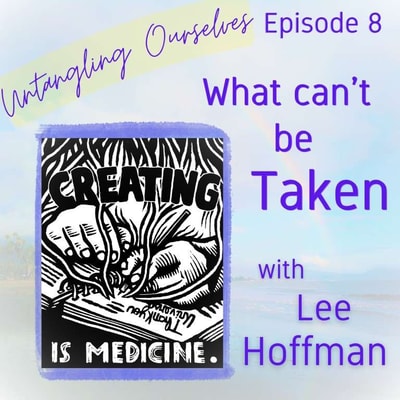
Episode artwork "Medicine Series" by Kill Joy from the Justseeds graphics collection.
Time stamps
3:24 Choir culture, safety and sound
14:14 Lee’s childhood in high control Christian churches
17:50 – 19:10 discussion of child sexual assault and religion
19:11 Homophobia, bullying and love as survival
26:54 Teaching voice and anti-racism
44:23 Singing as the doorway
49:09 Cathy Roma
52:19 Non-coercive leadership
1:02:58 Voice as anti-fascism
1:12:17 Silence as being with
Links
“Watch and Pray” sung by Tamara-Lynn Richards
Parker J Palmer A Hidden Wholeness
“All of Us” from Considering Matthew Shepard, Craig Hella Johnson
AVCP Listen to Herstory: Missing and Murdered Indigenous Women
Missing and Murdered Indigenous Women Khadijah Britton Search group
Support Untangling Ourselves by contributing to their tip jar: https://tips.pinecast.com/jar/untangling-ourselves
Find out more at https://untanglingourselves.com
This podcast is powered by Pinecast.