1.5: Mutual Aid with Andrea Schrimp
Building community after leaving Mormonism
Transcript
A brief content warning before we get started. This episode references child sexual abuse, religious abuse and death due to poverty and lack of housing. If you need support, check the show notes for links to resources around child sexual abuse and leaving high control religion, as well as links to multiple mutual aid organizations that offer opportunities to get involved. After spending days watching in Horror as Minneapolis St. Paul is invaded and attacked by racist thugs. I also need to add that listening and learning a story about mutual aid is about building the networks that we need to survive. I hope that people find value in Andrea's story, not just in terms of feeding people, but in also connecting to each other through care so that we can face off with a regime that thinks that guns, violence is power.
AndreaI mean, my journey towards mutual aid started when I would see someone who was unhoused outside of a fast food restaurant and I would go through the drive thru and buy them a meal along with my own once I had my own money to spend.
KaitlinYeah.
AndreaRather than choosing to look away, I would see and do what I could. And you know, that's not buying somebody a meal from Wendy's isn't anything huge or life changing, but it's the conscious choice of choosing to see. For me, even as a very young adult, I chose to see.
KaitlinWhat do you think made you choose to see? Like, how did you get there?
AndreaI think maybe when I was a child suffering, nobody saw me. And so I. I try not to look away.
KaitlinYeah. Hi, welcome back to Untangling Ourselves. Today I'm here with my friend Andrea. Andrea is a programmer. She's a neurodivergent, queer, unschooling mom, a pet rescuer, and a mutual aid organizer whose organization manages, I think, about 100 street meals every other week. Is that right?
AndreaYeah.
KaitlinYeah.
AndreaAnd mutual aid and harm reduction.
KaitlinMutual aid and harm reduction. You're feeding people and giving them safety supplies.
AndreaYeah, feeding people and giving them survival supplies and safer drug use supplies.
KaitlinOkay. Andrea also grew up a good Mormon girl, and I have her here to tell that story of how you go from being a good Mormon girl to someone who's on the street providing harm reduction supplies. So welcome. Hi.
AndreaHi. Thanks for having me.
KaitlinYeah. To start, do you want to talk a little bit about how you did grow up? I know Mormonism was really important to you. You were really invested as a kid, but you were also kind of a wild kid, if I get that right, like riding go karts into poison oak and blackberry bushes and things like that. And rescuing animals since you were little, Right?
AndreaYeah. Yeah. So we kind of grew up with one foot in kind of a very rural lifestyle. My. My grandparents had a ranch up in San Andreas, and my mom had grown up very rurally where she had horses when she was growing up and farm animals and we lived in the suburbs. And so in some ways my upbringing was super rigid. Like, religious wise, Mormonism is a high demand religion.
KaitlinYeah.
AndreaBut activity wise, socially, we. We really kind of were allowed to be pretty wild. We had snakes and frogs and crawdads and tadpoles and box turtles and a newt and at one. And rabbits. At one point, we had 19 pets and most of them were critters.
KaitlinAnd they were critters that the kids brought home.
AndreaYeah, yeah. My brothers would go out and catch snakes. I occasionally caught snakes, but my brothers were excellent snake catchers.
KaitlinI did not know that.
AndreaWe had a giant alligator lizard that came from a friend's backyard. She was going to have her husband kill it with a shovel, but thought to call my mom first. And so my mom and my brothers went over and caught it. And it lived in an aquarium on our back porch for years. It was so mean that you had to take a leather gardening glove and dangle it in the aquarium until it bit to clean the aquarium. And you would pick up the glove and the lizard all as one piece, drop it in a bucket, set it gently in a bucket, clean the aquarium. You'd go back to the bucket with a set of salad tongs. The lizard would still be bit down on the glove. You pick up the glove with the solid tongs and move the glove and the lizard back to the aquarium and then fish the glove out the next day.
KaitlinOnce the lizard was convinced it had murdered your hand.
AndreaYes. Had finally let go. And we had, we had that. It was probably 8 inches long when they caught it. And by the time that we. Eventually he went to like a wildlife education guy who went and taught about local wildlife in schools. But by the time he went to that guy, he was probably 15 inches long. He was huge.
KaitlinOh, my goodness. And so it wasn't just you and your brothers. Your mom had to be invested in this to rescue an alligator lizard for years. Yeah, yeah.
AndreaMy mom was definitely. She. She did a lot of, I think, surreptitiously springing all of the snakes that we had. We kept one or two as long term pets and the others just always seemed to get away.
KaitlinDecluttering snakes.
AndreaBut yeah, we had, we had a couple snakes that were very long term pets. The alligator lizard was a long term pet dog. We Always had a dog. Cats had rabbits for a while.
KaitlinYeah. I always think of the story of you sitting out in the cold rescuing baby bunnies all night long.
AndreaOh, yeah, yeah. We got a rabbit and she was pregnant when we got her. We didn't know. And so four weeks later, she started building a nest and we had baby bunnies during like Sacramento's 29 day hard freeze back in the 80s. 87, 88.
KaitlinYikes.
AndreaAnd the bunnies were born like right smack in the middle of that. And they lived outside in just a wooden hutch. We built a nest box on the back, but the baby bunnies would get dragged out onto the wire bottom touch part. Which, by the way, if you have bunnies now, don't keep them on a wire bottom hutch. But it was the 80s, we didn't know. So the babies kept getting dragged out onto the wire bottom hutch. And they were. They would freeze if they were out there, you know, for any length of time. And they can't crawl back in themselves because they're blind. Little wrinkled pinky rat things. And so I would check right before I went to bed for buddies out of the nest box. And then I would wake up. I would beg my mom to wake me up as soon as she woke up. And I would run out and I would check at like 5 in the morning.
KaitlinOh, my goodness. Okay.
AndreaAnd rescue the bunnies, whatever. Bunnies. It was usually just one. The same bunny almost every day, would not remember to let go from nursing when he should. And he'd get dragged out and I'd rescue him and warm him up inside my clothes and put him back in the nest box.
KaitlinOh.
AndreaBut they all survived.
KaitlinWow. Yeah. And you've been doing that ever since, basically.
AndreaI. I have.
KaitlinAnd so at the same time that you're doing all of this with the alligator lizard and the bunny, you're also pretty strictly Mormon. I don't know the range where you fall on the range in terms of strictness. Like, were you wearing underwear and stuff when you were a teenager?
AndreaSo the. The underwear doesn't come into play until after you've gone through the Mormon Temple, which is not until like after adulthood. So that wasn't a thing, specifically when I was a kid. But my family's policy, my parents policy was that we had to dress like we were, so.
KaitlinOh, wow. Okay.
AndreaShorts were always past our knees. We couldn't wear sleeveless shirts, tank tops. We had to have sleeves. We had to. Obviously we couldn't wear crop tops or anything like that. So like of all of my Mormon friends, my family was. This was the strictest, like, in the. In the scheme of things, in terms
Kaitlinof, like, the little rules that you have to follow.
AndreaWe weren't. We weren't allowed to watch any. Any TV on Sundays except for Mormon movies or nature shows. We weren't allowed to, like, play. Play on Sundays. We were supposed. It was supposed to be a day of rest, so we. We weren't allowed to play with our toys or to play outside.
KaitlinYou weren't allowed to play with your toys?
AndreaNo, it was supposed to be a day of rest, so we were supposed to be reading church literature, church magazines, scriptures, watching church movies, or taking really long naps.
KaitlinEvery Sunday.
AndreaEvery Sunday. Yeah.
KaitlinWow. And not catching snakes.
AndreaNo, no catching snakes on the Sabbath.
KaitlinOkay.
AndreaHard rule.
KaitlinAnd when you were catching snakes, it was in the appropriate clothing that was down to your knees.
AndreaYes.
KaitlinYes. Okay. That's quite a. That's quite a childhood. And so you were really invested in this when you were. When you were a young kid and a teenager. I know that there was a point where you really peaked in terms of believing and being a good Mormon. What do you feel like kind of drew you into that when you were invested in it?
AndreaI. So there's a lot of work in the Mormon teenage community on creating spiritual experiences and like, wrapping up Mormonism in friendship and youth activities and music and togetherness and community, all as part of this big emotional package. And it's very compelling. You know, you get a bunch of teenagers all in a big group and you play this play or sing, sing the spiritual music and have speakers who are crying up on at the pulpit and you're sitting with your friends and. Or you're at like a girls camp and sitting around a campfire bearing your. Your deepest fears, and it feels like. It feels like divinity.
KaitlinYeah.
AndreaAnd that was probably the time in my life when I was the most personally invested.
KaitlinYeah. Yeah. Because all that vulnerability and the actual connection to people and expression felt so right. It sounds like.
AndreaYeah.
KaitlinYeah. And I can. I was gonna ask you about how you brought that into your life, but as soon as you started describing it, I can picture it in terms of, you know, you're getting teens together and running talent shows and making spaces happen where people can be vulnerable or have a campfire and talk about themselves openly. You're making that kind of space without the church now and as an, as an adult.
AndreaYeah, yeah. Because you don't. You don't need the religious connection to have those cool, special, like, small, intimate Close experiences. You don't. You don't need the religion to benefit from that.
KaitlinYeah. But they do need some kind of structure. And I think that's one of the things I do see you doing, which I think is really awesome. And the work that you do, in part is creating community structures for people, whether it's homeschooling group or feeding people.
AndreaYeah.
KaitlinSo when. What made you start stepping away from that? So you had this. It felt really powerful. It felt like divinity. And you had your family on board in terms of following the rules. What started a crack in your commitment to Mormonism?
AndreaI think that as I became an older teen, it was twofold. So initially it was the. The Mormon Church's intense focus on sexual purity, especially for girls. Especially for teenage girls. And I was a victim of childhood sexual abuse and experienced a lot of lessons about people who had had any sort of sexual contact being used chewing gum or licked cupcakes.
KaitlinIt took me a second to even process that metaphor. I like the people were trash, basically.
AndreaYeah.
KaitlinOkay.
AndreaAnd it wasn't probably doctrinally, was not directed at people who had experienced sexual abuse, but in the mind of a teenager who had not had a whole lot of really great sexual education, like, had really just had what the school provided and who had never received counseling, adequate counseling for the sexual abuse. It. I don't think that I even really distinguished between sexual abuse where I did not try and fight off my attacker, my abuser versus consensual sexual activity. There was no difference in my mind I had, which is I'd never been taught about consent. Honestly, I don't think anybody had ever even taught me about consent.
KaitlinYeah.
AndreaAnd so I remember really clearly in an early morning seminary class. We had early morning seminary every school day at like 6 in the morning. One of the boys in the class, and this was a boy who we even. None of us even liked, but he said, well, I would never marry a convert because I wouldn't want used goods. Oh, God. And I like the. The way that women's bodies were talked about and value was placed on sexual purity. Like, I felt like there wasn't a place for me as a person who had no choice but was definitely going to be considered damaged goods.
KaitlinWow.
AndreaAnd I think maybe even at that time, I saw it more as nobody would want me and less as this system is misogynistic and gross. But, like, that grew and changed as I grew and changed.
KaitlinSo your initial crack in Mormonism was I'm never going to be a good Mormon wife because this thing happened to me, basically. I can't qualify being a new cupcake
Andreaor unchewed chewing gum. Oh, God.
KaitlinI mean, it's just women as a.
AndreaAs a product for consumption.
KaitlinYeah. As a product for consumption. Yeah. Yikes.
AndreaAnd then part two of that was the Mormon Church's judgment of people who were lgbtq, because I had friends who were lgbtq. I had friends who I loved who were lgbtq. And the Mormon Church was actively antagonistic to LGBTQ people in the 90s and early 2000s, and then has maybe made some. Some shifts recently. But the hate was a huge breaking point for me with. With the Mormon Church
Kaitlinbecause it was organized, hate and systemic. Right. They were campaigning for like, anti gay marriage laws and stuff like that.
AndreaYeah, yeah.
KaitlinAnd so you had friends who were out and you were able to center your friendship with them and your care for them in a way that made you reject the church teachings. Yeah, yeah. So how did you actually get out? Because I know it's very hard to leave.
AndreaSo for a couple of years after. So I first I moved out from my parents house when I was 19, I moved out and I had. I had to be moved out from my parents house and I moved in with an actual Nazi. That's a whole other story, folks. Ask your roommates if they're Nazis. But then I was going to the young single adults ward instead of my family ward. And so I had a little bit more space from my parents there. And for a while I was very much mentally out and still attending the young single adults word. And I was leading the music for the church services and teaching in Relief Society, which is like the women's organization teaching and Relief Society. And I would. And really realized that I was out. And so, you know, I was. I would get a lesson about like paying tithing and I would just teach about kindness and love and service, no matter what the lesson was supposed to be.
KaitlinYou were doing the Unitarian Mormonism.
AndreaYeah. So for probably like two years, once a month, there was a very predictable lesson on kindness, love, or service. No matter what I was supposed to be teaching on, I'd like read one scripture or one quote about what the lesson was supposed to be on, then just talk about service, kindness.
KaitlinOkay, that's interesting. So you were still holding on to all of that. Like those values just stayed with you.
AndreaBut then the young single adult ward dissolved and I did not move back to the family ward that I was in at the time, which wouldn't have been the ward that my parents were going to.
KaitlinMm.
AndreaAnd so it gave me a space to just disappear.
KaitlinYeah. So you had known you're mentally, you were out, you weren't believing specifically in the church. Did you move into like atheism or.
AndreaInitially I tried out and researched basically every other religion that I could find information about. So like Buddhism and Hinduism and like just, you know, low, low demand Christianity, like basic Methodist Christianity and Wicca and paganism, all of that. Like, I read so many books, so many books.
KaitlinOkay.
AndreaAnd at some point realized that any organized religion frightened me. And so I, you know, I would dip my toe in the water. I would, I went to a super, you know, super basic Methodist service with a, you know, it was geared for people who were spiritual, not religious, and everybody was lovely. But organized religion and the power that it can have over people frightened me.
KaitlinYeah, yeah.
AndreaAnd I think I kind of grew into atheism from there.
KaitlinOkay. And so how else did you transition? So you had this community. You were like teaching, leading music. Did you just sort of transition into. After you did this research on religion and all that community wise, did you just jump into a work life or did you start building other kinds of community? Like, were you aware that you needed to build a community around you at that point?
AndreaWell, I tried to find community was more. What I started out with was trying to find community that already existed. So I got involved with the sca, which was like a medieval recreation group. And that's a strong community group. But it wasn't my community and work like I was. I did have friends at work, but work friends have a way of disappearing when jobs disappear. And it was the dot com boom and companies were going out of business all over the place. And so work friends were hard to, you know, to really hang on to there. They tend to not be long term friends.
KaitlinYeah.
AndreaAnd I think for probably 10 years, I really experienced a lot of emptiness around that community. Like I really didn't have a good local community. I had, I had friends who I was friends with even from like junior high. And we stayed really close. Friends still are to this day. But a couple friends are not a cohesive community the way that I had experienced in the past.
KaitlinYeah. What was good about the church and stuff?
AndreaYeah. And after I had kids, I wanted community for my kids. And I actually went back to Mormon events. I thought, well, maybe I can do just the community, go to the events, the non religious events and not the religious part. Because I wanted community for my kids. I wanted my kids to have friends. And yeah. So I went back to Mormon activities and realized that the church was still protecting sexual abusers and allowing them to have access to children. And it wasn't a safe place for my kids. And so do you think, do you
Kaitlinthink that's fundamental to why other organized religions scared you? Was it the power hierarchy in general or was it. Do you feel like that experiencing abuse made you wary of anything that had that structure and that spiritual power in organized religion?
AndreaI think that the reason that my abuse was covered up was to preserve the power hierarchy of the religion.
KaitlinYeah.
AndreaAnd I think that religions very, very commonly do that. They protect male abusers over protecting children.
KaitlinYeah.
AndreaAnd women. Adult women, too. That that is how the power of religion is often used.
KaitlinYeah.
AndreaAnd, you know, I kind of hope that after a ten year break, and at that time the Mormon Church was being more opening and accepting of LGBTQ people. This was, you know, like the Prop 8 have failed. They were no longer campaigning hard for. Against LGBTQ people. They were teaching love from the pulpits. And I thought that there might be space.
KaitlinYeah.
AndreaFor. For me to find community there. And there wasn't.
KaitlinYeah. I mean, one of the things that I respect about you is the way that you not only invest a lot of time and effort into community building, but you also are willing to call people out and to face conflict when it has to be faced. And I can see that in your, the story that you're telling, obviously why that's so essential if you're going to create a structure for it not to just avoid conflict, avoid confrontation about things that go wrong.
AndreaRight. It has, it has to be safe or.
KaitlinYeah.
AndreaOr it ends up being harmful.
KaitlinRight, Right. Yeah. Okay, so you had kids and you started building community.
AndreaRight.
KaitlinAnd at the same time, well, first of all, what does mutual aid mean to you?
AndreaSo to me, mutual aid means that the people who we serve are as much helping us as we are helping them. But it also means, in a more practical sense, listening to people and helping them in the ways that they are asking for help, rather than deciding how I'm going to give aid and build community based on what I think people need. And so Dandelion Seeds started. I mean, my journey towards mutual aid started when I would see someone who was unhoused outside of a fast food restaurant and I would go through the drive thru and buy them a meal along with my own. Once I have my own money to spend.
KaitlinYeah.
AndreaRather than choosing to look away, I would see and do what I could. And you know, that's not buying somebody a meal from Wendy's isn't anything huge or life changing, but it's the conscious choice of choosing to see. For me, even as a very young adult, I chose to see.
KaitlinWhat do you think made you choose to see? Like, how did you get there?
AndreaI think maybe when I was a child suffering, nobody saw me. And so I. I try not to look away.
KaitlinYeah,
Andreayeah.
KaitlinAnd so then you were doing that informally for once, once you had your own money. Yeah.
AndreaAnd then Michelle and I met in. It was Sun Network. The homeschool group was back then, Sacramento Unschoolers Network. And we were both then like, we got together and made 10 meals or 20 meals to take out to the street a few times or collected socks and made care packages with the scout group also still pretty informal.
KaitlinWere you just going somewhere, anywhere to hand it out at that point?
AndreaYeah, we would like the care packages. We would pack up and then everybody would keep a few in their car. And so then if you saw someone, you could hand them a care package with a meal or. Or we would take them downtown. Like you can always find unhoused folks downtown. So it was when my kids were younger, it was still very informal. And then probably 10 years ago, we started trying to care for unhoused community members in a more planned and more formal way. We started doing like soup meals where we would crowdsource 100 cups of soup and then pair them with bread and drive around and deliver them to people in the camps that they were at. Trying to focus on underserved areas rather than just the areas where we could find people. Trying to kind of consciously think of where people aren't able to get food as easily.
KaitlinAnd in that process, you started getting to know people, I'm assuming.
AndreaYeah, yeah. And then post. Well, mid Covid we realized that there was a large community of unhoused folks that really had no access to services. They were a long way from all of the shelters, all of the places where you could go get meals. And there was a big empty field that probably 100, 150 people were living in. Almost all of them lived, housed in that area at some point in time. It was during the right to rest protests. There was a lot of activism around that. And in the end, the city did kick them all out. The owners of the property put up a giant fence. The city said that it was going to be converted to super low cost apartments, super affordable apartments, and they needed to clear it so that they could do that work. And it's probably eight years later now. So eight years later, the property is still vacant. It's never been converted to affordable housing. It's just now empty with no property.
KaitlinYeah.
AndreaAnd so we realized that a lot of the people were the people who were living on that property and they have very limited access to services. And so we found that community maybe six months into Covid, eight months into Covid, and have been working there ever since.
KaitlinSo you started forming this connection to that community at that point, realizing that this was where people needed the most in terms of food and stuff.
AndreaRight.
KaitlinYeah. And so the work that you do is a lot more now than getting people to cook 100 cups of soup.
AndreaRight, right, right. We still have meals kind of at the heart of our distributions. We always, almost always go out with food because there's something healing about sharing a meal with people. You know, we're not. Realistically, one meal every two weeks isn't keeping anyone from actually going hungry.
KaitlinYeah.
AndreaBut it says we care enough to bring you homemade food.
KaitlinYeah, yeah. And people have gotten to know you and have that rhythm and that expectation. Yeah.
AndreaAnd so people will come for the food or for the water or for the Gatorade and we get to know them. We have harm reduction supplies, safer use kits, needle exchange, safer sex kits, condoms, toiletries. I do vaccines for people's pets when I can buy a tray of vaccines. But I think a big part of it is that we know people. We make and keep long term connections and friendships with people. Like I have. I have friends who live in tents.
KaitlinYeah. And I guess I'm wondering, and I feel like in a way this is sort of a judgmental question, so you can tell me if it is. But do you feel like there's progress? Do you feel like you've helped people get healthier? Or is it more just seeing them where they are at and meeting the needs without any expectations? I.
AndreaI'm not sure. I guess I would say I don't have the answer to that. I'm. I don't have the solutions that would help people get sober or get mental health care or get housing. Like, I don't have the solutions to give that to people. If I could, I would. Obviously, certainly Narcan helps keep people from dying. It saves lives. Almost every two weeks we hear about somebody who was saved with Narcan that we undoubtedly. Narcan that we took out to the street and distributed safer injecting supplies. Absolutely. Keep our communities and the unhoused community safer. They decrease the spread of hepatitis and hiv. Sharps containers keep sharps out of people's Feet unhoused and housed like there are. There are benefits to people's health and safety from what we do.
KaitlinYeah.
AndreaBut realistically, very few people have moved into long term housing and stayed housed in the communities that we serve.
KaitlinYeah. Because the systemic problems are worse, not better than right when you started.
AndreaAnd we. We don't have a system that makes space for them to do it. Like, how do you. How do you get housing if you have a job? How do you get a job if you're living on the street? Let's say you do manage somehow to find yourself a job, clean up enough to get hired somewhere. What happens when the police sweep your encampment and now you're living three miles away and you don't have anywhere safe to leave your stuff, and so you can't work that swing shift at a gas station anymore because if you do, you're going to go back and your dog's going to be cut loose and your tent's going to be gone. How do people dig their way out?
KaitlinYeah. And as you've been doing this work, you've been seeing the sweeps, the police sweeps of camps get worse and worse, which has been heartbreaking. I mean, even just for me on the sidelines reading your stories, it's brutal beyond just the problems that people face without housing.
AndreaAnd in the wake of sweeps, people die, like.
KaitlinYeah.
AndreaAnd there's nothing that we can do about that.
KaitlinYeah. So you're out here and in part, it seems like this is. This is your community. Is this community where you have connections to people living in this general area who are getting battered by the system.
AndreaYeah.
KaitlinYeah, I know. One thing that you've said to me that I always think about is you can't get healthier when you're living in a tent. It's not the space to.
AndreaNo, no. Nobody is more mentally. Well, nobody is more sober when they live in a tent.
KaitlinYeah. And I think part of the reason I hesitated to ask that question, it's the question that comes to me. You know, people want to see problems fixed. They want to see progress. But in a way that's kind of back to the question of what is mutual aid? Because mutual aid isn't about fixing people.
AndreaRight. Yeah. It's about taking care of them where they're at and them taking care of you. When my mom had a stroke and lost her eligibility for her lung transplant, I sobbed on Patty's shoulder. And Patti lives in a tent.
KaitlinYeah. And the whole time you're talking about this, even from doing drive through Meals to going out there every couple weeks with these meals and the harm reduction supplies. Now, what strikes me, I was going to ask, you know, do you have advice for people wanting to get involved in mutual aid? And when I hear you talk about it all together, it's not even just like a thing that you try to get involved in. It's, it's a way of being in the world. What you're describing, seeing people and making connections to people. So do you have, what would you say to people who say, like, oh, I want to do mutual aid, what does that look like to take steps to being more involved and connected?
AndreaThere's so many different ways that you can get involved. I mean, a really good first step for a lot of people is to find a group that, that's already doing the work in a way that feels, you know, in a way that feels respectful and join in and start working with a group. But that's not always available a lot of places. Still, you know, the only thing that you're going to find is a really kind of classic charity model where organizations distribute supplies and don't necessarily build connections and don't necessarily ask what people need, don't necessarily listen. And so if that's the case, everybody has somebody who's struggling in their community, whether it's someone who sleeps behind the grocery store or someone who's on community Facebook groups asking for help. The listen, listen to the asks or look for the people who are struggling right around you and introduce yourself and ask if they could use anything.
KaitlinAnd it's really that simple. You don't need to plan out ahead of time because all the work that you're doing, I mean, you've described what you offer, what you've been able to do, but I know in the background you're doing tons of work, you're doing organizational work, fundraising work, you're stacking boxes of harm reduction supplies all weekend. Because when I think about Dandelion Seeds and the work that you're doing, I know that it's a huge amount of organizational work at this point. You have people volunteering, you have funds that you're managing, you have supplies, you have storage, people don't. What I hear you saying is people don't need to think about building a project right like that. They need to just start by asking open ended questions of what people need in their community.
AndreaAnd I mean really finding one person who needs help that is, that's valuable, that's valid and that's helping someone who's asking who's there asking for help because they need it.
KaitlinYeah.
AndreaAnd that's just as valid as the work that we're doing.
KaitlinYeah. And I wanted to ask too, if you have advice or thoughts for people about building community after leaving something like Mormonism that is so feels like this automatic community at your fingertips.
AndreaI think learning how to build community takes time. But what I found is showing up for people is really what builds cohesive community. Like, it's not about the activities. It's not about having a ton of things in common. It's not really about shared interests. It's about do you show up for people? And when you start showing up for people, people start showing up for you. And when you have that throughout a group of people, suddenly it's magically community.
KaitlinYeah. And you do that so well and so appreciated. So, finally, to wrap up, I do have a quote or something that you always keep in mind with this work that you're doing and the life that you've built. Now, do you have something that guides you or a mantra that helps keep you centered when you're doing this work?
AndreaI do. This was one of the things that I wrote notes on. It's from an old 90s jewel song. In the end, only kindness matters.
KaitlinYeah.
AndreaAnd I think if I was going to choose anything to be my religion, that would be it.
KaitlinYeah.
AndreaMy guiding light.
KaitlinYeah. Well, thank you so much for sharing. I'm really excited to put this out there and have people learn about what it looks like when you live with that principle of kindness mattering. Thanks for telling your story here.
AndreaYeah, absolutely. Thanks for chatting.
KaitlinYou've been listening to Untangling Ourselves. Andrea organizes mutual aid through Dandelion Seeds. You can learn more about Dandelion Seeds in the show Notes with a link to their information, their PayPal, a recurring donation link, and an Amazon wish list. There's also links to other organizations doing powerful work in the community. If you appreciated this episode, subscribe, leave a review and share the podcast with a friend. It helps a lot. Thanks.
CW: References to child sexual abuse, religious abuse, and death due to systemic vulnerability.
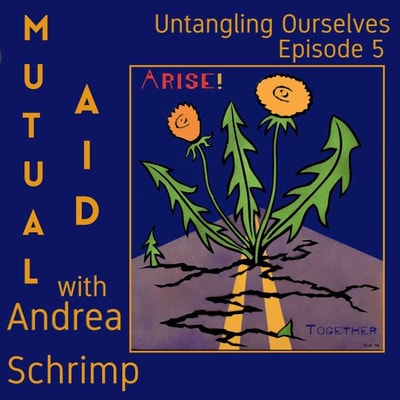
Podcast cover image by Dave Lowenstein, used under Attribution-NonCommercial-NoDerivs CC BY-NC-ND Creative Commons License via Justseeds. Modified with podcast text.
Dandelion Seeds: https://sacdandelion.org
3:05 Andrea’s childhood catching lizards and being a good mormon
10:33 Why she was invested in Mormonism, and what made her leave
26:19 What is Mutual Aid and Dandelion Seeds’ work
37:35 Advice for getting involved and finding community
Help for survivors of sexual assault
https://www.childhelphotline.org/
https://protecteverychild.com/
https://snapnetwork.org/resources-for-survivors/
https://www.revitalizewellnesscounseling.com/blog/csa-in-the-church
For leaving high control religion
Steve Hassan’s “BITE model” https://freedomofmind.com/cult-mind-control/bite-model-pdf-download/
National Domestic Violence hotline https://www.thehotline.org/
Also see notes on Ep. 1 with Delia
Other mutual aid resources:
https://sacramentohomelessunion.org/
https://foodnotbombs.net/new_site/
https://www.radical-guide.com/listing/punks-with-lunch-sacramento-chapter/
https://www.facebook.com/SactoPPC/
https://www.norcalresist.org/index.html
https://www.deanspade.net/mutual-aid-building-solidarity-during-this-crisis-and-the-next/
More about Dandelion Seeds
https://linktr.ee/dandelionseeds916
Dandelion Seeds is a grassroots mutual aid group working to provide food, water, survival gear, harm reduction, first aid supplies, and other small comforts to our unhoused neighbors in South Sacramento.
We (Dandelion Seeds) do street meals on average twice a month, with supplementary runs in extreme weather conditions and for special occasions. We hand out home cooked meals, water, blankets and sleeping bags, Narcan, baby wipes and other hygiene supplies, tents, tarps, socks, hats, gloves, flashlights, first aid, condoms, harm reduction kits, books, reading glasses, pet food, firewood, and more.
In addition to material needs, we make an effort to connect with the communities we serve. We spend time getting to know people, their families, their pets. We help with some basic veterinary triage and first aid, give basic general advice on pet and personal care. We listen.
In 2025, Dandelion seeds handed out 2,571 meals, 4,258 bottles of water, 790 electrolyte or hot drinks, 95 tarps, 34 tents, 485 packs of wipes, 64 blankets or sleeping bags, 1,020 doses of Narcan, 1,529 harm reduction kits, 311 first aid packs, 11,129 condoms, 1,248 maxi pads, 2,236 tampons, 4,575 pairs of socks, 1,054 hygiene packs, 100 storm kits, 75 emergency food bags, and 50 hot weather comfort kits.
We did 38 street outreach days in 2025, with 8 street team volunteers backed by a team of support from volunteers at home, cooking, sewing, knitting, building outreach kits, sourcing supplies, and, of course, making our work possible with money and supply donations.
We’re back at it already this year, with 6 street meals scheduled in the first 3 months of 2026. If you want to get involved, send us a message! Or if you want to help with funding, there’s two ways to get money to us. The fast way is to send PayPal as a “friends and family” transaction. That puts money directly into our working account.
https://www.paypal.me/DandelionSeeds916?locale.x=en_US
Alternately, if you’d like to make a tax deductible donation, and/or set up a recurring donation, you can use this link to the donation page set up by our fiscal sponsor, A Radical Guide. All of those funds, less the credit card processing fees, go to us. It’s a little bit slower, but it’s tax deductable, AND when you set up a recurring donation, it helps us even more because it allows us to make plans for ongoing expenses
https://www.radical-guide.com/dandelion-seeds/
And we’ve recently updated our wishlist. (We hate Amazon too, alas, they have the most functional wishlist feature for our needs. If you want to buy stuff for us from someplace else, get in touch and we’ll figure out the best way to make that work.)
https://www.amazon.com/hz/wishlist/ls/2261OGZ8J8LBA?ref_=wl_share
Let it begin with each step we take,
and let it begin with each change we make,
and let it begin with each chain we break,
and let it begin every time we awake.