1.4: More K-Pop with Rob Cunningham
Part 2 of 2
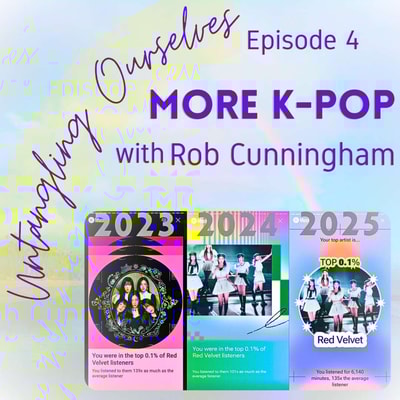
Transcript
One of the things about it is that there's so much to it when an album comes out. There's, you've got the music, but then you've got like the music video, you've got the performance video, you've got many, many live stages that the artist does for that song and you've got like the dance practice videos. And then often you have other stuff, you have these like cinematic trailers that go along with it and all this other stuff that, that goes along with the album that's just kind of like a general commentary about how much you get out of it and how there's like all these different ways to, to approach K pop.
Speaker B:Welcome to Untangling Ourselves. This is the second of a two part interview with Rob about finding joy in music. For part one where we cover Rob's journey through music, go back to episode
Speaker C:three of the podcast.
Speaker B:We talk there about his search through goth, electronic and experimental for new mind blowing sounds. Today we're talking about K Pop. Rob thought he was searching everywhere for sounds that could change the way he sees music. And he felt lost for several years. He finally found an endless source of fun, creativity and new ways of literally seeing music when he gave in to becoming a K Pop fan. We talk about how the spectacular creativity of K Pop loops back to MTV in the 1980s. And we explore what fandom means in this repressive political moment. If you're new to K Pop, you'll learn about eras, comebacks, bias and how much you're missing. If you're already a fan, I hope you'll be nodding along as we celebrate the abundant audio visual world of K Pop's last decade.
Speaker C:And if you end the episode curious to learn more. Whether you're already a fan or had
Speaker B:just getting to know K Pop. Rob has many music reviews and playlists on his blog, the Aquamarine Lair. I'll link that in the show notes along with playlists and links to specific bands that we mention in the show. So definitely check that out.
Speaker A:Okay, now we're getting towards like the 2000 and twenties. We ended and thought we were done with a very awful presidency. You know, that didn't turn out that we were done, but at the time it felt like we were liberated from that. And then we went, you know, during that transition we went into a pandemic and we were all home and we were all having kind of a big reset in terms of what does this mean? Like what is the meaning of life if we're not ever seeing anyone or connecting, you know, Being present with others in my personal life life. I was also at home not doing much and I hadn't really had much of a thing before that. Although I was also always very busy with work and family life and going on trips and whatnot. But I didn't have like something electrifying me the way that that music used to. But during like kind of most intense part of the shelter in place and everyone staying home and not even going to the store and stuff like that, it just got me thinking, like, what is the point of life, like when I get through this, how am I going to really live, quote unquote, to. To make up for this time period? And that brought to mind the feeling of being at. At shows and at music events, DJ events or whatever, and just like being present in the moment with other people and appreciating music as being like moments when I've been really alive and present and had that. That feeling where kind of like the past and the future just like melt away and. And I can live in the moment. And that sort of like crystallized in my mind as something that I really needed to return to once we could do things again.
Speaker C:And you had experienced that in some of the previous subcultures that you'd been in, but it wasn't necessarily what you were aiming at.
Speaker A:I mean, yeah, that feeling. I mean, I went to tons of shows in college. I got that feeling of being totally immersed in sound, being with my people, being like, yeah, having a very immersive experience in those. Those shows. And I had like tons of fun doing that, you know, here and there. We went to Elaine Grimaud's recital in New York City that one time and that was just like incredible experience. We were like so far away. We were a mile high.
Speaker C:Yeah.
Speaker A:And we went to like see Marisa, the Brazilian fado singer that came Davis, that one time. That was like incredible. So just like one off things like that. What I was lacking during that time was sort of like any reliable way to find these things. So here I am, 2020 and I'm like, I need to re engage with this. That's what this period of reflection has led me to. But I have no idea how, you know, I don't know like what I'm into. I don't know who is doing that or where it's happening.
Speaker C:So you know what you want, but you have no idea what the next step.
Speaker A:And the only specific kind of music that I like that is like very fun is 80s pop music that is approaching 40 years old at that point, or I mean the earliest year of it is 40 years old. And meanwhile, you randomly recommended that I go to this session on K Pop at the homeschool California HSC conference that we went to, which at that time was online because of pandemic stuff. So there was the session where a mom talked about ways that you can use K pop as part of like an educational journey and you know, learn a little bit about the language and learn a little bit about the culture. And she talked about like cooking Korean meals with her daughter, but also went into like the culture around it and the, how the groups are structured and how fans can have a bias which is their favorite member and like all these different things like that. So it was just kind of like interesting and intriguing and got me aware of that culture that was just really interesting. And I had heard of K Pop before, but had never really listened to it. I think I had heard the name BTS before. I had heard like the, the Gangnam Style song when it blew up and got a billion views. And even 30 something year olds who just read the news in their offices were hearing about it. But I didn't, I definitely didn't know really anything about it. I mean like when you're not used to it and you first visually see the groups, they, they're very young or like you might see a group that's very young, it looks like it's something that's like four people much younger than, than me.
Speaker C:And also very corporate, kind of corporate.
Speaker A:And. And it's produced. I've talked about how like pop music is, is very produced by like K Pop, maybe even more so than others because it's groups that are formed by companies, which is like an idea that kind of mostly died out in Western pop music after the Spice Girls and Little Mix and a few other groups in the 2000s. And Western pop became a lot more about soloists. So now I' that it exists. And I thought certain things about it were intriguing from this, this session at a homeschool conference. And also I'm like home a lot and don't have as much to do or places to go as much because that's what we were all doing during the pandemic. And we had gotten our kids, the family subscription to YouTube because we didn't want our kids to be watching ads whenever they saw YouTube. So we all had a family plan. I never used YouTube at all other than like, I need to go so funny now figure out how to fix something so I'll like go find a video about that. And then, like, we watched the stuff that our kids watched with them. I don't recall, like, what is the precise. You know, this led to that. But, like, somehow I started looking up videos. I found some dance practice videos, which is one of the things that K pop has. One of the things about it is that there's so much to it when an album comes out. There's. You've got the music, but then you've got like the music video. You've got the performance video, You've got many, many live stages that the artist does for that song. And you've got like the dance practice videos. And then often you have other stuff. You have these like, cinematic trailers that go along with it and all this other stuff that. That goes along with the album. That's just kind of like a general commentary about how much you get out of it and how there's like all these different ways to. To approach K pop.
Speaker C:And that doesn't have a parallel in anything you were listening to before? I can't think of anything parallel. I mean, it's partly a YouTube culture where there's plethora of video. You can just put out a hundred videos about an album.
Speaker A:It's not parallel to anything I was into. Like, what I was into didn't have that at all because it was more pure or thought of it, thought of itself as more purist. But even, like Western pop music doesn't do all that stuff. Like, it's. It's very K pop specific to. To go to that level with the amount of content that they push out.
Speaker C:Yeah, they'll do like maybe. Maybe they'll do like a making of this.
Speaker A:But yeah, a Western artist does a making of. Maybe they'll go on a show like Good Morning America or Jimmy Kimmel or one of these people, and you'll get like one or two live stages. Or they'll go on like a KEXP does these live things. But you might get like a few live videos. Yeah, so, like, I got into it through that because I was like, this is like, really fun. It. You know, the outfits are cool. Like, the settings are cool. They're doing cool dance moves. They look good. It's fun. Whatever. It was just like a fun diversion. And I would watch that every once in a while. It still didn't become a thing. But like, at one point I was like, wait a minute. Like, this song that's playing right now is actually good. And that was twice. Jelly. Jelly. And it was like this really fun song with this fun Backing beat that reminded me of the song hey Mickey, you're so fine, you're so fine you blow my mind from the 80s. And it kind of like. So I've used this term when I do like my write ups about K pop that is like the 80s, but more so that's this whole like strain of K pop where it to me at least the way it comes off is like if you went back to that super fun cheesy 80s music but kind of like dialed up the colors and the contrast and put in modern production and like updated the special effects and whatever. Like if you kind of like modernized it and made it even more the way it is.
Speaker C:And that's. You've said that's partly coming from a certain producer who's very into 80s music.
Speaker A:Well, that song and some of that stuff is from JYP who leads the company that Twice is part of. And has he actually like me, said that the thing that made him into music and then led towards where he is is Michael Jackson.
Speaker C:Okay, interesting.
Speaker A:And also like just it all comes back to Michael Jackson's music that's like a strain of, of K pop.
Speaker C:That's not all of K pop at all, but it was sort of your entry point.
Speaker A:It's a certain sound. So I was like, oh, that's cool. And then I watched another video and I was like, this song is cool. And that song was Signal by Twice. And then I was like, okay, who is Twice? And that's, that's what moved me like towards really like falling down the rabbit hole or it inched me towards it because I started googling them and found my way to the Twice subreddit. And I like searched what groups are like Twice and I found like some discussions and a really funny thing. That's how I found Dream Catcher. Because in this post that I found on the Twice subreddit that was like what K Pop groups are like Twice. Someone told people to listen to Dream Dreamcatcher, which now like coming at it from a music fan perspective makes like no sense because they are almost as far apart as you can get and be female fronted K Pop. But if you're coming at it from the fandom perspective and you understand that someone who is an insomnia, which is a Dreamcatcher fan, is going to take any and every available opportunity to tell people to listen to Dreamcatcher, then that makes perfect sense.
Speaker C:So it's like this level of fandom where you just are beyond even caring about the music. I mean the, the type of music.
Speaker A:Yeah, it's like, here's a person who's open to finding something new. I'm gonna tell them to listen to Dreamcatcher.
Speaker C:Yeah.
Speaker A:And for listeners that they are, have a very metal influenced sound that borrowed a lot from goth as well in terms of like the imagery and the vocals. Twice is like generally a lot more upbeat.
Speaker C:And I know you've. You've sort of moved away from Twice for various reasons in the last couple years. Are you in Insomnia? Like, is Dreamcatcher still.
Speaker A:No, I'm not quite in Insomnia, but I like Dreamcatcher. They're still one of my faves. They're like in my second tier, I guess.
Speaker C:Okay, okay.
Speaker A:And Twice has just sort of fallen out for various reasons. So they were my. My gateway drug.
Speaker C:Yeah. So you heard Dream, started listening to Dream Catcher and at that point you've heard this hyper 80s sound and now you're hearing this metal sound. And so then what's happening?
Speaker A:So what's happening is I'm like, there's a lot of different things going on. And it. To me, I find it very sort of puzzling or. I don't know how to say. It just. It doesn't connect at all to me when people talk about how K pop is exactly like Western pop or is completely derivative of it because it just. I don't know how you could hear it and. And hear that because it just sounds. K pop goes all over the place. And like there might be. You. You could probably point to like a particular song being similar to another particular song. But like the whole thing is. Is so vast and also goes to so many places that western pop, like, doesn't go very much anymore or doesn't.
Speaker D:Has never gone.
Speaker C:So you were on this journey for a long time of pushing the envelope of innovation and K pop has kind of brought you to this universe where you can cast a wide net of not derivative, but like developing these sounds. Yeah, it's spinning off kind of.
Speaker A:It's definitely riffing off sound. And there's endless and infinite debate that I have in my time gotten into on like, what is originality anyway? You know, that is a very fraught question. You know, everything comes from something.
Speaker C:So the other aspect that we haven't mentioned is that you're a philosophy major.
Speaker A:That's right, I am.
Speaker C:That's what got me to pay attention to academics at all, basically. So what is original?
Speaker A:I'm thinking back to like when I was deep in my philosophy days and I. I got into this on the Internet with Someone. And my position at the time is that there is no such thing as originality and it doesn't matter.
Speaker C:So even as you're looking for more and more innovative sound, you, like, fundamentally didn't believe in originality.
Speaker A:Yeah. Or at least like, that was what I felt had to be the conclusion. If you follow the definition in a very philosophically rigorous way, like according to the. The Western philosophy tradition, the concept just breaks down and makes no sense.
Speaker C:Whoa. Okay.
Speaker A:But either that or it's like everything is original, but then if everything's original, then nothing's original. But I don't think that's quite the right way to. I mean, that doesn't fully cover the concept of originality. But I think there is something to it more than that being, you know, more of a post philosopher now. But also it's just very complicated. And I mean, there's two things to say, which is that pulling things from different places and doing something new with them is original. And also that there's a lot of things to like about music other than originality. So I'll just leave off that topic with both of those statements. So we're in like 2021 in my story, and I'm starting to find things I like. I still was kind of like, this is this fun thing that I'm not sure about. And I just watched these videos for fun sometimes. Not like, this is something I'm totally into. And I started building up this playlist of K pop videos and that. That's when I started getting. Becoming more of a YouTube user and actually understanding how to use it and follow the sidebar to different things and just like, how you can, like, go down these pathways and find things. So I found like, some Red Velvet songs. Who's been my. My favorite group for three years, and some itzy songs and some more Twice songs and some Dreamcatcher and some blackpink. And that was that. And now we're looping back to when I was talking about how it was like, I really need to get out in the world and, like, hear music and do that with my life that I have once people are able to do things again. And I was sort of like, what? How am I gonna do that?
Speaker C:Even as you're listening to these K pop songs, you're kind of still setting them aside as, like, not.
Speaker A:Yeah. And. But I was also like, that would be funny if I went to a K pop concert and. And I think I just, like, went to our K pop, the K pop subreddit, and just wrote Tour in the search bar. Like the top result is Twice. And I was like, are you serious?
Speaker D:The.
Speaker A:The one group that I have actually figured out that I like is the one that came to the top of the search result. And then I looked at, I looked it up on Ticketmaster or whatever. Initial sale had already happened and it was only resale and the cheapest ticket available was $300. And that was, that was just so outside of my reference at that point. Like I used to go to shows that were $5.
Speaker C:Yeah. And I mean, had you ever gone to a $300 ticket show?
Speaker D:No, No.
Speaker A:I mean, I think I've paid maybe close to a hundred to go to
Speaker D:like an opera or something.
Speaker A:And I was just like, that's crazy. So I just sort of had that in the back of my mind. And it was like the day of that concert when it actually happened in Oakland, which was February 17, 2022. But I. That was like the day I like super fell into it. Like I was just like, I think I was just like moping around all day about how I like wasn't going to the concert and because this, you
Speaker C:had already decided this is like your life's purpose. I mean not your life's purpose, but it's what brings you joy. It's what makes it meaningful to be with people, to be post pandemic.
Speaker A:Yeah, but I just didn't quite make the leap that like I should go to this.
Speaker C:Yeah.
Speaker A:And. And then I was just on the subreddit, like watching people like post videos of it and I was just like, oh my God. And. And I. Then I just started just totally listening to Twice, like non stop. Like I think I didn't listen to like anything but Twice for as you are aware, for like two months or something. So that was how I sort of just completely dived in to the deep end. But my completist and archivist kind of tendencies also went into this. So I started. I, you know, once I got into Twice, I needed to make a playlist that was like every single Twice song that's ever come out in order and listen to that. And I started to like get into other groups, but I started to have this like pretty systematic way of doing it on YouTube and, and I started learning Hangul and learning how to like pronounce things and learning all the members names and blah blah, blah. Like and, and going back through the discography and finding like all the different performances and, and doing all that. And I felt at that point like a sense of community in the Twice Subreddit. Like they had this weekly thread that was just like this chit chat and it was just very like very friendly and very all over the place. They would talk about whatever was happening in K Pop or sometimes other kinds of music or sometimes not to do with that at all. Like just stuff going on and it was very chill and would be like visited frequently. So if you load it in the morning and then you loaded in the afternoon, there's like more stuff going on. That really, that was like part of feeling like I am a twice fan because I like do this. I like hang out in this space and, and know all this discourse about which member did what, when and blah blah, blah, and like who has which kind of personality and. And just like falling into that whole like fandom thing where you get super into the, the people in a irrational way because they're actually just people.
Speaker C:But, well, the Personas.
Speaker A:You get into the Persona. Yeah, you're not really getting into the person, you're getting into the, the Persona and getting kind of like wrapped up in that. And so then they wrapped up that tour and then they decided to do an encore concert in la. And I felt like, you know, this is like a calling. Like they're actually coming. I had that experience where I deeply regretted not going to that and then I came back. So I just decided I had to do that and had this kind of absolutely crazy experience like taking the train down there. Instead of paying 300, I balked at playing 300. I ended up paying 400 for that ticket. And I had like, this is my first experience with the whole Ticketmaster thing where you go into the queue and like 30,000 people join the queue. I had never even been remotely interested in anyone where anything like that happens. So that, that whole, that whole experience was, was new. But yeah, like I went down to la. It just was incredible. It's hard to describe the feeling of it and it's kind of an irreplaceable experience. Like having that experience after coming through a pandemic and barely go, you know, barely going anywhere. Not being in like a concert type, exciting concert type environment for many years prior to that and like understanding that I was gonna follow this pathway of, of fandom and then just completely going all the way into it, getting the light stick and all that stuff. And then kind of like an. Another amazing aside with that is that I. I went to that concert two times because it was two nights in a row and the second one had a lunar eclipse and I got to sit and watch A lunar eclipse for an entire concert, which was really incredible.
Speaker C:I guess. I think what I'm most interested in now, after this conversation is what are you currently into? And do you see. Does it feel completely different than the past? Like it's perceived as completely different than your musical past? Does it feel like that to you? You? Or do you feel like, you know, maybe it's a different angle but you're. Do you feel like it's a continuation?
Speaker A:I feel like some aspects of it are a completely new thing for me and then a lot of it is not. So. Yeah, from that point I described, I spent probably the next year or so like mostly only listening to K pop because there was so much K pop to, to listen to and it was all new to me and it was all incredibly exciting.
Speaker C:So you were really finding. You talked before about casting a wide net to maybe find these gems of music that bring you joy and you were just like, gold mine, like gem after gem after gem.
Speaker A:So it wasn't a totally different process, but it was like, now I know where to, where to dig. Yeah, I've got my, like I've got my mind that I can go into. And it's. It is incredibly productive after like a decade and a half of being less productive. Yeah.
Speaker C:Yeah.
Speaker A:But it was also an audio visual way of appreciating music, which I talked about as, as something that is. Is new and following it like via the music videos, making these, these big playlists of all the music videos that I like. And then the way that the. So when, when a new album comes out, it's always called a comeback. They use that term. Even if their last album came out four months ago, every time they put out a new thing, it's a comeback. It's just a word that they, they just adopted and, and decided it means something else. And the comeback cycle has all these things that go into it. Like there's a whole teaser cycle where they put out. First they put out some pictures that are supposedly supposed to have something to do with the mood of the album. Sometimes they absolutely have nothing to do with it. But.
Speaker C:Right.
Speaker A:There's some interesting examples of that. But often they at least try to set the mood. They put out some like, videos, they put out a little snippets and then the album comes out, it has a music video, and then there's this music show cycle where there's music shows on air Tuesday through Sunday. The most typical day for a comeback is Monday. So usually they come back on Monday, usually skip the Tuesday, Wednesday and then Thursday through Sunday they're on the music shows and you get these really awesome live stages. And then they do like the two, maybe the Tuesday through Sunday, the next week. And sometimes if you're lucky, they'll go a third week.
Speaker C:So it's very immersive, like you can be.
Speaker A:And they're doing the whole time appearances in different places. So you get. But also they use the word era. Like in western music I would talk about like ministries, synth pop era, which was five years, and then their industrial metal era, which was 10 years or something. But every single one of these in K pop is called an era. Like that whole time period surrounding before the album comes out to like when they peter out their activities. That's an era. And then, you know, a few months later there's a new era.
Speaker C:Yeah. And a lot of people here would just be like, that's our album tour.
Speaker A:Right.
Speaker C:But it's a lot more.
Speaker A:There's a concept. So each comeback has a concept. So like Red Velvet put out this song called Feel My Rhythm. And it had this kind of ballerina concept where they dressed as like weird ballerinas and had this very dreamy like midsummer night's dream type of thing. And that was the aesthetics visually for that whole comeback time period. And then next they had birthday, which was all kind of like wild and colorful and cartoonish, you know. So they had like this whole different look that time. That. That's incredibly interesting to me. Like you just have all this stuff that you can get engaged with and. And get interested in or re engaged with these. These new aesthetics that they're putting out as opposed to like a band like Metallica. They got their look in 1983 and that was their look until maybe they changed it a little bit 15 years later, you know.
Speaker C:Well, and I'm even thinking about. You were talking earlier about going to, I think experimental or industrial shows. People just showing up in jeans and the T shirt because it. It meant something to not care about your aesthetics.
Speaker A:Right, yeah, that was. There's a. A strain of the underground where the idea is to be very functional and to like not be concerned with appearances.
Speaker C:But when I think about that, it makes me think about the neutrality of white culture. That like white culture, jeans and T shirt, American culture is considered like a neutral. Like there could possibly be a neutral aesthetic. You know, we were talking about western philosophy, separating out noise from aesthetics. In order to make a separation and pretend like these other things don't matter, you have to create a zero or a neutrality point. And often that's just like whiteness, you know?
Speaker A:Yeah.
Speaker C:And so this is completely different. I mean, you're just. You're saying, let's just like, totally explore this one aesthetic and then jump to the next one and just explore it in every way that we can think of.
Speaker A:It's very much like celebrating the spectacle and the. The bigness of it. And is. Is sort of. In. One of the books I read was called the Society of the Spectacle when I was more of a theorist in grad school, Guy DeBoer. And that. I think that concept was looked down on and like, we need to. To be authentic and get away from. From that. So, yeah, this is. I think it's pretty, like, postmodern in a way and is just like, let's just have fun with whatever.
Speaker C:Yeah.
Speaker A:Like, musically they just. They'll just do kind of whatever. So. Another thing that I should talk about is that now that I know the history of K pop, because of course I learned that there was kind of like this decade where it got more. More out there and experimen and also used a lot of, like, more in your face aesthetics and a lot of, like, campy aesthetics and things like that. That was like roughly 2011 to 2022 and really peaked from 2018 to 2022. There was kind of a sense that companies would just sort of throw out whatever. And a lot of K pop is fandom based, where they had just have like, this army of fans that will support them no matter. Sounds like. But also that, like, created this space where a lot of the producers were just doing, like, whatever. And it was kind of amazing for me. I came in right, like, at the tail end of that. I didn't know that that was what was happening and it was still happening. So no one really knew that. And I got to sort of like, inhale that entire decade at once. And that was an incredible experience.
Speaker C:Yeah.
Speaker A:To me, like K pop before that is not terribly interesting. So, like, when I think back on it, like, it's interesting to think about how I had my entire life, from the 90s to the now, happening, and K pop was happening that whole time. I just didn't know about it.
Speaker C:Yeah.
Speaker A:I mean, it just makes you think there's all these. There's so many things going on all the time. And when I think about that, in some ways, I needed to develop to a point where I could appreciate K pop, but K pop also needed to develop to a point for me.
Speaker C:Yeah.
Speaker A:Because it wasn't really there in the 2000s.
Speaker C:And before, was it mostly like rock music? Like what?
Speaker A:No, it was. I mean, if any, like early generation K pop fans listen, they'll probably disagree or whatever, get offended. But to me it's like just behind western pop, like, it just sounded like a rehash and not very interesting and like very safe, easy to listen to kind of whatever music would they.
Speaker C:Were they singing in Korean? Are there probably parts that were missing from Korean culture and that, you know,
Speaker A:like rehashing, you mean that I'm missing?
Speaker C:Yeah. And talking about it is like a rehash of pop. There's probably some elements.
Speaker A:I'm sure there are things, you know, that I'm just not appreciating or attuned to about it. Yeah, I wouldn't. I wouldn't put that as like a gospel opinion. Just like it just that it comes across that way to me is like there just isn't very much that I find very interesting going on. Obviously, like, it was very meaningful to a lot of people who were into it at the time. And there's probably stuff that I don't know about or don't appreciate about it.
Speaker C:Yeah.
Speaker A:But like, then, you know, my bias take, there was this kind of like Quantum leap in the 2010s, and I would pinpoint like Girls Generation, the Boys, that song, and exo mama in 2012. And like girls generation, I got a boy in 2013. Those were some of the jumping off points. And then to me, things just got really super interesting towards the end of that decade and the beginning of 2000s.
Speaker C:So when you say those words jumping off points, can you explain to me, someone who's not a music person, how did it jump off from an easy pop sound?
Speaker A:They brought kind of like a heaviness of sound into it and kind of like this high level of drama to me. Like a song where just kind of hits you in the face and doesn't let you keep it in the background.
Speaker C:Yeah. And I've heard those songs for sure with you, so I know what you're talking about.
Speaker A:You know, like the first two songs I mentioned, then I Got a Boy is just crazy. It's like a song that does like 12 different things. It keeps jumping to completely different musical ideas. It's very strange. And it's four and a half minutes long, which is very long for a K pop song. K pop songs used to average like three minutes, and now they are even shorter. And it has like this apart where they just shift to Taeyeon and Tiffany doing like total, total, like Diva level vocals just for the hell of it. And it just does all these different things. It's hard to describe, but it's a song that's been written about a lot. I can probably link to it. And that became known as mix pop, like mixing different genres. And that was 2013. Red Velvet debuted in 2014 and has from then like consistently both went all over the place and went in like very experimental directions musically and also often have like really funny campy aesthetics in their videos and, and their Personas that they use FX was another group that they, they kind of pushed the envelope with electronic music, like bringing EDM into K pop. So there's just like a lot of stylistic exploration kind of all over the place. And then as you get later, you've got like Dream Catcher doing. Their entire career was spent doing hard rock and metal focused K pop songs. You had Luna, which was this very like interesting project with a, with a really, really talented producer that can, I think like he really understands how to make interesting electronic noises that tickle my brain, that, that my electronic music brain.
Speaker C:Yeah. So there are the, so there's that connection in some of these things. Yeah.
Speaker A:And then what has happened since I got into K pop is that that decade kind of started to wind down that long decade. There was a group called New Jeans that debuted in the summer of 2022 and they had this more like throwback, early 2000s pop, like very easy listening type of sound.
Speaker C:And they got really popular when they got.
Speaker A:They just like exploded. And also aesthetically they people were like, oh, they're just like girls next door or whatever. Like they just wear jeans or whatever. I don't know. I don't.
Speaker C:We were just talking about.
Speaker A:I wasn't that into them, but like they weren't like wearing ballerina costumes like Red Velvet or. Or things like that.
Speaker C:Yeah.
Speaker A:And that suddenly became this like huge wave. And I was jokingly calling it to myself like the New jeans ification of K pop because it's like 70% of all girl groups in the next year or two tried out putting out easy listening pop music and just kind of having like a much. Okay, biased take, like much more like bland aesthetic.
Speaker C:Yeah.
Speaker A:And that to me was not my favorite, but whatever. I'll just leave it to the side and follow what I like. And Aespa like never did that. So I, I, you know, kept following AESPA and Red Velvet and nmixx kind of like dabbled in that for one comeback and then they went back to being weird. And over time I Kept just, you know, diving into different groups in the way that I do. Like, I had a pretty systematic way. Like, I sort of, like, start dabbling. I'm like, I've got a video or two that I think is interesting. And then there's sort of a point where the floodgate opens and I decide that I need to go through their whole discography. And so that's what I do.
Speaker C:Yeah.
Speaker A:And then delete out the songs that I don't like and make this whole playlist. I got into organizing this all in a spreadsheet. So, you know, it's like, wherever you go, there you are. Like, it's still. It's still me doing spreadsheets and stuff. I just have a new thing.
Speaker C:Yeah.
Speaker A:I could talk a little bit about just being in fandoms because I've sort of talked about those, like, different modes of following music. And being like, a fan in that way is something I've never done. I never was a sports fan. I never. I never really, like, followed anyone for the sake of following them. Especially, like, post high school. And that, you know, feeling of, like, watching an album come out and being there, like, right when it comes out and being one of the first people to watch the video and then, like, commenting with all the people who are watching it for the first time is. Is kind of this new experience that has been part of. Of this for me, like.
Speaker C:Yeah. Following things, it's not just your joy. Like you were looking for those moments before just for yourself, but this is like a community, communal experience of feeling. Yeah.
Speaker A:Hopefully it's good. Sometimes it's not, but whatever, you're sharing
Speaker C:it with people, even if it's not. Yeah. I'm also curious about how that intersects with the political landscape right now, which is so dire with fascism creeping in everywhere. I know a lot of the scenes you were in before could be very political. K pop doesn't tend to be as overtly political. So I'm wondering how you see your cultural involvement with K pop generally intersecting with politics right now.
Speaker D:Yeah, it's kind of interesting because K Pop groups themselves don't usually take any kind of overt political stances unless it's very safe, like donating money to the children or something.
Speaker A:I don't know.
Speaker D:Something that wouldn't even be seen as political, per se.
Speaker C:Yeah.
Speaker D:And there's that because it's so corporate.
Speaker C:Right. It's like this big corporations, a lot of time. Yeah.
Speaker D:They're formed by a company. The company wouldn't want to get in the crosshairs of anyone in particular or any fans that believe certain things. So they sort of shy away from stuff that could be controversial. Then separately there is the. The international fans. And when I say international, I mean outside of South Korea, that's sort of a whole. At least the fans that I encounter on the Internet is a whole other kind of world that has different concerns and different beliefs, I guess. Or that's just a whole different thing.
Speaker C:So you think the international fans have some kind of like expectation in terms of politics of K pop groups that they love or like a standard? Yeah.
Speaker D:And those communities can. Can be active politically. I mean the spaces that I kind of get involved with have pretty left leaning politics among the users who go to that. So that's always kind of an interesting dynamic that you have this, this fan base that has a political stance and wants to see certain things and we're all fans of this type of group and, and kind of this thing that tends to not take political stances. So the fandom itself can be active in certain ways that the artists themselves don't get into. And.
Speaker C:Yeah, and an example of that is the kind of famous time when K Pop fans sold out a Trump rally and then didn't go to just like tank the rally in the.
Speaker D:Yeah, that was kind of a funny way of trolling the 2020 Trump campaign that I learned about Early K Pop journey. Back in 2021, I had found out that this had happened. I thought that was kind of cool. I think another example that came kind of early when I was discovering this stuff was in a BTS video for a song called Not Today. And basically the kind of the theme of the song is like one day we might lose, but that day is not today. And I found that song like early in 2022 and it was. It happened to be around the time, I think it was maybe even the same week that the Russian invasion into the Ukraine was starting. And so I go to the YouTube video and at the top there's this comment that is like, I'm from Ukraine and I listen to this song every day and it makes me think about how we're not giving up and stuff like that and that.
Speaker A:So kind of like general human to me. Yeah.
Speaker D:Or just feeling, you know, maybe the song actually the song itself. Then I sort of looked into it and it's had. Does have. Because BTS writes their own lyrics, unlike a lot of groups and actually does have a kind of political backdrop. It is more about the way that younger generations are being treated in South Korea. As. As lesser and just things that people are going through. Young people in South Korea.
Speaker C:Okay, that.
Speaker A:That's a whole other.
Speaker D:That's a whole story. And it actually was super interesting to learn about when I looked into that. But then kind of how it's interpreted by possibly assuming this is genuine, like this Ukrainian person on the other side of world, like, listening to the songs was very inspiring to me at the time. So those are just some examples. And there's are examples in the other direction of things that I've. That have happened or things that I learned that. That were not very agreeable, like where people use symbols like Nazi symbols or other. Other things that just are taken totally out of context and then they kind of issue some really lame apology and just sort of brush it off like it didn't matter, you know?
Speaker C:Yeah.
Speaker D:In the kind of online fan wars, people will say, oh, well, they're in East Asia. They wouldn't, you know, have the same importance or feel the same importance to that. But it's like, you know, you're marketing internationally and it's not like it's hard to know what these things mean. So just some things like that have been pretty disappointing. But, you know, try not to. To get too invested in that because ultimately we are not really privy to the inner beliefs of these people because they don't share that them.
Speaker C:Yeah. And they're kind of constructing a Persona as part of their stardom and stuff.
Speaker D:So you just basically can choose to be a fan of the Persona and follow it, and if something happens and you're not happy with it, you can leave it behind and that's that. But I guess kind of in terms of how K pop kind of inspires me and how I feel like it fits in with this moment for me, because it did come to me and sort of lift me up out of. Of a time period that was. Was really dark for me, like the first Trump regime and Covid and other things that were happening at the time. And I think ultimately I, at first I was kind of getting like, probably too invested in these stories, like, oh, they sold out the Trump rally. It's so, like, revolutionary.
Speaker A:Whatever.
Speaker D:It's not necessarily, but it's how it affects me individually by inspiring me and. And bringing me joy and making me feel like getting out of bed in morning and making me feel like I know who I am and I know what I like. And I feel like that in and of itself is a really powerful thing. Just understanding yourself and what brings you joy and having that as something that you can, you can go back to and feel good with. Because ultimately joy is kind of a tool of the fascists. They use that, that it's like first they scare you, they say everything is going to hell and we're the people that you feel at home with or you feel joy with. And that is part of their kind of recruitment process. So I feel like, I guess knowing yourself and knowing how you can find that without them is a really powerful thing.
Speaker C:Yeah. So it's not really about what individual groups or people who are K pop stars or even the companies believe necessarily. It's more about not even like the fandom as a collective, but the fandom as a source of joy and a culture that gives you kind of a sense of community that can't be co opted by fear, it seems like.
Speaker D:Yeah, yeah, that's what I would say.
Speaker C:And I'm also thinking about earlier in our discussion, you talking about just digging through your archives and kind of being lost and like unbounded need to review everything. Not really knowing where you wanted to go and how it got so much easier once you really knew what you liked. And K pop helped teach you that. And you know, that's all. I mean, when you're kind of lost in your own archive and thinking that you need to look at everything, it's another one of those shoulds. Right. Like I should review every single album, even if I'm not that into it. I should do this. And you're sort of vulnerable to political groups or whatever that say, like, we have the answers, we have the structure for your life. Yeah. And if you can structure your life around Joy, that gives you a kind of cultural immunity, I guess I would hope too, being co opted by these movements.
Speaker D:Yeah, I think it helps.
Speaker C:Yeah.
Speaker D:Earlier I was talking about the early years of K pop got to stuff like in the 2000s and the late 90s, that I was not really as inspired by that stuff. And you were talking about, you know, maybe there are things I'm missing.
Speaker C:Yeah.
Speaker D:That made me think of another podcast that I listened to called K Pop Dreaming that's available on the Laist. And maybe we could link it. But it's a really interesting story about a woman who I think is probably around your age or my age in terms of how she describes herself, a Korean American woman growing up in LA and finding K pop in the late 90s and 2000s and how much it meant to her at the time and I think really brings out like what was special about that time to me that, you know, from this perspective, that is just completely different from my own way of finding my way into K pop. But I think also just, you know, illustrates the many ways that K pop can be exactly what a person needs.
Speaker A:And that's a beautiful thing.
Speaker C:Yeah. So we should definitely link that. Do you remember what she said kind of about, like, why. Why it meant so much to her?
Speaker D:You know, I think in terms of describing the music, I don't think I'll be super good at that. I think I'll have to lean on, go listen to the podcast. But I do remember it, what I found really cool about it. Like, she talked about it really helping to define herself as a Korean American, as having that identity and being, like, really not. Not one or the other, like, not exactly Korean, not exactly American, or maybe all of both or something. But that. That part of it was really interesting and. And just the context of how she found it, like, was so different from now. Like, you had to go to Koreatown in Los Angeles to have, like, any chance of encountering anything like that in that time period.
Speaker C:And ironically, like, not that far away. I mean, you were talking before about having to go to LA to find stuff.
Speaker A:Yeah.
Speaker D:It also makes me think of, like, how LA was right there when I was that age, and I found some things there. But there's all these. There's so many communities and so many things going on.
Speaker C:Yeah.
Speaker D:And, you know, like, there's these music shows that I watch earlier. I talked about how you get so much great content as a K pop fan. You get all these, like, different types of videos that come out. And we're in this, like, age of abundance where it all just comes to YouTube and I just open my phone or open my computer and these. These music shows where they do performances just come on right afterwards. I get to see it. And like, back then, the music show would happen in Korea, and some weeks or months later, VHS tapes would be shipped and would make their way to the video rental shop in Koreatown that carried them. And then you could go there and rent the VHS tapes. And that's how you could see those music shows.
Speaker C:Yeah, yeah.
Speaker D:Really different kind of thing.
Speaker C:Well, it's interesting too, because it's a different. It's a whole different perspective on this idea of, like, constructing identity and culture and joy together. You know, like, it meant something different for her, but in a way, it's giving your life this, like, structure and purpose. I mean, that is parallel kind of to what you found. Yeah. I was gonna say something else, but I'm I lost my thought there for a second again. Let me think. Oh, I remember. So I was talking to a friend about this episode and she was. Was suggesting, you know, maybe it's not so much like a huge change in your life, but rather just having a monotropic focused interest where you do this deep dive into noise and experimental new music for like 20 years, and then now you're doing this deep dive into K pop. And that resonated. But I also was thinking about how your interest in these things, it's more than just there's you and you have an interest and you follow that. It's more like, to me, at least from what I see, this is an interest that kind of shapes who you are. You know, like you, when you said about that podcast, she, K pop helped her define herself as Korean American. And when I see you just finding your joy with K pop and finding this culture, it shapes who you are are. You know, it's not just something you. You as a separate person are pursuing, but being someone who does these concerts is a big part of who you are. And maybe it's just a reflection or a continuation of a part of you that's always gone to like 80s music, dance nights or whatever, but you're getting to expand that part of you. And I also see that, like, the joy is not just, oh, I like this song. The joy is like. Like getting to express a part of yourself that has so much room in this culture that K pop has created.
Speaker A:Yeah, I like that.
Speaker D:Yeah, I don't know that I'm.
Speaker A:Well, we don't. I don't know. We need to debate that on the podcast. I'm not sure I completely agree about the thing about it being monotropic, but
Speaker D:I'm also wary of defining myself, so.
Speaker A:But. But the engagement with it is something that is very new for me in the past couple decades. I'm engaged way more and it has caused me to like, loop back around to all my other music as well. Because eventually I did kind of listen to all the K pop that I wanted to, and I just got to the point where I was following new stuff when it was coming out. So then I started branching out in other directions. I've listened to a lot of Japanese music. I'm. I'm finding like a ton of. Of really good Japanese rock music. And I've tried listening to a lot of, like, western pop that I ignored for years and found some good stuff, but also just like, re listening to my whole thing, like, once again, like all that, all that stuff that I have accumulated, and it's, like, so much easier for me to come to a conclusion now. For a long time, I was like, I know all of this is important to me, but I. I don't know what to keep and whatnot. And I just felt, like, very muddled. Like, I. I would listen to an album re. Listen to it and be like, yeah. Like, this reminds me of times in my life that were good. This is important. Like, I do think that this music is historically important. There are things I like about it. Some songs I like more than others, but I'm not sure I'll just leave it in my collection and think about it it later.
Speaker C:You kind of lost your, like, compass.
Speaker A:Yeah. I really relate to this moment in that show. The maid, the. The woman who was abused and went to a home, but. But, like, when she first goes to the shelter, and they're like. They take her to the place where you can pick out clothes, and they're like, just pick out whatever you want. Like, what's your favorite color? And she's just like, I don't know. And then she goes through a lot through the course of the show, and towards the end, she's going to, like, this court hearing with her previous partner and wants to dress well for it. And she walks in and she's like, I'll take baby blue, my favorite color.
Speaker C:Yeah.
Speaker A:And I feel like something like that has happened in my life. Like, I go back now and listen to, say, all the music by Depeche Mode that I accumulated, and I'm just like, yeah, I like this song. I don't like this song. I like this song. I don't like this song. Like, it's incredibly clear. And then I just have the songs I like, and I can jam that playlist whenever I want.
Speaker C:Yeah, it's.
Speaker A:It's. I don't know. There's something that is, like, that some. Some kind of, like, switch that turned on that made me engage with music like the way I used to and in a way that's, like, a lot clearer.
Speaker C:Wow. Yeah. I mean, that's beautiful. It's a inner compass and sense of self, and, I mean, I think everybody needs that, but maybe finds it in different places. Right? Like, not everyone's gonna find that in music so definitively, but for you, it's really important.
Speaker A:Yeah.
Speaker C:And so, like, finding this whole world of K pop and the joy in the songs and the joy of discovery, like, joy gives you a compass. I mean, that's a whole unschooling principle. Right. Joy gives you. Joy gives you a motivation. Joy gives you a compass, you know? Yeah, that's really. That's really cool. I love that. Okay, cool.
Speaker D:Cool.
Speaker C:Thank you so much. I'm gonna put all these things in the notes of various songs and links and stuff, because this is really rich, if people are interested.
Speaker B:Thank you.
Speaker D:Cool.
Speaker A:Bye.
Show Notes Ep 4: More K-Pop with Rob Cunningham
How does an experimental music aficionado become a K-pop fan? Always on the search for mind-blowing sound (see part one of his story in Epiosde 3), Rob reoriented to fun and living in the present during the pandemic. This led him to K-pop and its spectacular, dramatic audiovisual abundance. We talk about K-pop’s relationship to 80s music, Rob's favorite bands, originality, whiteness, politics, and joy as a compass.
You can find playlists and reviews at his blog: https://theaquamarinelayer.blogspot.com/
Or on mastadon at: @toblaveistobluff@kind.social
--
1:54 Pandemic reset
5:10 Intro to K-pop via homeschool conference
9:53 Twice
19:48 Diving into the deep end
24:05 Connection to past music genres
28:34 Functional versus spectacle aesthetics
33:26 Girls Generation “The Boys” as a quantum leap
38:32 Fandoms and politics
47:54 K-Pop Dreaming podcast
53:32 Joy as a compass
--
Key links
K-pop homeschool: https://www.instagram.com/kpophomeschool/
Twice “Jelly Jelly”: https://youtu.be/WuLQ5iV3Q64
Dreamcatcher: https://www.youtube.com/watch?v=1QD0FeZyDtQ
Red Velvet: https://www.youtube.com/watch?v=YBnGBb1wg98
Girls Generation “I got a boy”: https://www.youtube.com/watch?v=wq7ftOZBy0E
About “I got a boy”: https://web.archive.org/web/20230120020946/https://www.mtv.com/news/nol58l/girls-generation-i-got-a-boy-new-retro
K-Pop Dreaming Podcast: https://laist.com/podcasts/california-love
Maid: https://www.netflix.com/title/81166770
--
More links
Homeschool conference: https://www.hsc.org/
YP: https://en.wikipedia.org/wiki/JYP_Entertainment
Itzy: https://www.youtube.com/watch?v=zndvqTc4P9I
Black pink: https://www.youtube.com/watch?v=2S24-y0Ij3Y
Ministry: https://www.youtube.com/watch?v=D2MH5c2sTvc
Guy Debord: https://en.wikipedia.org/wiki/Spectacle_(critical_theory)
Girls Generation “The Boys”: https://www.youtube.com/watch?v=6pA_Tou-DPI
Exo “Mama”: https://www.youtube.com/watch?v=KH6ZwnqZ7Wo
Loona https://youtu.be/zW-AIXAnLcE
NewJeans https://youtu.be/js1CtxSY38I
On BTS “Not Today”: https://muish.wordpress.com/2015/12/06/bts-baepsae-english-translation-ramblings/
“Flawless”: https://www.npr.org/2023/05/22/1177477181/beauty-culture-in-south-korea-reveals-a-grim-future-in-flawless
K-pop and feminism: https://web.archive.org/web/20211213160637/https://catapult.co/stories/dear-irene-im-still-learning-how-to-be-a-feminist-too-k-pop-fan-giaae-kwon