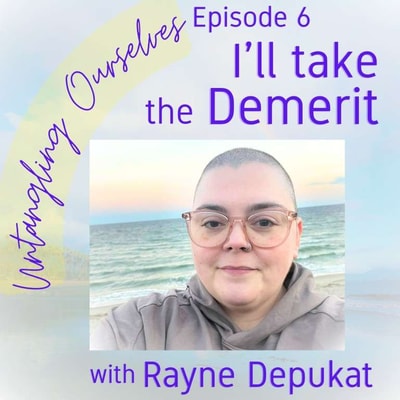
1.6: "I'll Take the Demerit" with Rayne Depukat
Ex-evangelical, disabled, autistic, ASL interpreter's story about inner conflict and accessibility
Transcript
So I think everyone is saying ableist things and then backing up. Like, everyone is on a learning curve for everything all the time.
KaitlinYeah.
RayneAnd either you're actively participating in the learning curve, or you're kind of ignoring it, or you're bucking against the learning curve. I think all of us are on that curve somewhere.
KaitlinRight, right.
RayneThe more immersed you are with the modeling, you're seeing people around you, the people you surround yourself with. It's being around people and immersed with people who have the same values, but also, I feel like, for me, are aspirational in terms of the way they can understand their own values and they can embody them and how they can, like, act them out.
KaitlinHi, this is Kaitlin. And welcome back to Untangling Ourselves. Today, I'm here with Rayne Depukat. They're an ASL translator, and I'm excited to talk to them because they're one of the best people I know to talk to about disability justice. They're also a neurodiversity consultant. And. Hey, Rayne, I'm happy to have you here.
RayneYeah, thanks for having me here. And I will add, I am a translator, but also, more commonly, an interpreter. There is a slight difference between the two, but I do.
KaitlinYeah. What's the difference?
RayneYeah. So as an autistic person, I like to get pretty nerdy with it. But the difference is that translation goes from what we call a frozen text to a frozen text.
KaitlinOkay.
RayneMeaning if you're using spoken language, like English and Spanish, let's say you would take something that was recorded in English and make it recorded in Spanish. Or you would have something written in Spanish and create something written in English. With signed languages, it's usually a video is the documentation. So translation is from something written down or something that's been previously recorded. But interpretation is live.
KaitlinOkay. Well, I'm always learning something when I talk to you. So I wanted to talk to you about your perspectives on disability justice, how you maintain that lens. But first, do you want to get into a little bit about your background and how you got into this?
RayneSure. And I will try to keep it clear because there's. I feel like a lot. So I'll try and keep it a little more simple, and then you can always ask questions. There's so much. I've spent a lot of time trying to figure out how to kind of tell the story. My life was not very typical, I think, of people in general.
KaitlinYeah.
RayneAnd so I even forget large chunks where I'm like, oh, wait, this whole other thing happened. And I was just talking to my mother the other night about this, and we were reminiscing and both going, wow, I totally forgot about that five years where this and this thing happened or that thing happened. So my parents were already separated when I was born, and so I always lived with my. Well, I started out living with my mother as a baby, and we didn't really have anywhere to live, and so we stayed with a couple of people here and there, and I was only a couple months old. And then we were taken in by a family we had never met through a church that my mom was attending at the time. They just asked, would anyone be willing to help out? You know, a new single mother and a newborn. And so this family of two adults and four kids decided to take us in. So somebody brought us there, literally, like, in the middle of the night. I was, like, 2 months old, and my mom was just like. Didn't have any money, you know, didn't have a car, and just. She said it was like being brought into the forest in the middle of the night. Which. The house that they lived in at the time was in a town that was not very built up at the time. And so it was. The house. It was dark. There was tons of trees. It was like, my mom's from right outside Boston. So I think. I always think, like, I don't know how she did it, but I think she just figured she had no choice. And so we got there, and my mom realized it was a family that she had seen before at the church. And the youngest child, she didn't know at the time, but he was deaf. And so he was seven. So we're exactly, like, seven years apart. The other kids were all older. And she had seen him around, like, the church and events and stuff and was like, what's up with this kid? Because he didn't really sign. They had tried everything else, which is pretty common for parents, you know, hearing parents with deaf kids. And so his behavior was really sort of all over the place. And my mom was like, what's going on here? You know, so we moved in, and, you know, she didn't need to pay for anything. She would just help out around the house and then help, like, take care of the kids and things like that. And so it was a really good deal for us. And so we ended up living with them for years, off and on for many years. And then that youngest kid was how I learned sign language.
KaitlinOkay. Because you knew it early. He didn't.
RayneYeah, he would. He didn't have sign and so my mom actually was like, they kept, you know, people kept thinking, oh, he has an intellectual disability. He has this, and she has a sister with an intellectual disability. And she was like, that's not what's going on here. You know, like, what's going on here? So she gathered information and was like, oh, there's like, schools for deaf kids. I think this kid's just. Just deaf and not anything else, you know, Like, I think it's communication. So my mom took ASL classes and became pretty fluent. And I would go with her when I was like 2 years, 2, 3 years old at night in the classes, and I'd sit under her desk and play. And then the teacher would come over and sign with me on breaks and stuff. So I started signing, she said, about like five months old, which is.
KaitlinOh, amazing.
RayneVery possible. You know, my daughter started signing a few signs at like three or four months old. And so as I call him my brother because we grew up together and we're. We played together and all that. Who's deaf? He was learning sign as I was learning sign. So for a long time we were on the same level. Then he went away to a deaf school finally, and he came home and it was just like totally different atmosphere, like not in the same solar system anymore.
KaitlinSo you had, like, a visceral experience of, like, the difference that deaf culture makes this person change.
RayneAnd we were. We were spending time with other deaf people. We would. But it was mostly families that had one deaf kid, or it was, you know, it was mostly one deaf person in a family, which my brother was. And, you know, they say, like, roughly 90% of deaf and hard of hearing people are born to hearing parents. So the majority of deaf and hard of hearing people have hearing parents, and the majority of them don't learn sign. And so there's a lack of communication, basic communication in the home. Right. For deaf people. And so what my brother experienced was language deprivation, which we now know is detrimental to the brain and all kinds of stuff. Thankfully, he was able to go away to a deaf school. And he's doing great now. Like, he's a great person. He's well adjusted, like, all this kind of stuff. But if my mom hadn't really, really pushed, I don't know. And this was, you know, in the early 80s, like, people really were really focused on making deaf people speak and use hearing aids. And so then he became like glue to my mom. And then him and I would play all the time.
KaitlinYeah.
RayneAnd he always would ask everyone if I was Deaf or hearing?
KaitlinWell, because you. You could communicate and.
RayneYeah, I could communicate. And we were kind of the same, like, you know, level. And he only knew deaf kids who could sign like that. And so he was like. We'd play and play and play, and he'd look at me and go, are you deaf or hearing? And I'm like, I'm hearing. And he's like, no, you're not. Like, no, I'm hearing. And I would always be like, why does he think he sees me walking around talking to people? Why does he think that? I. You know. But I was like, okay, you know, and then we play and play and play, and then he'd come back and go, wait, are you never hearing? Really? Tell me. Like. And I always thought we've known each other for years. We were little kids. But I was like. So then he'd go. I'd be like, ask my mom. And then he'd go over to my mom, be like, is Rain deaf or hearing? I was like, hearing, remember? And then he's like, it's so cute. Yeah, it was the cutest thing at the time. I was littler than him, But I remember looking up at him being like, why do you keep asking me that? Why would I lie?
KaitlinBecause you had no concept of this being, like, unusual for him.
RayneI didn't have. Yeah, I didn't have the concept of his experience. That's the story. I had my experience, which was I thought every family had one deaf person.
KaitlinYeah.
RayneYes.
KaitlinThat's the kids thing.
RayneYeah. Because I was like. Because the people I knew, a lot of them had a deaf person in their family because we were spending time with them, but I knew a lot of people who didn't, so I don't know what my thought was there.
KaitlinBut you were like, where's your deaf person?
RayneThat's literally what I started saying to people. I'm like, oh, who's the deaf person? Like, you know, who's your deaf person in your family? And they're like, what are you talking about? Like, they didn't even know what deaf meant. And I'd be like, well, you. And I was like, oh, they haven't met them yet, but they're probably a disoral.
KaitlinOh, that's adorable. Oh, that's awesome, though.
RayneI was like, you'll meet them. That's how. Like, in my head, I'm like, okay, they'll meet them at somebody. And I could.
KaitlinDisability is going to be part of your family. It already is, whether you know it or not. It's Just like a fundamental toddler thought, but also very profound. Right.
RayneI will say I was older than a toddler.
KaitlinYeah.
RayneIt definitely wasn't to elementary school where people would come to my house and then we'd be signing at home or my brother would be there and then I'd be. I remember suddenly going like, oh. I think it was in middle school where I finally was like, oh, people who. People haven't seen this before.
KaitlinYeah.
RayneBecause when I was younger than that, I went to. So I also went to like 10 different schools before I dropped out in my junior year. So I did first grade in public school. And then it was like, now we moved back to Massachusetts. Now we're back with the original family living in their house, going to that church again, which had now grew and now had its own school. So I went to school there from second grade to fifth grade. It was inside of the church, which. The church was in an industrial park. So the church was not a church. It was like, if you've seen the show, the office, it was kind of like in a building like that.
KaitlinOh, very 80s. Yeah, yeah, yeah.
RayneExcept it was like one floor. Right behind us in a very similar building was a Coca Cola distribution center. The other side had a Marriott hotel. There was a big parking lot between us and the Marriott. We used to ride a shopping cart down the parking lot for entertainment because we didn't have swings or. Yeah, yeah.
KaitlinOh my gosh.
RayneThere was also a broken down bus that we used to play games on. Yeah, it was pretty. It was pretty pathetic. So most of the rooms didn't have windows.
KaitlinUh huh.
RayneAnd so the classrooms mostly did not have windows. And they were big classrooms with like three grades in them. And you were basically. They started out just doing homework, Christian homeschooling, books where you would sit and just do the work yourself.
KaitlinYeah.
RayneBut literally they started making us stand up during math lessons. You weren't allowed to sit. And they would be sometimes three hours long.
KaitlinOh my God.
RayneYeah. And he would stand at the board and go, okay, 1. And write a 1 on the board divided by 2. No. And then erase one of the numbers with his finger. That was it. That was the whole thing. And so they had a demerit system. And if you got three demerits, then you would get detention. I never got in regular trouble. I would get in trouble for stuff they made up or that I was accused of. They really liked making up stuff. I don't know why. Probably because I would point things out that were wrong. And yeah, they knew my mom was the same way. And so maybe that's probably why I would get accused of things. But, um, I never was like a troublemaker. I never got in trouble, but I started getting in trouble and my mom was like, why? Why is this happening? Like, Rain does not do this kind of stuff. Like, what's going on? And so she was suspicious of them, which at the time I thought, oh my God, they're going to tell her something and they're going to convince her, you know, that I'm doing something wrong. So there was, you know, I kept trying and then I was like, you know what, I'm not going to try anymore. They. I couldn't do the times tables test consistently, so they. I didn't have recess for, I don't know, a year.
KaitlinOh God.
RayneBecause they would just make me keep taking the test over and over again till I got 100 and I would never get 100 because I would get different ones wrong.
KaitlinThat's so bad. Oh, she. Yeah.
RayneI also have a math disability. So my. I eventually started going, you know what the math thing is starting. Instead of standing up and hoping I can make it and not being able to pay attention, I just started taking a demerit right at the beginning. Then I could sit.
KaitlinYeah.
RayneAnd actually try to do the work.
KaitlinUh huh. You made your own accommodation.
RayneYeah. And to me, I was like, you know, I'm probably going to get a demerit for something anyway. Because you'd get a demerit.
KaitlinDo it.
RayneYeah. If you weren't looking at the board.
KaitlinOh my God.
RayneThey'd give you demerit. Yeah. So I'm like, I'm just gonna sit.
KaitlinYeah.
RayneThen I've got my demerit. And usually you wouldn't get more than one for the same activity.
KaitlinYeah.
RayneSo I was like, yeah, I think that's smart.
KaitlinRight.
RayneSo I'd be like, I'll have a demerit now because I'm going to sit. And then everyone else would be standing and shifting and like for like. And it's three, two and a half hours going on three hours. And I'm like happy sitting. Like, if you're going to make me, you know, be in trouble, then I'm going to do it for a good reason. Right.
KaitlinYeah.
RayneMy mom ended up coming and observing because she was concerned. We just talked about this actually, and she was sitting right there watching. I remember she was looking at what he was doing, making people stand up and she's. I. So I was like, I'm not going to act any Different. That was my plan. I was like, I'm not going to act any different. So I took a demerit, I sat and I was like, I don't know, I think I'm gonna get in trouble. And she looked so pissed. And I. She kept looking at me and looking out and I was like, oh my God, she's gonna be mad.
KaitlinBut she was mad at the teacher. Yeah.
RayneBecause they were so good at just making stuff up and gaslighting, whatever.
KaitlinYeah.
RayneShe took me out of the school that day. She was like really big. So I left and I was there for second, third, fourth, fifth. So there was stuff like that. So I had all this school trauma from that school. Religious experience. And I had only gone to public school for one year prior to that in first grade. And then before that was doing homeschooling in a very religious setting.
KaitlinYeah.
RayneAnd then we were still in the church, just not in the school. And so I was with the same people, I had the same friends, you know. And my mom was just getting more and more fed up, like with the church. And she was just like, this is unacceptable. Like, we're leaving right now. And so I left in the middle of the day from that school. And then going to a public school after I hadn't been to public school for years and joining a class the last three months of the year was pretty wild. I changed schools a bunch more times. And then I went to a private school, a private art school for freshman and sophomore year, which is a very, very expensive school that I went to. Financial aid, didn't scholarships and stuff. Like really, really rich people. But it was also very arts focused. It's very different, but extremely academically rigorous. That I wasn't also was like, I don't know how to been very self driven. It was just like you, everyone just did their work. That's you do it. You figured out you could get help and all that, but it was like they weren't going to micromanage you. And for me, I had not had any space or support to figure out executive functioning for myself. Yeah, I didn't have an ADHD diagnosis. I had no diagnoses at the time. So it was a mess. Moved to California with my mom and my brother and couldn't adjust to California. Came from Boston. I was like, nope. I was like 15, like this, this is not working. Was Northern California. Everything closed at like 6pm and Applebee's would close at 6pm it was like, what is happening here? It was in, you know, wine country area.
KaitlinOkay.
RayneSmelled a lot like cow poo. And, you know, they had days they would fertilize and stuff, and it just wasn't. I would go down to San Francisco, which was cool, but it just didn't fit me at the time. And I was done with. I was just like, done with school. It just a long history of school stuff. School stuff. So when I got to California, I finally was like, that's it. I'm dropping out.
KaitlinYeah.
RayneI then eventually end up doing a bunch of retail management and food service and all other kind of junk. Got my ged. And then I eventually decided to go to college in my 20s only because I discovered that American Sign Language Interpreting was a job. I had no idea that people did it as a job. I think most people don't unless they've encountered it. Because I get people every day that are like, this is your job. Oh, wow. I never thought about that being a job. So when I first got interested in interpreting and was like, well, I'll check it out. I don't know if I'm going to go to college for this, but I'm going to take one class.
KaitlinYeah.
RayneAnd it was at a school that offered the degree for interpreting. And it was a class, Sociocultural Perspectives on the Deaf Community. Up my alley. Big, long name.
KaitlinYeah.
RayneTaught by a deaf professor. And it had interpreters, which I did need because I could. I did not have the language for that content at the time. I got into the class and immediately was obsessed.
KaitlinYeah.
RayneMy mom was living in California. She agreed to pay for the class because she's like, go to college, go to college. And she was making a little more money now. So I was like, okay, I don't know how. She's like, I'll pay for the one class. Just go see. And she's like, hoping I'm going to go to college. And I was in retail management still. And I was like, I don't want to do this forever. And so I took the class and I was like, oh, my God, this is everything. And the only reason I was interested in going to that program. I went to New Hampshire to take it, was because the way they described it in the program, they talked about being deaf as a cultural and linguistic minority. They talked about the identity of it. And other programs didn't do that at the time.
KaitlinYeah. They just. Here's to learn. Oh.
RayneBecause I didn't necessarily know those words for that.
KaitlinYeah.
RayneIt was all gut still.
KaitlinRight.
RayneAnd so.
KaitlinWell, and your own childhood experience, too. But yeah.
RayneYeah. It was gut instinct. In terms of, like, what I knew about deaf people just based on my experience. And so. But that's. I was like, I feel like that makes sense.
KaitlinRight.
RayneSo I ended up at that program, which was designed by somebody whose parents were deaf, and it really was deaf focused. But it was also very traumatic for me to see so many deaf kids whose parents weren't signing to know they were going to end up where my brother had ended up. Where he had end up kind of isolated nowadays. He's not, but he was for a long time. And nobody in the family could communicate with him the way that my mom could or I could. And he was in California living with my mom, and I was in Massachusetts living with his parents. And he came home for a visit from California. And it was after I was in the interpreting program. And so I was talking with him a little bit, and I was like, wow, he's completely changed.
KaitlinYeah.
RayneAnd I. And I was. As I'm talking to him, I'm like, wow, did he change this much in California? Because we all live together in California, too. So I had spent a lot of time with him, but I'm like, did he change that much? And it. I don't remember if it was the end of the conversation or it was later on. It was like, ding. Oh, my God. I completely changed.
KaitlinAnd you were able to connect with him in that way?
RayneI could understand him.
KaitlinYeah.
RayneHe could sign differently with me. I was signing different, and I was like, he's a different person. And I was like, oh, no.
KaitlinYou just didn't have the space to know him before.
RayneI didn't know him like, I thought I knew him. And the more I learned in the program and the more I learned as an interpreter, and the more I. He ended up moving him and my mom ended up moving back, and he lived with my mom. They were roommates for a long time. So I'd see him a lot. And I was just like, I was so wrong that it was painful, and I actually had to grieve it. And it took me a number of years, actually, to grieve my ignorance. How we treated him sometimes, how people in the family would talk about him. And I learned that those were things that all deaf people were experiencing pretty much if they were from families. And I was like, oh, no. So I'd call my mom when she was in California with them or when they were back, and I'd be like, oh, my God, I learned this, and it reminded me of this. And she's like, oh, no.
KaitlinWhile she's Living with him. And you guys are processing. Yeah.
RayneIt's inefficient to get upset without addressing accessibility first.
KaitlinThere you go.
RayneThat's one of the ways I think about it.
KaitlinYeah. Were you and your mom still in the church at this point? Were you still.
RayneLet's see. We left the church when we were in, living in the Boston area. So it was what it was prior to going to California.
KaitlinOkay.
RayneThat we transitioned out of that extreme church.
KaitlinYeah.
RayneAnd into a well known, sort of large church in the Massachusetts area, which was less intense. So they're all evangelical born again.
KaitlinYeah.
RayneBut all the ones we were in. But this one was a little. It was much more subdued. It had a very large sanctuary. It could hold, like thousands of people. And so it was a little more traditional in that sense.
KaitlinSo that was. That was kind of a slow transition, it sounds like.
RayneYes. And it wasn't totally clear to me what was happening. Exactly. And. But she then transitioned completely out of that as well.
KaitlinSo when you left California by yourself, were you still considering yourself Christian evangelical?
RayneNo, no, no. What the. When I. In my freshman and sophomore year of high school, I was still trying to figure it out, and I didn't really believe it. But also I didn't realize how ingrained it was because my dad's whole family is also extremely heavily into it. And so that's how my mom got into it. And so that whole side of the family was also very, very into it.
KaitlinSo it was pretty culturally immersive for you, like Christian evangelicalism.
RayneEverywhere. Everywhere.
KaitlinWater you swim in?
RayneYeah, everywhere.
KaitlinYeah.
RayneSo it was. It was fully immersive because my mom's friends were in the church. My friends were in the church. My friends, mostly their parents were the pastors, the deacons, the people in charge. Yeah. I also spent after school time there. The people who babysat me once in a while, they were all from the church. Like.
KaitlinYeah.
RayneThey did not encourage talking with people outside of the church. My mom always had friends that were outside of the church. But it as a single parent, I think it became really immersive because it was our whole support network.
KaitlinYeah.
RayneAnd she didn't realize how immersive it was to me and how harmful it was to me because she didn't agree with a lot of it.
KaitlinSo your mom always had some doubts and kind of eased out having other connections. But for you, like, how did you work your way out of that if it was so immersive?
RayneAnd I think part of it was. I don't remember my mom and I have talked about this. I don't remember her saying certain things that she said. She was very, like, careful to make sure she did say. For example, if they were talking about homosexuality, my mom would be like, well, I don't really agree with that. Like, she would tell me, I don't really agree with that. And I knew gay people, unlike most of the people in my church. My mom's family, who was very. Not religious at all, were all in the theater and musicians and stuff. I knew lots of gay people from the theater, from bands, from just the art scene that they were all involved in. Like, I always knew gay people. Yeah, but it's just we were so immersive in the church and I was so young that it's like, to me, I just assumed that she was on board with everything they were doing and saying.
KaitlinYeah, as a kid.
RayneI think you do.
KaitlinYeah.
RayneBut then I would. I would have these doubts and I. When I tell my mom about them now, like, oh, I remember this. And she'd be like, oh, yeah, they came and talked to me about that.
KaitlinAbout how you questioning things.
RayneYeah, like, they got a bunch of church adults, got all the kids in one of the big classrooms. But it wasn't a school day. It was like, I think. I think it was like a church day. They would separate the kids and the adults always at church. And so they had all the adults in the sanctuary. And then a bunch of the adults did this for the church or whatever organized this, came and talked to, like, all the kids, which are huge room of like, just all different age kids. And they were talking to us. It was one of the. One of the many, many, many times where they're like explaining what I remember specifically word for word. And what everyone looked like was the. You have. Everyone has to be born again to go to heaven. You could be a good person. They say, I hear people all the time say, oh, but I'm a good person, or they're a good person and they do all these good things for the world and they help people. And it's sad. It's sad. But that's not enough. They will go to hell. They will burn in a lake of fire for a turn. And then they would go, you know, you have to be born again. But I, in my head, I'm sitting there going, first of all, that doesn't seem fair. Yeah, just one, like, off the top of my head, right. Like off the dome. Unfair. Because that's always my first, like, pattern recognition. Yeah, yeah, that seems extreme and unfair. And then it was like. So I was like, well, okay, so what if somebody doesn't get the chance because they live somewhere or they're a little kid, or they, like, if they don't know even that this exists, how are they supposed to. Why would there be a rule about this? It doesn't make any sense. Yeah, like, well, everyone. Well, God will make sure that everyone has an opportunity. They'll be presented with the choice before their death.
KaitlinQuite a claim.
RayneAnd then I was like, so, like, raise my hand again. So what you're saying is that, like, if somebody lives their whole life sinning up a storm, and then suddenly they're about to die, and then God appears to them and is like, do you want to go to heaven or hell?
KaitlinYeah.
RayneOpportunity. And they're like, oh, I'd like to now that I know it's real. Huh? I'd like to go to heaven, please. Yes, I accept you as my, you know, Lord and Savior. Then they get to go, but if I lived my whole life because I happen to be born into this, and I live my whole life trying it, trying to do the right thing, and I'm born again and whatever, but then I mess up these sins that you're telling me about, then I don't get to go either.
KaitlinLike, yeah.
RayneAnd they were like, well, that's not what. You know.
KaitlinToo many questions. Yeah.
RayneAnd I was like, literally, I think, in second grade. And I will say that was also a very important experience, that specific instance, because I remember all of that. And then I remember they basically stopped taking my questions. And then they basically was like, well, God knows if it's in your heart.
KaitlinWhich is kind of the opposite of the original premise.
RayneCorrect. But they were like, no, you can't just get. Because I was like, well, what if I live whatever way I want? And then I know before death that I'm gonna get a chance to. And they're like, no, God knows your heart, so God knows if you're doing that. So I was like, okay, so basically, we're screwed. Like, you're basically telling me there's just like, no. Like, I just have to be perfect and born again and not mess up. Because you could be born again and still sin and then still go to the. Go to hell. It was very tricky. And I just thought, this doesn't seem possible. Like, it seems like an impossible thing to reach for. So that's when I decided, right at that conversation, when they were like, God knows your heart. You can't get away with it. Whatever. And then they Just wouldn't take any more questions. I was like, in my head, I thought, well, if this. If this is true, then that means that I'm definitely going to go to hell. Because I. Even if the. The God. The God is real and this is exactly correct what they're saying to me, I don't think that's right or fair. So I refuse to participate.
KaitlinI was like, you were ready to take the demerit? Just. I was, I'll take my demerit now.
RayneThat's hilarious. That's. Yeah, that's exactly what it was that I thought. You know what? It made me kind of sad because I was like, you know, with all of this, it feels like if this is the way God really is, then God's an ass. Yeah, God sounds like a terrible, terrible person, entity, whatever. And I was like, and I don't want to support that. Like, I don't want to be part of this. And I thought, I'm not gonna. Yeah, it's not. And I just. I remember in second grade, I just remember thinking, I don't think this is gonna work out for me. So what the experience that I was having was. And even into, like, well into my adulthood, well into, like, maybe even close the time I had my daughter, who's now gonna be 14 soon, I still had that same kind of conflict that I described before, where I was like, I'm not going to support a God who behaves that way. If God really is doing this, I think it's wrong and I think it's cruel, and I am not okay with it. And I refuse to follow a God like that. If God is not like that and is more like what you learn a lot of times about God, then I'm already good. Because I think I'm doing my best, you know. But I also had a lot of dysfunction and stuff, family dysfunction and other things. So I always was struggling with, am I a good kid or a good bad kid or a good person? Bad person? Really struggled with that a lot.
KaitlinYeah.
RayneAnd I think a lot of other autistic people identify with that, even if they don't have that super dysfunctional environment.
KaitlinSo, yeah, for sure.
RayneCompounded for me. And then with the religious stuff, and I was also. I was also being punished, accused of things or whatever, always within the church, within the school. So it was. It was like all those layers were kind of happening simultaneously.
KaitlinYeah.
RayneAnd over time, it morphed into. I thought, well, I don't know that I believe in, like, God per se, but I kind of Got into this, like, Spinoza's God, which is, like, the idea that there's something and it's causing things to happen that then cause other things to happen, but there's not someone up there going, you get cancer and you don't. Which made perfect sense to me.
KaitlinYeah.
RayneWhen I learned about it, and I learned about it, actually, from someone in Al Anon who talked about it, and I was like, that's what I've been looking for. And that was a transition for me into atheism.
KaitlinOkay.
RayneSo I think the church was right the second I started fraternizing with people outside the church. Going to a secular school, doing art, you know, talking to people outside the church. Yeah. It was like atheism all the way made me super evil.
KaitlinThere's so many different, like, levels of conflict in your childhood mind, like, the sensory and the, like, empathy and sense of justice for everything, and then the religious and the doubts. And I think that's. Well, wanting to do school and then feeling guilty that you're never doing it. Right. It's just like, there's so much contradiction. True. You know, that's.
RayneThat's a really good point.
KaitlinYeah. So how did you get to the point where you could recognize these stories as being about disability? Like.
RayneI didn't start saying that I was disabled or that I had any disabilities until after my daughter was born. So it wasn't until my. I'm really bad with numbers. But I want to say it was probably in my 30s.
KaitlinOkay. So there's a whole. There's a whole time where you were just a young adult, and you were like, I'm gonna just manage. Basically, yes.
RayneAnd I was also going, I can't manage this.
KaitlinYeah.
RayneI was frequently like, why can't I do this? Why does it seem like other people can function and I can't function? Why am I really good at some things, and then I can't function at all in these other areas. But it's also, for me, about. It's deeply, like, ingrained in my set of values, how I, like, really, really, really feel about the world. People, you know, everything. Plants, animals. Like, I'm just like. It's how I think about everything. I've always been obsessive about what is equitable, what's fair and unfair, what's harmful. And I've been always extremely sensitive to that. Even as a very, very little child, My mom would be like, I was. It was a very high emotive, very conflicting kind of way of being. And I feel like that carried through from the very first moments I remember, which I was very young to, like, now I still deal with that. But finding out that I was autistic as an adult, that's where that started to calm down, because I was able to go, okay, these are the things that are happening to me. Like, these are the reasons that I'm not a bad person. I'm not a difficult person. I'm not, you know, high demand person, because that was often times how people viewed me.
KaitlinYeah.
RayneAnd instead. And I'm not just, like, sensitive, and instead I'm having this, like, real turmoil about conflicting values, which it's still very hard for me to hold multiple things as true.
KaitlinYeah.
RayneI think that's a common thing. A lot of autistic people that, you know, talk to, struggle with sometimes is we have very strong feelings. And then it's like, well, but I have strong feelings in both directions now.
KaitlinWhat?
RayneAnd so just another reason why I think being autistic and having anxiety is kind of a. Yeah, it's a twofer.
KaitlinYeah, for sure. Yeah. Well, I'm curious, like, in your 20, let's say, between 15, and whenever you started being a parent and pursuing diagnosis, you were not managing, or you were just wondering why you weren't managing. Basically, you also, during that time, became an interpreter. And when you became an interpreter, did you start seeing things through a disability justice lens? Was that. Did that come with that process or was it just a job for a while?
RayneThat's a really good question. It's an interesting question. I think the best way I could answer that is to say that I grew up around people who were disabled, but in different ways. And it was called Different Things, you know, with my aunt, who prefers the term special, and on my mom's side and that being. She lived with us for a while when I was really little as well. So that was like, very. And. And we hung out with groups that she was part of, like, People first and, you know, disability rights groups and things like that. And we were around a lot of people like that, so that was very normal to me. And then spending time with the other deaf people and other deaf people we knew when I was growing up were mostly deaf people with multiple disabilities for the most part. And if they weren't, they were deaf people who didn't really have language, so had language deprivation, which is now considered a disability, but not quite yet in the dsm. It should be, but there's a lot of research to back that up. So I was spending a lot of time with disabled People as sort of a norm. Yeah, My. My mother also was really, chronically ill from the time that she got really, really ill when I was in, like, middle school, and for a number of years was very, very, very ill. So that was all the norm, like, to me. Yeah, so it was. I found that I made friends with kids who had disabilities, but I didn't always realize that until later, when I would look back and be like, oh, yeah, that kid actually had disabilities.
KaitlinSo making accommodations was just, like, part of your life for a long time.
RayneYeah, it was very normal. And that was how my mom always was. And my mom's younger than her sister, and there's five kids, but my mom was right below her. And my mom had to take care of all the kids because of the dynamic. So she became, like, my aunt's interpreter because my aunt couldn't really talk when she was really young. They said she wouldn't talk, she wouldn't walk, she wouldn't ride a bike. They also told my grandmother to put her in an institution, which was what happened in the 50s, for sure.
KaitlinYeah.
RayneBut my grandmother was also like, no. So, like, all of that was normal stuff in my family. And so it never felt like necessarily that I was accommodating other people. I think people, like, when people. They didn't have any deaf people in their family, they didn't know what the word deaf meant. They didn't know that some people are disabled. Like, I really had trouble connecting with them, I think. I think I would end up more likely to connect with people who either understood that experience or were living that experience. There's also a lot of people that I can look back and I'm like, they were definitely autistic. Now that I have the information I have, and some people, I found out.
KaitlinLater that which makes sense. You know, the thing that I'm most interested in with you is, like, how did you get to the point where disability justice is just. It, like, when I talk to you, it feels like it just comes easily.
RayneTo you, you know, like, for me.
KaitlinI feel like I have to, like, say ableist things and then be like, wait a second. And, like, backtrack myself and unwind that a bit. And when I talk to you, it's like, oh, of course. Like, the person's autonomy is centered. Of course we can think about these accommodations. Of course. You know, it feels obvious. It's part of the reason I like talking to you about stuff.
RayneSo I think we. It's. Everyone is saying ablest things and then backing up, like, Everyone is on a learning curve for everything, all the time.
KaitlinYeah.
RayneAnd either you're actively participating in the learning curve, or you're kind of ignoring it, or you're bucking against the learning curve. I think all of us are on that curve somewhere.
KaitlinRight, Right.
RayneAnd the more immersed you are with the modeling, you're seeing people around you, the people you surround yourself with, whether it's in digital space, in virtual space, in, you know, face to face with people, whatever, or combination. It's being around people and immersed with people who have, like, have the same values, but also, I feel like, for me, are aspirational in terms of the way they can understand their own values and they can embody them and how they can, like, act them out so that I can have people to look to, to go, I. Oh, I really like this about that person or the way that they operate. I really like how that person has a really, like, friendly, fun relationship with their child. That's something I want. I don't know how to get that.
KaitlinMm.
RayneSo I'm gonna spend time with them, I'm gonna talk to them, I'm gonna observe. I'm gonna join them and their kid. If I can't, like, yeah, whatever I need to do. And then somebody else. Oh, this person really, really is good at this particular thing. Or I really admire this about them, and I want to embody that. So it's just the more we're around that I think it's. I think part of why people think sometimes that it's easy for me. Because you're not the only person that said that, which is. I. I don't feel like that's true. It might be easier for me than for some other people. For sure. I think that's true. But it's also, like, I think about these things 24 7, 365. Because one, it's an interest area of mine.
KaitlinYeah.
RayneI'm basically hyper focusing on it all the time. And two, it's the way my brain works is just to think over and over and over and then use that new information and analyze everything around me using that new information. So I think it appears to people a lot of times like, I'm kind of the duck who's, like, smooth on top of the water, isn't he? And then the feet are paddling. That's my mind. Just like. Because I'm even having dreams about it. Usually.
KaitlinIt's just.
RayneIt's all encompassing.
KaitlinYeah.
RayneTo me, as an autistic person, as a person with adhd, like, that's my natural way of being. And that's where I enjoy being, is thinking about things that I enjoy are and that are interesting. So I think that can lend itself to looking. Like, it's easier when it would be. If it was anything else that I wasn't interested in, it would be incredibly difficult.
KaitlinRight.
RayneBut when you're, you know, for lack of a better word, when you're waking up to it, like, I was always aware of disability. I was always aware, to an extent, as much as I can, you know, as a white person who was assigned female at birth and socialized that way, you know, until I was much older. And, like, there were certain things that I was not going to personally experience. But I had a big awakening with feminism that was, you know, progressive feminism. Feminism, like, trying to think what wave where feminism is about everyone. That's the point of entry for me. And it was. The point of entry was disabled, primarily disabled queer people, disabled black women, disabled. Like, that was kind of my entry point. And so I went in reading because it was a lot online and listening and learning a lot, and it started to take root. So I needed that. Even though I feel like I came with a lot, I came to the table with a lot.
KaitlinYeah.
RayneI had to unlearn the religious stuff that was still in there because all of that is deeply patriarchal, deeply misogynistic, racist. It's just. Yeah, it's everything Able. I mean, it's everything they laid hands on deaf people, try to get them to hear what I was.
KaitlinYeah.
RayneI mean, like. Yeah, So I. I needed that. So I feel like if someone's coming to it without all of that already, it takes a. It takes a lot. It's not like an easy thing. Right. So I did that around the same time that I got pregnant and that. That was. I got pregnant at the same time that we were taking in our first foster child who was a teenager. And so there's a lot going on. So I'm getting heavier into this sort of feminist thought that is intertwined with queer theory and disability justice and all that kind of stuff.
KaitlinYeah.
RayneAnd then at the same time, I have people coming into my home who are supporting us as parents. We can call anytime, because these are kids with extra aids.
KaitlinAnd at this point, you don't know you're autistic. But now looking back, you.
RayneYeah, it's. It's like, painfully obvious.
KaitlinAnd you hadn't really addressed, like, any of your own disabilities at this point.
RayneNo, I kind of, you know, I had been. Yeah, I Had been thinking about ADHD for a while, but I was so sure that my husband had it. And he's again, he, he's the poster person.
KaitlinRight. And then you, you're the contrast. You're the.
RayneYeah, I'm the opposite. Yeah. I was so dysregulated and in such a bad place after my daughter was born. Everything with my daughter was good. I could bond with her. Like, I'm thankful for that. But my mental health just went out the window.
KaitlinYeah.
RayneThen I started having symptoms of the neurological condition that I now have. So it was piling up. Right. Things are getting added and I just was like, I don't feel good. I just feel bad. I just don't feel good. And so I was getting worse and worse. And finally I had a really good friend who identified as disabled, who was chronically ill and who also had ADHD and some other mental health stuff. And they were talking about it and I kept thinking, well, in all the spaces I'm in, this is how people are talking about disability. This person identifies as disabled. We're not exactly the same, but I'm having pain just as much as they're having pain during the day. I'm unable to move and I have to lay down or stay in bed or lay on the couch just as much as they do, if not more. Maybe there is. Maybe that is where I'm at. But you have. I think when people transition into that mindset, it's. There's a lot of. Again, it's the conflicting thoughts, well, maybe I'm not really disabled. And then people say to you, we don't look disabled.
KaitlinRight.
RayneYou know.
KaitlinRight.
RayneOh, you just need to exercise more. It's like that's really not going to help.
KaitlinYou know, it's almost like a through line from these parents not learning ASL to just your own self. Gaslighting of maybe I don't need to have this label. Maybe if I just tried harder.
Rayne100 accurate. I think that's. And it. And it also connects back to the idea of, you know, the Trump regime not wanting to have interpreters because of it. Supposedly image hearing parents, for the most part care about their deaf children, deaf or hard of hearing or deafblind. But they, they don't know what they don't know. They don't have any access to it because the only information they get is medical.
KaitlinYeah.
RayneSo they only hear from audiologists. They hear from cochlear implant surgeons. They hear from. And insurance companies will cover cochlear, but they won't Cover. Fully cover hearing aids. They'll cover cochlear implants, which is hundreds of thousands of dollars, but that requires you drill into the skull. But they won't pay for hearing aids to go on the outside of the ear that are much cheaper. They won't pay. Like, there's no money for learning asl. Yeah, there's no money. So really just makes me think, as you pointed out, like, it's a through line of, of course. Ableism. Yeah, of course. It was audism. Audism, which is what it sounds like. Auditory, spoken language and hearing are considered, you know, superior to everything else. But also it's this facade, this keeping up appearances. One of the interesting thing that things that happens, and I have seen very minimal written about this, but I've always wanted, like a good someone to do a good research study. Most deaf kids, their parents, when you have like a mom and a dad, man and a woman pair, the dad will not sign or will sign very little.
KaitlinYeah.
RayneThe mom is always the one who learns.
KaitlinYeah.
RayneAnd that's not necessarily because the mom is home more, because oftentimes that's not the case. It's. There's something about masculinity and signing. Mm. Because signing is seen as less masculine by hearing people.
KaitlinRight.
RayneBecause it's more performative. So it's like, you know how women are expected to be more. What's the word? Like activated emotive, I think is the right word. They can be. They can. They can use more of their voice. They can.
KaitlinYeah.
RayneBecause what I see is dads who are embarrassed to be signing.
KaitlinYeah. Well, that kind of gets to the distraction thing. Right. Because, like, even if it's not a man on stage, even if it's a woman on stage, especially for like a political event, they're expected to have this professional speaker, non emotive demeanor. You know, at least that's our cultural norm. Like, you're supposed to move around. No, you're not supposed to move around. You're not supposed to lean or, you know, like anything.
RayneAnd so then God forbid someone sits. Yeah, that's like really weird.
KaitlinForbid someone sits like you. The most you can do is drink water. But you're not even.
RayneYes, but you're not. A certain way they'll criticize you if you don't drink it a certain way. I've seen that too.
KaitlinYeah.
RayneIt'd be very, like a normal sip.
KaitlinHuh.
RayneSo if you're somebody like me that needs to sit.
KaitlinYeah.
RayneWhen I give a presentation and I drink out of a Water bottle because I'm dehydrated by all my medications. So I drink over a gallon of water a day. I need to be. People don't always like all that stuff or they think it's less professional.
KaitlinYeah, but it's like, well, and then just having an interpreter up there introduces the body in a way that people can handle.
RayneAnd it looks emotive to people who don't know the language. The interpreter, if they're doing their job, which they usually are. They are not. They are. Their affect is exactly the same as the person who's using a spoken language. So the person who's speaking in English and they're speaking like this. We just wanted to inform everyone that blah, blah, that's what the interpreter sounds like, quote, unquote. For the deaf people, there's a different register called a register in language, in linguistics. So they are doing that. It just looks different. And if you see. So that's why it's always like, oh, the interpreter's over the top. Every interpreter knows and every interpreter has experienced ASL interpreters I'm speaking for, or sign language interpreters have experience being told that we're being distracting, that we're taking focus away from whatever else is happening, that we're distracting other people. Like the non deaf people that are there. We should go to the back of the room. We should go in the hall. We should not interpret anything or sign at all until it's over. And then sign everything to the deaf. I know it's ridiculous, but it's common. I just watched a video recently that came up in my memories that someone made about being an interpreter and those kinds of things. And that was actually one of the scenarios. I'm like, oh, yeah, that happens all the time.
KaitlinWow.
RayneThere's. There's all kinds of things. Or like, do you have to do that when you're interpreting? And you're like, yeah, what did you think I was gonna do? That was my question. When they say, oh, can you go in the back of the room? And I'm like, well, then how would the deaf person see me? Yeah, like, huh? Well, I just. It's distracting a parent. I'm like, trust me. It's not like after 5 minutes everyone will forget I'm here.
KaitlinYeah.
RaynePeople have been doing this forever. Don't worry. I. We got it. I'm always like, don't worry.
KaitlinYeah, yeah.
RayneBecause then they go like. And it's only really them. I mean, I've worked with classrooms full of teenagers. The people that get distracted are the adults. Yeah, the people that get worried about it. Teachers often are flipped out. They do not want you at the front of the room. And it's like, if we work together, everyone could actually be more engaged. Because people like having an interpreter in their room. They can add a different dynamic. They want to hear what the deaf person has to say.
KaitlinYeah.
RayneEspecially if they've never met a deaf person before or they have and the deaf person couldn't talk, quote, unquote. But now there's an interpreter. Deaf person contributes something. Everyone always goes interesting, like, because it's a different perspective, you know, so it's always weird to me that people are like, oh, well, that's going to detract from something, because to me, you know, accessibility is just addition of things. Yes. Sometimes we have to remove something to make something more accessible. But in my mind, it's still a total gain. Like, that's just how I think about access. And I think a lot of us probably think about it. But if you're not. If you don't need it or if you don't know you need it, like, I spent all that time not knowing what I need, then it can, I guess it can feel threatening or confusing or overstimulating to or something. It's out of the norm.
KaitlinBut I mean, earlier when you were saying, talking about surrounding yourself with people that are, like, aspirational, that was such an interesting comment to me, because a lot of times people that I know who are progressive are constantly disappointed and frustrated with the people around them.
RayneVery true.
KaitlinYeah. And so in terms of, oh, I want to increase my disability justice literacy, I want to be able to get to that lens quicker. A lot of people do that by being like, I need to be more.
RayneCritical, you know, Which I will not say that I haven't done. Like, I think that that's a phase. It can be a phase. I think it's been a phase for me. But I also think that I still am that way, but I have curated the spaces that I'm in and where I spend my energy so that I don't have to be constantly doing that.
KaitlinYeah.
RayneAnd I was lucky to come in at the Disability justice place and then learn about the. All the other stuff after.
KaitlinYeah. So what do you see as the difference between disability rights and disability justice?
RayneThat's the $10 million question. Right. So I'm not going to say it as eloquently as some of the people I know who. Who are really great at explaining this. Like, I don't know if You've seen stuff by Heather Watkins. She's a disabled black person in Boston area.
KaitlinOkay.
RayneBut she's done writing about it. She's also just super nice person, but she's talked a lot about the differences. The difference. The main difference for me in coming into it is that disability justice was coined and defined by disabled people of color, queer and queer people and women. And it's a set of standards, it's very clearly laid out. Disability rights came before disability justice. Disability justice is like the amplification and adding on and really focused on like the intersectionality piece and all that. Disability rights is like a historical period of time where people were fighting for basic rights for disabled people. So sometimes people talk about the ada, you know, well, the ada. And it's like, yes, great, the ADA was important. We just never went beyond it because the ADA is like the floor or below the floor, depending on your definition. It doesn't go well, it doesn't go far enough. But it also doesn't go into all the intricacies of what it's like to be disabled and have multiple other marginalized identities especially. So, like the first one is intersectionality. That's the first principle.
KaitlinYeah.
RayneDisability justice. We do not live single issue lives. That's Audre Lorde. So that's really about ableism, white supremacy, capitalism, all of that being part of it you can't untangle. For example, like ableism doesn't exist without white supremacy. Which I remember learning that and being like, how. And then when I learned it, I was like, oh, makes perfect sense. We don't have, you know, anything. We don't have sexism without white supremacy. We don't have, you know, because everything is kind of what you were referring to earlier. It's the sort of white male ideal.
KaitlinYeah.
RayneThat doesn't emote much, doesn't move. So anything deviating from that, including being disabled, is not good. So there's. I can send the list to you, but there's no.
KaitlinI pulled it up. Yeah.
RayneOkay, perfect.
KaitlinYeah. So I'm looking at the leadership of the most impacted anti capitalist politic. Commitment to cross movement, organizing, recognizing wholeness, sustainability, commitment to cross disability, solidarity, interdependence, collective access and collective liberation. I think you know what I mean when I say I'm misusing it is because I worked with you as a consultant and because I'm often talking to you in the context of like, how do we work on the ableism in this situation? Or how do we like center lived experience in this situation is very Practical. So kind of what you said earlier about like, it's inefficient to get upset about something without considering access. That's kind of where my conception has been going, is that like, you just can't really help a situation, any situation, without addressing accessibility, what's going on from lived experience for each person, whatever their intersectional identities are. So I've been thinking about it in a very, like, practical way.
RayneLike an application.
KaitlinYeah, yeah. So even when we started this conversation and I was like, you, you always impress me that you keep disability just as front, front and center as your lens. I'm thinking about access, basically. Like that's, you know, that's basically efficiency and access and practical problem solving.
RayneYeah, that's interesting. Go ahead.
KaitlinSo reading all of this, and that's why, I mean, I'm using the word wrong, because I'm not. I mean, in a way, this is what we're talking about the whole time, what you're telling these stories. But.
RayneWe'Ren'T talking about it as a set of principles, like saying the 10 principles of disability justice. I mean, more about like the ethos of it.
KaitlinYeah, yeah, yeah. All of this in here, but yes, exactly.
RayneAnd I think what you just described, where you said, this is how I was thinking about it and this is what I see in your work when you just said that to me. To me touched on so many of these things. Yeah, right. Because we may be talking about a particular challenge that you're consulting me about, and it may not include a person of color. Everyone in the situation may be white, for example. So that. But that doesn't take away the fact that these other things still exist. So it's not like, well, we weren't doing disability justice because we weren't talking about race or something. It's like, it's more of, to me, the disability justice principles. It's very important that people are aware of that. Them. That they are checking them, that they're reading them, that they're rereading them. Like I go back and reread them and I go back and watch the video of it. Because it's a lot. Every single principle is a lot. Even just the top, like anti capitalist politics. That's a lot, right?
KaitlinNot something you check off.
RayneOh, anti capitalist politics. Perfect. Done. That's like you do it every day in everything you do. Or in this moment. I'm choosing not to do that. I'm choosing I have to order things from Amazon.
KaitlinRight.
RayneBecause I'm a disabled person. I live in a House full of disabled people and none of us can get medicine another way, or we can't get whatever the thing or it's not.
KaitlinSustainable to go searching through 20 other websites to figure out how to do it because your energy's already gone.
RayneYeah. There's so many reasons.
KaitlinRight.
RayneOr it could be just total overwhelm. It could be I have to get the exact same thing every time for my child and I can't risk ordering it from anywhere else. There's so many things that go into it in the moment. I'm making a decision to do something that actually doesn't align with my values, which is shop at Amazon. But it does align with my values in the sense of I as a disabled person, deserve to live a life that I have chosen. I deserve to live a life that feels safe, that feels comfortable, that's joyful, that has people in it that I want to have in it, doesn't have people in it that I don't want to have in it. And that I am guaranteed a future where I get to exist and other disabled people get to exist, and that we're all collectively moving towards that. Like, that's really the value. And so in the moment, if I have to choose something and. And I'm in those conflicts because I'm like, should I buy this thing that's pre cut? Even though I could really cut it up myself and save money, even though I can't cut stuff up, this point in life, it doesn't work for me. I have to be able to go. I deserve to make this decision for myself right now.
KaitlinYeah.
RayneBut it doesn't mean I'm not holding all the things. So that's like a really simplified.
KaitlinYeah.
RayneWay of. Of saying it is that even though it might not be talking about a particular issue or it may not seem relevant in that moment, it has to be the lens that's always still there.
KaitlinYeah.
RayneAnd when it's not being like. Oh, let me put it back on.
KaitlinYeah.
RayneThe thing that I will say on here that I really, really like out of the principles, one is interdependence.
KaitlinYeah, I was thinking about that one too.
RayneYeah. That, you know, we meet each other's needs as we build toward liberation, knowing that state solutions inevitably extend into further control over lives.
KaitlinAnd so relevant right now, it's like magic, right?
RayneIt's like, oh, how did they know? Well, because it's always been this way.
KaitlinBecause it was written by people of color.
RayneYeah. It was written by people of color who were like, hello. Yeah, it's not new at all. But it's more obvious right now. And it's like, right. We can't rely on state solutions because the interest is not the same. You know, that's the through line, I think with these principles is it's all about like commitment to cross disability solidarity, collective access, interdependence, collective liberation. It's very much about the collective and moving as a collective. One of the most important things to me here that I do feel like under. I understood easily because of my experiences in life was leadership of those most impacted.
KaitlinYeah.
RayneSo for me, if I want to know about autistic people, I'm not just going to ask certain autistic people. I want to know from non speaking autistic people, you know, multimodal communicators that are autistic people with intellectual disabilities who are autistic. Like I want to know really what's up.
KaitlinYeah.
RayneAnd for who knows the most, it's them because they're not getting the privilege that a bunch of us are getting.
KaitlinWell, and a couple of things there like cross disability solidarity and interdependence, you know, those things are so complicated. Like to be interdependent and try to meet each other's needs involves all these practical navigations of these power dynamics that.
RayneHave so many barriers.
KaitlinRight. To get a kid and a parent to listen to each other is work.
RayneYeah. And because they're in a capitalist system.
KaitlinRight.
RayneHave the pressures of the.
KaitlinI mean, that makes it scarier.
RayneYeah. When do parents have time and energy for that?
KaitlinNo. And we don't have the right to housing or medical care. And so it gets scarier. You need to do your homework because it's scary out there.
RayneYeah. And then how are they going to access therapy? Like I always am. Like, look, I'm not a therapist. Maybe you should consider also adding therapy at the same time. It's very rare that I could even recommend anyone.
KaitlinYeah.
RayneBecause anyone I recommend usually doesn't take insurance because people are bailing from the system right now.
KaitlinYeah.
RayneAnd if they do, it's like the parent. You know, it's just there's so many barriers that I've tried to help people vet people for, whether it's therapy, neuropsych. It was so hard. There's so many other barriers that, that we end up with very few choices unless the family has a lot of money.
KaitlinRight.
RayneAnd I do work with families who have money because not. Not exclusively, but some families. Because I do charge for my services as well.
KaitlinRight.
RayneWhen I Work with deaf people, whether it's deaf individual, deaf parents of a child, or hearing parents with a deaf child. I don't charge for any work relating to deaf people. I do it pro bono specifically because I already make my living.
KaitlinRight. Yeah.
RayneAnd so I feel like I do pro bono interpreting as well. We all, you know, kind of are. We're expected to. It's not like lawyers where you're required. Yeah, but you're expected to do some. And I do for. Particularly for deaf people who shouldn't have to pay for interpreters ever. And for things that aren't covered. You know, there's certain states, funerals, things like that don't get covered. So I, I do that. But to me it's like I don't want to have a second way of making money off of deaf people and I don't want deaf people giving me money directly, like ever. That makes me really uncomfortable. Unless it's a deaf friend of mine or something.
KaitlinThat's because your profession is borrowing their language and culture. Basically, yes.
RayneAnd in addition, deaf people are making and on average and overall significantly less money than interpreters. Yeah, but when I go to interpret for a deaf person at their job, I can guarantee I'm probably making more money than them. They're working there. I'm coming there to interpret and iron more. So it's. To me, it's not going to fix anything, but I can afford to do that. And it's such a weird intersection. Where are they going to find somebody who could help with an IEP for an autistic deaf kid? Like, you'd have to pay a lot of money. And even then it's not really a lot of people doing it.
KaitlinRight.
RayneSo if there were deaf people out there doing it, I would refer to them.
KaitlinRight.
RayneBut there's not. Not much.
KaitlinYeah. Okay. I feel like we should wrap up.
RayneYou don't want to go for like 20 hours? We probably could. I feel like things I still didn't talk about that I meant to.
KaitlinOh, I know.
RayneI'm sure there are.
KaitlinI mean, we could always talk again if you feel like, oh, we really need to get this in there. But I do want to ask you my sort of wrap up question, which is is there something that stands out to you as like a kind of mantra or anything that helps keep you oriented in this work that you're doing.
RayneYes. And of course I didn't. I thought about this because it's a really good question, but it's also one of those things that's Hard for me to answer because I want to say 5 million different things.
KaitlinYeah.
RayneAnd then I'm like, we'll just pick one. And then I'm like, I got nothing. My brain is. So I was like, well, let me write it down. And then, of course, I didn't. There's a number of them. There's really two main ones, and I'm blanking on the other one. I say it all the time, too. There's a very misattributed quote, which, as an autistic person, irks me. There was. Well, there is a writer who had. He used to have a Facebook page and kind of blogged a lot about all these issues we're talking about.
KaitlinYeah.
RayneAnd his name is Robert Jones.
KaitlinOh, yeah, yeah. He has a substack now, doesn't he? Does he?
RayneMaybe.
KaitlinMaybe.
RayneIf I don't already have it saved. I need to go check it out.
KaitlinOkay.
RayneHe probably does. So I was a huge follower of his when he was going under. Son of Baldwin.
KaitlinYes. Yeah. He has a substack. Yeah.
RayneOkay. I probably am on it. I just forget to read everyone's.
KaitlinYeah.
RayneSo he. Eventually he wrote a novel that got published, and then he basically archived Son of Baldwin page. But it was an extremely active activist space. Yeah. He's one of the very rare people that I feel like I never. I don't remember him ever kind of messing up, like, kind of. And I think he might have. And then he apologized for it, like perfection. But, like, I'm never looking for perfection, just to be clear, because people love to say, well, progressive people are looking for perfection. I am looking for growth, intent, trying, you know, asking permissions, like that kind of stuff. So to me, he was one of those very aspirational people.
KaitlinYeah.
RayneHe talked about race, he talked about gender. He talked about gender identity, sexuality, every single thing that's in disability justice. Like, he just really was like, all about every issue. And that was. I spent a lot of time on his page, interacted with him a lot, read everything of his. And a quote that he said on his page, Son of Baldwin. It got misattributed to James Baldwin.
KaitlinOh, yeah.
RayneWhich is. The Son of Baldwin is a reference to James Baldwin. But he said we can disagree and still get along unless you're. Unless your disagreement is rooted in the denial of my something and my right to exist.
KaitlinYeah.
RayneI think my humanity and right to exist. Something like that. Which a lot of people know now because it got misattributed to James Baldwin and got circulated all over the Internet many times. But that was really poignant at the time that he came out with it. Not that it's not now. I just think more people have come across that idea now. I think it was extremely well put at the time. And to me, what that means. That's a guiding principle. Is that when I think, am I being too whatever or am I being. Because I'm always accused. I've been accused of being a bully because I don't allow people to come into my real world or online space and say things that are harmful. I've been called a bully. I've been called lots of other bad things. And so when I go, wait, am I one of those things? I go, no, you know what? This is one of those times that you're denying somebody's right to exist. Mine, someone else's. And for me, as part of disability justice, no one is free until everyone's free. That's another quote that I don't know if it's attributed to somebody, but your liberation is wrapped up in my liberation.
KaitlinRight.
RayneYou know, that kind of stuff comes from Audre Lorde as well. Like, we can't. You do your thing, I'll do my thing. That's not how it works. Like, even people who are on opposite sides of the globe from each other and are doing completely different things are impacting each other. It's all like, we can't be disconnected. We have to be collective as much as possible. And that quote really helps me, sort of. It's been a guide for me as I've changed from people pleasing.
KaitlinYeah.
RayneWhich is what I was growing up. You know, people pleasing going along, keeping the peace, to now where people have called me the exact opposite of that.
KaitlinRight.
RayneI still think I'm respectful and kind, but people who want to test my boundaries don't think so. Yeah. Because I'm direct. And that's kind of where I got a little bit of that ability from. Is. Is quotes like that that I could go, this. Nope. This is what I'm doing. And it's coming from a person and a community that was built that I trust. And so that's that aspirational. I want to be the person who sets clear boundaries and makes people feel safe who are going to act safe.
KaitlinYeah.
RayneI don't want to allow harmful people in because I grew up around harmful people. Even though some people tried to keep some of the harmful people out, they always get in. And for my kid, I had to make the circle really, really small. And I have a lot of guilt about that, but then I always go, nope. But they deny our right to exist, so they don't get a ticket, you know?
KaitlinYeah.
RayneSo that's been a really, really big one for me. The. The. Nope. I had another. I had the other one, and then I lost it.
KaitlinWell, I mean, when you combine that one with the disability justice principles, it gets even more powerful because it's like, what does that mean, Your humanity and right to exist, you know?
RayneYeah.
KaitlinLike, what does it mean to have access to that even?
RayneRight. Because people will say, well, you can. Nobody's stopping you.
KaitlinRight.
RayneDoing X, Y and Z. And it's like, right.
KaitlinWell.
RayneBut they. They really are. They've just convinced you that they're not. And that's the twisted part. And we need people to go, really? Let me check into that. Let me learn about that. You know, if I say this isn't accessible to me, I need people who go, oh, okay. How can we make it accessible to you? How can I help?
KaitlinRight.
RayneNot in what way. What do you mean? You were just doing it yesterday. So it's kind of that I assume that other people are the experts on what they need.
KaitlinRight.
RayneAnd what works for them. And if it's not harming anyone else, and if it is, is there a way we can mitigate that? You know, like, that's people's right to exist is. Right to exist as is.
KaitlinYeah. Yeah, exactly. That's what I'm saying. It's not just. I think that quote. Often people use it as a way to shut down directly hateful statements on the Internet. That's why I see it a lot.
RayneAnd it's been flipped.
KaitlinYeah. Like, I could. I can. I can block this person because they are saying hateful things. But if you pull that right to exist is more than just surviving. Right. More than just existing. Isolated, without speech or without access to things.
RayneYeah. Safety without love, without connection, without. I mean, we know that people deteriorate quickly without human touch.
KaitlinRight.
RayneSo people who need to be in proximity of people and can't be, like, that's denying their humanity. That's in.
KaitlinExactly. Yeah.
RayneSo it's. It's kind of like, for me. Yes. That quote, like I said, that quote has really blown up. I think when I first saw it, it summed up everything that I was trying to, like, figure out in my life at the time. And I think anything that becomes popular, people misunderstand, especially because, like, that page and that community doesn't exist anymore. So it's kind of like they don't have any context for where that quote came from for his writing, unless they've gone and looked for it. And a lot of times they think it's James Baldwin's.
KaitlinRight.
RayneFind it anyways.
KaitlinYeah.
RayneBut, you know, and there is a lot of James Baldwin. Same thing that really has informed my books. But the thing about Son of Baldwin is that it took things further and it was always towards the direction of black women. Because, again, if you look at the people with, like, the least amount of power in a system, just like in disability justice principles, it's black women. If you orientate yourself. If you orient yourself towards black women, so many other things will. Will already be better.
KaitlinYeah.
RayneBecause black women are really so far out of being given anything that they need or deserve, and they take the worst of, like, society. So if you're a disabled black woman, for example, you need a lot of people behind you just to get you, like, anywhere.
KaitlinYeah.
RayneYou know, and it's. So if you. That's what I learned is you orient towards the people with the. The least power or that your privilege can do the most to support. You know, you ask, of course, but that's. You don't orient towards a well known, you know, disabled speaker necessarily. You want to orient towards the person who can't get access to even attend that event because it's not existing. Yeah. That sort of thing.
KaitlinYeah. Okay. Well, I feel like that's probably a good place to end.
RayneYep.
KaitlinI really appreciate you taking the time to talk to me and. Yeah, thank you.
RayneThanks for having me. And, you know, if you want me to talk about literally anything else.
KaitlinYeah. All right. It was really good to talk to you.
RayneYou too.
KaitlinYou've been listening to Untangling Ourselves. More information about Rayne's coaching consultant services or interpreting can be found in the show notes as well as links to the disability justice principles and more. If you appreciated this episode, subscribe, leave a review and share the podcast with a friend. It helps a lot. Thanks.
Rayne shares a story about inner conflict, growing up autistic and surrounded by both disability rights advocacy and evangelical Christianity. They decided early on to “just take the demerit”: discovering that although it may sting, liberation is possible when—in an oppressive system of high control religion, ableism, and patriarchy—you decide to just get on with what you believe is right, regardless of all the ways the people in charge tell you that you’re wrong. Rayne is an ASL interpreter, consultant, and parenting coach, whose work is continuously informed by the Disability Justice principles and in particular disabled Black, indigenous, and people of color’s perspectives.
“We can disagree and still love each other, unless your disagreement is rooted in my oppression and denial of my humanity and right to exist.” -- Robert Jones Jr.
2:19 Learning ASL
23:04 Leaving Evangelical Christianity
34:34 Identifying as disabled and autistic
41:57 Learning disability justice
58:54 Practicing disability justice principles
Rayne Depukat: https://www.linkedin.com/in/rayne-depukat/
Disability Justice Principles: https://sinsinvalid.org/10-principles-of-disability-justice/
Heather Watkins: https://slowwalkersseemore.com/https://slowwalkersseemore.com/
Robert Jones at Son of Baldwin: https://sonofbaldwin.com/https://sonofbaldwin.com/
Robert Jones' substack, "Witness": https://robertjonesjr.substack.com/
New Hampshire-Manchester ASL Interpreting Program: https://manchester.unh.edu/program/bs/aslenglish-interpreting-major
More on disability justice: https://stimpunks.org/glossary/disability-justice/
Review of research on fathers of children: https://academic.oup.com/jdsde/article/26/2/187/6102075
Research on hearing parents learning ASL: https://pmc.ncbi.nlm.nih.gov/articles/PMC10785677/
This podcast is powered by Pinecast.